President Donald Trump offered every adult US citizen $5,000 on 9 September if Republicans hold both chambers of Congress in the 3 November midterm elections.
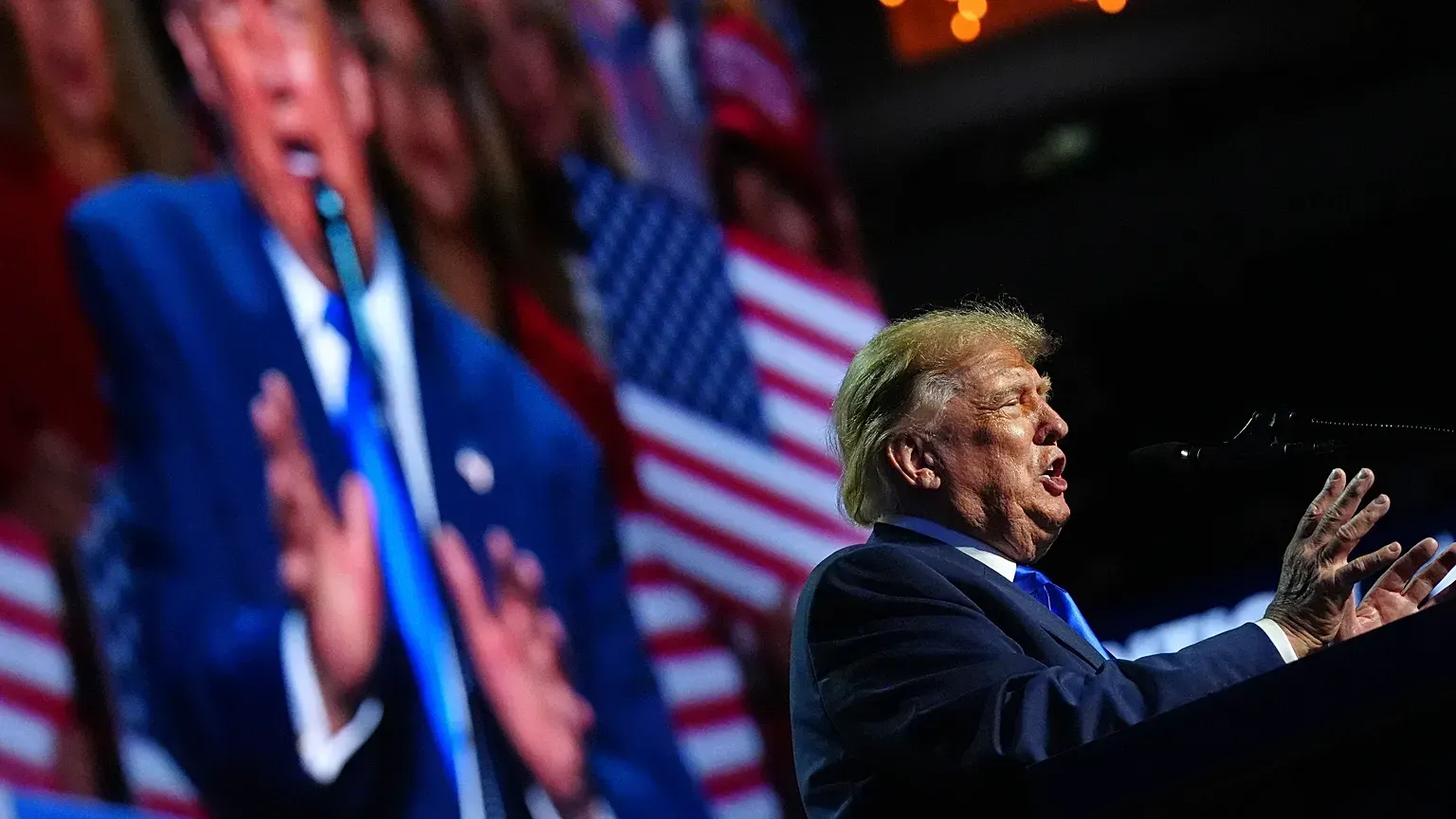
Trump made the offer during a primetime address of one hour and 45 minutes at the Republican Party's first midterm convention, held in Dallas. "If the Republicans win, you win with us and you get $5,000," he said. He called it the Trump Dividend.
Section 597 of Title 18 of the US Code prohibits making or offering an expenditure to any person to vote for or against any candidate. It carries a fine or up to one year in prison, and doubles the maximum to two years where the violation is deliberate.
Vice President JD Vance told Fox News within the hour that the payment would draw at least partly on tariff revenue and would probably exclude the wealthy.
Republican Senator Bernie Moreno of Ohio wrote on X the same night that he would have a bill ready to pass the Trump Dividend immediately after 3 November. Representative Chip Roy of Texas questioned how a payment above $1 trillion would be financed.
Cost and the fiscal position
Estimates put the total at $1.2 trillion to $1.35 trillion, depending on how many adult citizens are counted, against roughly 240 million to 270 million people.
Customs revenue came to about $154.5 billion over the first 10 months of fiscal 2026, less than an eighth of the low estimate. The Supreme Court struck down Trump's tariffs under the International Emergency Economic Powers Act on 20 February 2026 by six votes to three, holding that the statute does not grant a president power to impose tariffs of indefinite scope. The Penn Wharton Budget Model put collections under that authority at about $164.7 billion and estimated up to $175 billion in refunds to importers.
The federal deficit reached nearly $1.8 trillion in fiscal 2025. Total federal debt passed $40 trillion last month.
Marc Goldwein, senior policy director at the Committee for a Responsible Federal Budget, said Trump has no authority to send money to citizens without congressional approval. "We don't have surpluses to give away," he said.
Trump attached one further condition, that the money would have to be spent inside the US. He gave no method for enforcing it.
Section 597 and the defence
New Mexico attorney John Day told the Associated Press the offer is lawful because the money would go to everyone regardless of how they voted, or whether they voted at all. "This is a campaign promise," Day said.
The statute does not require the payer to know how any individual voted. It reaches whoever "makes or offers to make an expenditure to any person, either to vote or withhold his vote, or to vote for or against any candidate." Prosecutions under it are rare, and the US Justice Department reports to Trump.
Congress legislated the 2020 and 2021 relief payments, and neither carried an electoral condition. The $1,776 military bonus Trump issued last year went to serving personnel and was not tied to a vote.
The Wisconsin referral
The Wisconsin Elections Commission voted five to one on 9 July 2026 that probable cause existed to believe Elon Musk violated the state's election bribery law, Wisconsin Statute 12.11, by offering $1 million payments to voters during the April 2025 state Supreme Court race. The commission referred two complaints for possible criminal prosecution.
Wisconsin's statute prohibits offering or promising money or anything of value to influence voting. La Crosse County District Attorney Tim Gruenke declined to charge Musk on 25 August 2026, saying he could not persuade a jury. "Nobody was paid anything of value for voting or promising to vote," Gruenke said.
Gruenke said the payments as finally structured had been corrected into compliance, and that he could not show a jury that value passed in exchange for a vote.
Election bribery law in other countries
Section 108b of the German criminal code makes it an offence to offer, promise or grant gifts or other advantages to another person so that they do not vote or vote in a particular way, carrying a maximum sentence of five years in prison.
Section 282.7(1) of the Canada Elections Act says no person shall, directly or indirectly, offer a bribe to influence an elector to vote or refrain from voting, or to vote or refrain from voting for a particular candidate, potential candidate, registered party or eligible party. Where a candidate or a candidate's official agent commits that offence, section 502 classes it as a corrupt practice, and section 502(3) bars anyone convicted of a corrupt practice from being elected to or sitting in Parliament, or holding any office nominated by the Crown, for the next seven years.
Section 113 of the United Kingdom's Representation of the People Act 1983 makes bribery a corrupt practice and defines the money element to include "giving, lending, agreeing to give or lend, offering, promising, or promising to procure or endeavour to procure any money or valuable consideration" in order to induce any voter to vote or refrain from voting.
Section 261(a) of the Philippines' Batas Pambansa Blg. 881 prohibits offering, giving, promising or contributing money or anything of value to induce anyone to vote or withhold a vote. Section 264 sets a penalty of one to six years in prison, disqualification from public office and deprivation of the right of suffrage.
Article 73, paragraph 10 of Brazil's Law 9.504/1997 bars the free distribution of goods, money or benefits by the public administration in any year an election is held, with exceptions only for public calamity, a declared state of emergency, or social programmes authorised by law and already in budget execution the previous year. Brazilian electoral courts treat a breach as made out on the distribution itself, without proof of electoral intent.
Section 170 of India's Bharatiya Nyaya Sanhita defines bribery to include giving gratification to induce a person to exercise an electoral right, punishable under section 174 by up to one year in prison, a fine or both. The same section exempts "a declaration of public policy or a promise of public action." India's Election Commission bars the announcement by administrative rule instead. Its Model Code of Conduct, which takes effect once polling dates are announced, says ministers and other authorities "shall not announce any financial grants in any form or promises thereof" and shall not sanction grants or payments out of discretionary funds.
The Venice Commission and the OSCE Office for Democratic Institutions and Human Rights adopted joint guidelines on the misuse of administrative resources during electoral processes on 11 and 12 March 2016, at the Venice Commission's 106th plenary session. Guideline B.1.3 says no major announcements linked to or aimed at creating a favourable perception towards a given party or candidate should occur during campaigns, with exceptions for urgent and unforeseen circumstances such as natural disasters. The United States became a full member of the Venice Commission on 15 April 2013. Trump directed US withdrawal from it in a presidential memorandum on 8 January 2026, one of 66 international organisations named in that instruction.
A record of payments announced and not paid
Trump wrote on Truth Social on 9 November 2025 that a dividend of at least $2,000 a person, excluding high earners, would be paid to everyone. He repeated the figure in the Oval Office the following day. Asked about the pledge on 11 January 2026, he responded by asking when he had made it, then said tariff money would let him do $2,000 toward the end of the year. No payment has been issued.
Stephen Kates, a certified financial planner at Bankrate, put the odds of the $2,000 payment at effectively zero, citing the absence of White House authority and insufficient support in Congress. The Yale Budget Lab estimated a one-time $2,000 rebate would cost $450 billion, roughly double projected 2026 tariff revenue.
The DOGE dividend, floated in 2025 as a rebate from federal spending cuts, was never paid either. The Democratic National Committee cited both when calling the $5,000 offer empty.
Two years of personal income
Trump's 2025 financial disclosure, released on 30 June 2026, reported more than $2 billion in income, including over $1.4 billion from family cryptocurrency ventures.
World Liberty Financial, the crypto firm Trump co-founded with his sons, generated more than $550 million in token sales, nine times the $57 million reported for 2024, plus $260 million from sales of business interests. The $TRUMP memecoin, issued through CIC Digital, produced more than $635 million, chiefly in licensing royalties. A stablecoin holding company equity sale brought in more than $196 million. Digital wallet holdings exceeded $60 million.
Golf courses and resorts returned more than $500 million, up 15 per cent. Mar-a-Lago took $77 million, up from $50 million in 2024. Name licensing brought $52 million. Legal settlements with media companies came to more than $80 million.
Forbes put Trump's net worth at $2.4 billion in 2021 and $6.1 billion in 2026, and attributed most of the rise to crypto ventures created and marketed while he held office.
Richard Painter, chief White House ethics lawyer under George W. Bush, said the crypto holdings are a clear conflict of interest. "For every other executive branch official, it would be a violation," Painter said.
Stock trades from the presidential trust
Trump's trust executed more than 3,700 stock trades in the first three months of 2026, worth tens of millions of dollars.
The trust bought between $500,000 and $1 million of Nvidia stock in early January, a week after the Commerce Department approved Nvidia chip sales to China. It bought a further $1 million to $5 million in February, days before Nvidia announced a deal with Meta. Nine Palantir purchases totalled up to $680,000; Palantir holds a $1.3 billion Pentagon contract.
On 23 March, after nearly a month of war with Iran, Trump posted on Truth Social that conversations had been very good and productive. Oil prices fell 11 per cent. The trust bought energy stocks including Phillips 66, ExxonMobil and Chevron, alongside defence firms Lockheed Martin and General Dynamics.
"There's just no precedent in recent history," Dan Alexander, senior editor at Forbes, said of the trading.
Painter said a president who owns shares his official acts can move has a financial conflict of interest.
Gulf money and foreign licensing
The United Arab Emirates invested in World Liberty Financial. Sons of Steve Witkoff, Trump's envoy to the Middle East, are co-owners of the venture.
Five Democratic senators, including Elizabeth Warren and Richard Blumenthal, raised the UAE investments with the administration. The investments "raise questions about what more the UAE may receive," Warren said.
Figures published in August 2026 put Trump's foreign real-estate licensing income at $59.5 million, paid substantially by Gulf developers. Senate Finance Committee chair Ron Wyden and Representative Robert Garcia wrote to Affinity Partners, the investment fund founded by Trump's son-in-law Jared Kushner, on 19 March 2026 over its fundraising from Gulf states and a possible gap in foreign agent registration requirements.
Qatar's government gave the US a Boeing 747-8 valued at $400 million in May 2025. Independent estimates put the cost of fitting it out for presidential use at about $934 million in public money, drawn from the over-budget Sentinel nuclear missile programme. The retrofitted aircraft flew as Air Force One from 1 July 2026. The aircraft transfers to the Donald J. Trump Presidential Library Foundation by 1 January 2029, which would allow personal use after he leaves office. Members of Congress introduced resolutions arguing the gift required their consent under the foreign emoluments clause.
The Zhao pardon
Trump pardoned Binance founder Changpeng Zhao in October 2025. Zhao had pleaded guilty to money laundering violations and served four months in prison, from April to September 2024.
MGX, an Emirati state-backed investment firm, put $2 billion into Binance in May 2025 using USD1, the stablecoin issued by World Liberty Financial. Zhao applied for the pardon at around the same time. Binance holds 87 per cent of USD1 in circulation.
Elizabeth Oyer served as US pardon attorney until 2025. "This is absolutely not justice. This is corruption," Oyer said of the pardon.
Harvard legal scholar Lawrence Lessig said the deal makes sense only as a way to ingratiate the parties with the president. Michael Gerhardt, a constitutional scholar at the University of North Carolina, said the arrangement is a classic conflict of interest.
Public spending at private venues
Taxpayers have covered roughly $101.2 million in travel and security costs for Trump's golf trips since January 2025, on a HuffPost estimate built from per-trip figures in a 2019 Government Accountability Office report. A single Mar-a-Lago visit costs about $3.4 million. One trip to Trump's Scottish resort came to an estimated $9.7 million.
Citizens for Responsibility and Ethics in Washington has documented Secret Service payments of nearly $2 million at Trump-owned properties across his time in office, paid from the federal budget to the president's own companies.
Annual disclosure forms published in September 2026 show Trump gave $155,000 in cash gifts to four White House aides: $45,000 each to executive assistant Natalie Harp, communications adviser Margo Martin and deputy director of Oval Office operations Chamberlain Harris, and $20,000 to Oval Office operations director Walt Nauta. A White House official said the gifts were unrelated to official duties and permissible.
Appropriations and authority
Trump has said he profits because the stock market is rising and everybody is profiting. A White House spokesperson has said neither the president nor his family has engaged in conflicts of interest.
The $5,000 offer would require Congress to appropriate the money. The Constitution vests that power in Congress alone, and the Antideficiency Act bars federal officials from obligating funds that have not been appropriated. Trump said in November 2025 that he did not think he needed congressional approval for the $2,000 version.
Moreno said his bill would be introduced after 3 November. No bill text or Congressional Budget Office score will exist before polls open.
Section 597 is enforced by the Justice Department, through its Public Integrity Section. Two former members of that section told NBC News its complement fell from about 35 lawyers to four or five during Trump's second term.
The 120th Congress, the one the offer would seat, convenes on 3 January 2027 under the Twentieth Amendment. Section 597 carries no private right of action, so only the Justice Department can bring a charge, and the general federal limitation period at section 3282 of Title 18 is five years, to September 2031 on an offer made on 9 September 2026. Trump's term ends on 20 January 2029.