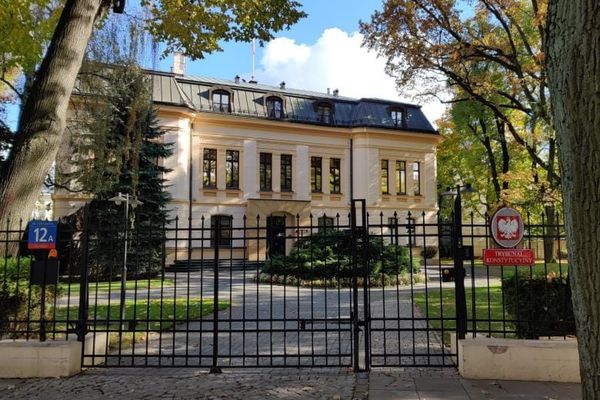
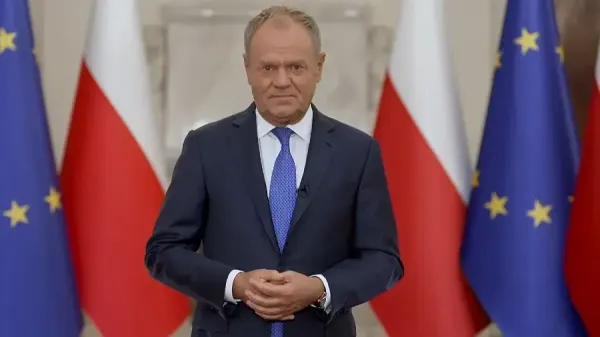
Polish President Karol Nawrocki used the televised opening of a National Security Council meeting on 3 November to accuse Prime Minister Donald Tusk, seated at the same table, of an illegal takeover of the Constitutional Tribunal.
Nawrocki said that responsibility for every police officer outside the tribunal, for the suspension of its president and vice-president and for what he called unlawful orders lay with "one person present in this room". He said he expected Tusk to be ready to curb the excesses of his power before Independence Day on 11 November, and that he would use all his prerogatives to stop an attempt to overturn Poland's constitutional order.
Since 30 October two groups of judges have issued conflicting orders at the 15-member court, which rules on whether Polish laws comply with the constitution. Eight judges elected by the current Sejm this year now control the building, while Bogdan Święczkowski, the suspended president, and six other judges have declared the measures taken against him unlawful, the International Commission of Jurists said. Dozens of constitutional complaints and judicial questions have waited more than five years for a ruling, and the next parliamentary election is due in 2027.
Tusk was not given the floor during the broadcast part of the meeting. After more than four hours of talks he rejected the accusations and told a press conference he was ready for a one-to-one meeting with the president "to reduce this tension permanently". In the closed session he told Nawrocki the president could have reached a compromise by swearing in the judges, TVN24 reported. He said the police were at the tribunal to protect the judges, the building and the demonstrators.
Rafał Leśkiewicz, the president's spokesman, said Nawrocki had repeatedly declared himself ready to meet. Zbigniew Bogucki, head of the presidential chancellery, said on 4 November that no date had been fixed and that a decision would come after Nawrocki returned from a meeting of Visegrád Group presidents in Slovakia.
The council's powers
The National Security Council is the president's advisory body on internal and external security under Article 135 of the constitution. It cannot issue orders to the government, the police or the courts. Nawrocki called the 3 November session before the tribunal crisis began, with a permanent U.S. military base in Poland on the agenda. Participants included Sejm Speaker Włodzimierz Czarzasty, the defence and foreign ministers, military commanders and the leaders of parliamentary groups.
In his opening Nawrocki tied the court dispute to the U.S. troop presence, calling it deeply irresponsible to put security and the presence of U.S. forces at risk for people who, in his view, are not tribunal judges. He said police and State Protection Service officers had been used as instruments of a political scenario.
The agenda Nawrocki set for a council session on 11 February listed an EU defence loan and Poland's invitation to Donald Trump's Board of Peace. It also listed the "eastern social and business contacts" of Czarzasty, the speaker of parliament.
No provision of the constitution gives the president authority over the police, which answer to the interior minister, or over the tribunal's internal orders. Polish headlines presented the 11 November date as a deadline. In the published text of his remarks, Nawrocki said only that the holiday was approaching and that he expected Tusk to be ready before it.
The Independence March
The annual Independence March, organised by nationalist groups, is due to set off from Warsaw's Dmowski roundabout at 14:00 on 11 November under the slogan "Polak w Polsce gospodarzem" ("The Pole is the master in Poland"). Marcin Osowski, president of All-Polish Youth and head of the march's organising staff, said the tribunal had become the march's dominant theme, invited Nawrocki as a repeat participant and predicted the largest march in its history.
Warsaw city hall had received notice of 20 assemblies for 11 November as of 4 November, in addition to the march. Robert Bąkiewicz's Border Defence Movement has announced its own bloc. Its members and clubs linked to the weekly Gazeta Polska tried in October to block a newly elected judge from driving into the tribunal.
The night of 30 October
Anna Korwin-Piotrowska, one of the judges elected by the Sejm on 13 March whom Nawrocki has refused to swear in, ordered Święczkowski and Vice-President Bartłomiej Sochański off the bench for one month on 30 October. She acted as the judge with the longest judicial service. Her order says Święczkowski kept four Sejm-elected judges out of the general assembly and left the court unable to adopt its 2027 budget. She justified the step by "overriding constitutional necessity".
Riot police cordoned off the building in the late afternoon. The Ordo Iuris Institute, a conservative legal group, wrote that Korwin-Piotrowska had asked for them in writing, citing a threat to the life and health of judges and staff. Citing the tribunal's spokesperson, it wrote that seven of the new judges entered with State Protection Service officers. Rzeczpospolita reported that they came through the grounds of the neighbouring Chancellery of the Prime Minister, whose head, Jan Grabiec, opened the way at the request of the police and the service. Police said they detained three people after objects were thrown at officers.
Nawrocki turned back from a flight to Senegal, met Zbigniew Kapiński, first president of the Supreme Court, and went to the tribunal overnight, where footage showed scuffles with judges including Korwin-Piotrowska. Two ambassadors, Jakub Kumoch in China and Paweł Soloch in Romania, resigned the same day in protest.
The legal basis
Korwin-Piotrowska's orders rely on Article 130 of the law on common courts, applied through Article 19 of the 2016 act on the status of tribunal judges. The Supreme Court's governing college resolved on 3 November that the measures had been taken without the required legal basis. Kapiński had wanted the full Supreme Court assembly to adopt that position, but judges appointed before 2017 stayed away and the assembly lacked a quorum.
The International Commission of Jurists wrote that the suspension was imposed "without a fair and appropriate procedure established by law" and that police must not be used to enforce measures on the tribunal's leadership. The same statement said Nawrocki's refusal to swear in five judges breached international standards and interim measures of the European Court of Human Rights, and called on him to administer the oath.
The court's general assembly needs two-thirds of "the total number of judges" to adopt resolutions. Szymon Syp, a lawyer, wrote that this means 10 of 15. Michał Romanowski, a law professor, argues that only judges able to sit count, which would make eight enough. Eight judges met on 3 November and adopted a budget and disciplinary panels for the suspended president. The same assembly would rule on six applications by Prosecutor General Waldemar Żurek to lift Święczkowski's immunity.
The government says the crisis began when Nawrocki swore in three of the eight Sejm-elected judges and refused the other five, and Święczkowski then kept those five from adjudicating. The five took their oaths without the president. Bogucki wrote in April that an oath "before the president" must be taken in the president's presence. A European Commission spokesperson said on 31 October that electing the eight judges falls within the Sejm's constitutional powers.
The court under Law and Justice
The Court of Justice of the European Union ruled on 18 December 2025, in case C-448/23, that the tribunal was not an independent and impartial court established by law. It cited the election of three judges by the Law and Justice (PiS) majority in December 2015 to seats the previous Sejm had already filled. It also cited the election of the tribunal's president in December 2016 at an assembly that lacked a quorum. The European Court of Human Rights had found the 2015 appointments irregular in a judgment of 7 May 2021.
The EU court also fined Poland €1 million a day from October 2021 for failing to suspend the Supreme Court's disciplinary chamber. Święczkowski, who became tribunal president in December 2024, was national prosecutor under the PiS justice minister Zbigniew Ziobro and earlier a deputy justice minister.
Orbán, Farage and Le Pen
The tribunal's official X account, which stayed with Święczkowski's side, wrote on the evening of 30 October that everyone taking part in the takeover was committing the crime of a coup d'état. Within 24 hours the word had been taken up by allies of the Polish right abroad. Balázs Orbán, a Fidesz member of the European Parliament and former political director to Viktor Orbán, wrote that night: "An attempted JUDICIAL COUP is unfolding in Poland".
Viktor Orbán, who led Hungary's government from 2010 until 2026 and now heads Fidesz in opposition, wrote on X on 31 October that the events in Warsaw were a blatant violation of Poland's constitution. He wrote that Tusk had sunk low enough to "stage a coup d'état against his own people" and that he hoped Nawrocki would succeed in upholding Poland's constitutional order.
Nigel Farage, leader of Reform UK, said the situation in Poland was "very serious". A review of foreign reactions by Klub Jagielloński, a Kraków-based think tank, records two further posts by him. In one he wrote that the arrests and the raid on the tribunal served only to defend an undemocratic European Union, and in the other he called Tusk and his EU supporters bad people. The same review records that former Conservative prime minister Liz Truss called the events an attack on democracy. She shared a graphic by the PiS politician Dominik Tarczyński that presented control of the tribunal as Tusk's first step towards handing Polish institutions to the EU.
Marine Le Pen, leader of France's National Rally, wrote on X on 1 November that the suspension and the security forces around the tribunal resembled a forced takeover of a constitutional institution, and criticised EU inaction. Foreign Minister Radosław Sikorski wrote beneath her post: "We ask you to respect us by not interfering in ours." He then wrote that Le Pen had joined Dmitry Medvedev, Orbán and Farage in coming to the aid of what he called Poland's pathological right.
CPAC and the U.S. right
Matt Schlapp, chairman of the American Conservative Union, which runs the Conservative Political Action Conference (CPAC), posted a statement on X: "CPAC stands with President Karol Nawrocki and the people of Poland." He wrote that no government may use force to paralyse a co-equal constitutional body. A government acting in good faith, he wrote, would not have waited until Nawrocki left Polish airspace, and CPAC was proud to have given Nawrocki its platform before his election. He called on Tusk to withdraw the officers and restore the tribunal's leadership.
CPAC held its first Polish conference in May 2025, five days before the presidential runoff of 1 June, and Homeland Security Secretary Kristi Noem endorsed Nawrocki from its stage on 27 May 2025. Trump had hosted Nawrocki at the White House earlier that month. At their meeting on 3 September 2025 Trump said he rarely endorsed candidates and was proud of having endorsed Nawrocki, who has suggested that a new U.S. base be named "Fort Trump".
Jack Posobiec, a Human Events commentator with 3.3 million followers on X, wrote on 30 October: "Globalist Tusk has ordered a raid on the Constitutional Court." Joey Mannarino, a commentator with about 750,000 followers, wrote that riot police had driven onto the grounds in unmarked vans to raid the building and push Tusk's pro-EU agenda. Mario Nawfal, followed by nearly four million accounts, asked whether a judicial coup was under way. All three posts were collected by nczas.com, a Polish right-wing site. Nile Gardner, director of the Heritage Foundation's Margaret Thatcher Center for Freedom, told Fox News the events had "all the hallmarks of a Soviet-style coup operation".
Police said they went to the tribunal in response to a written request from a tribunal judge and a letter from the Prosecutor General's office asking them to watch the building's security during the protests. Warsaw police said officers did not enter the building itself, while State Protection Service officers escorted the seven judges inside. None of the documents made public by 5 November shows an order from Tusk to deploy the police.
American Thinker, a U.S. conservative website, published a timeline from what it called a knowledgeable observer stating that Tusk had tried to appoint eight judges when he was allowed only three and had administered the oath to five of them himself. The Sejm, not the prime minister, elects tribunal judges under Article 194 of the constitution, and it filled eight vacant seats in 2026. Four of the judges elected on 13 March took their oath in the Sejm on 9 April in the presence of a notary after inviting Nawrocki, who did not attend.
U.S. Ambassador Tom Rose, a Trump appointee, wrote on 30 October that the crowds outside the tribunal "make an already dangerous situation more combustible". He described an unprecedented confrontation over the government's use of state power.
False footage
An X account called America First News posted footage on 31 October of what it said were 300,000 Polish patriots marching. The video showed the Independence March of 11 November 2017, and the post drew more than 12,000 likes before X attached a community note. English-language right-wing accounts reposted it as resistance to a "Tusk regime" or to "Nazi putschists", and accounts in Indonesia and Colombia cited it.
A Portuguese-language post on X presented a crowd singing the national anthem in Warsaw's Piłsudski Square as proof that Poles had taken to the streets and stopped a coup. It drew about 2.6 million views by 2 November. The clip came from a Warsaw Uprising Museum concert that was posted online in September, weeks before the tribunal crisis.
Russian amplification
Medvedev, deputy chairman of Russia's Security Council, wrote on the Russian platform Max on 31 October that "a coup d'état has taken place in Poland". He wrote that Tusk's liberals were oppressing PiS conservatives by the same method used in what he called neo-Nazi Ukraine. Tusk wrote on X that Medvedev's post made everything clear. On 1 November Medvedev wrote mockingly that of course the Russians were behind the crisis.
Russian Foreign Ministry spokeswoman Maria Zakharova used the crisis to mock Sikorski. Kirill Dmitriev, head of the Russian Direct Investment Fund, wrote of riots and coups in which he said Europe was sinking. The state news agency RIA Novosti carried commentary before midnight on 30 October, and Russian outlets spread speculation about Nawrocki's impeachment.
Grabiec posted screenshots on 31 October of accounts he described as Russian trolls backing PiS. The disinformation unit of NASK, the state research institute, said that accounts had reused old images to build emotional narratives. Tusk warned Polish politicians on 3 November not to act as Russia's useful idiots, naming Medvedev, Zakharova and Orbán as having sided with Nawrocki.
An analysis by the Polish firm ResFutura found that 0.9 per cent of hostile posts between the afternoon of 31 October and the morning of 1 November came from accounts with high bot scores. It also identified about 100 accounts commenting together within minutes. None of the material published by the government, NASK or ResFutura shows contact or coordination between Russian state actors and Nawrocki, PiS or the foreign politicians who backed them.
Police and the State Protection Service
Interior Minister Marcin Kierwiński said on 15 October that two tribunal judges had been given State Protection Service protection at their own request after threats. National Police Chief Marek Boroń stayed in contact with Kierwiński and Żurek throughout the operation of 30 October, according to the same Rzeczpospolita account. Kierwiński said in October that the protesters outside the tribunal were lawfully registered and that police would ask for the assembly to be dissolved if they broke the law.
Before 11 November
Nawrocki was due back from Slovakia on 5 November, six days before the Independence March sets off. Korwin-Piotrowska's suspension orders run for one month from 30 October, and the eight judges have formed disciplinary panels to hear the cases against Święczkowski and Sochański.