
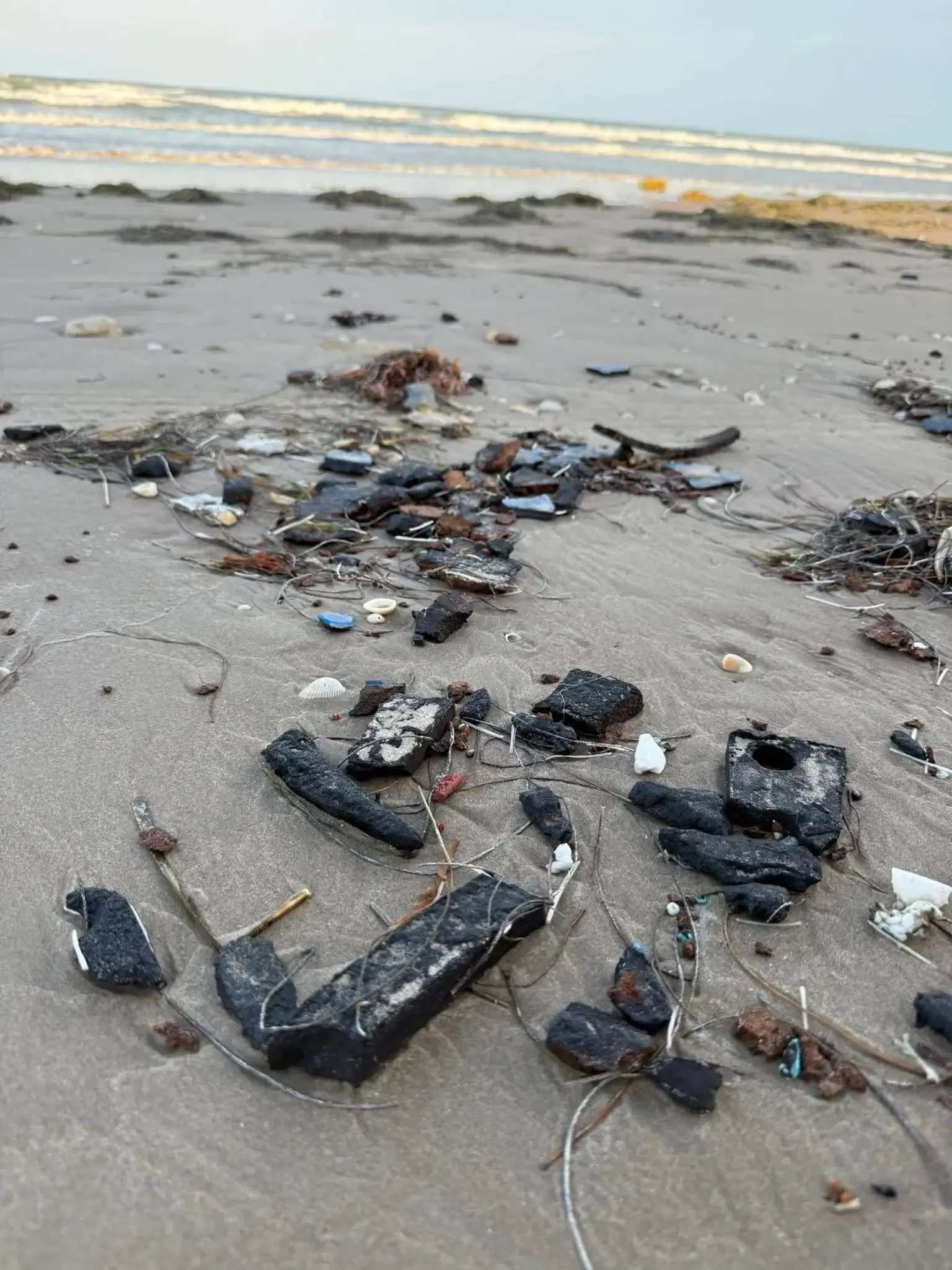
Mexico wants talks with the U.S. government that could end with SpaceX moving its Starship launch site away from the Mexican border, President Claudia Sheinbaum said on 26 November.
Starbase, the company's base in Cameron County, Texas, lies about 5 km north of the mouth of the Rio Grande, which Mexicans call the Río Bravo. Across the river is Playa Bagdad, a beach in the municipality of Matamoros, Tamaulipas, where Starship debris has washed up repeatedly since May 2025. SpaceX has applied to the U.S. Federal Aviation Administration (FAA) to raise the number of launches it may make from the site each year from 25 to 456. Sheinbaum told her morning press conference that Mexico wanted a meeting of the two countries' aerospace regulators to settle permission for flights through Mexican airspace, how often they could happen and, "if necessary, the relocation of the launch site".
FAA environmental decisions, Mexican government statements and replies to transparency requests show that the FAA approved new Starship return paths across Mexico in February 2026 on the assumption that Mexico would close its own airspace for them. Mexico's environment ministry and navy finished a study of the debris in July 2025, and Sheinbaum said it found effects on Mexico, but the study has not been released. Profepa, the Federal Attorney's Office for Environmental Protection, has classified its three case files on SpaceX. The scale of any ecological damage has not been measured in any published study.
The fish losses, turtle-nest failures and dolphin deaths reported at Playa Bagdad rest on the accounts of fishermen and of Conibio Global, a conservation group in Matamoros. The Washington Post found in January 2026 that no causal link between the launches and the decline in fish had been established.
SpaceX said on 19 November that its partners on the ground had found only a small number of pieces from the latest flight and that most social media posts about widespread damage were "intentionally misleading". It has said that independent tests show the materials in Starship and its booster carry no chemical, biological or toxicological risk, and it has not published those tests. The FAA says it coordinated with the U.S. State Department and the Mexican government before approving the new trajectories, and that its risk analyses account for effects across the border.
The relocation request
Sheinbaum said launches from Starbase were still infrequent but that SpaceX planned up to about 400 a year, and each launch brings restrictions on air traffic. Mexico's foreign ministry has already met the U.S. Embassy, she said. The questions belong between the two governments, she said, because a private company's operations are affecting Mexican airspace. The U.S. Embassy referred questions to the State Department, which did not immediately respond to Reuters, and SpaceX did not respond to Reuters on her remarks.
Mexico's foreign ministry told The Washington Post in January 2026 that the United States is liable for damage under the 1967 Outer Space Treaty and that each launch requires Mexico's express authorisation. Cristopher González Baca, the federal official who oversees Mexico's protected areas, told the newspaper that Mexico had received no direct, formal information from SpaceX. Américo Villarreal Anaya, the governor of Tamaulipas, said he had been told SpaceX wanted to launch weekly.
Sheinbaum kept the airspace talks apart from the environmental case. Profepa will decide whether SpaceX bears liability for the debris, she said, and Mexico will file complaints against the company if the findings warrant it.
Starbase's path from a dozen launches to 456
The FAA's 2014 environmental impact statement for the Boca Chica site envisaged about a dozen Falcon rocket launches a year. In 2022 the agency cleared SpaceX's Starship programme there after a programmatic environmental assessment, a shorter review than a full environmental impact statement, and allowed five Starship launches a year. In May 2025 it raised the ceiling to 25 launches and 50 landings.
On 14 October 2026 the FAA began a programmatic environmental impact statement on a SpaceX plan to go further in two phases. In the first, SpaceX could launch up to 100 times and land 200 times a year, on any day and at any hour. In the second, the limit would rise to 456 launches and 912 landings of Starship and its Super Heavy booster, on weekdays only, with temporary airspace closures for each operation. Spread across a five-day week, 456 launches would average about 1.75 for every working day. Starship has flown at most five times in a single year from the site.
President Donald Trump signed Executive Order 14335 on 13 August 2025. It directs the U.S. transportation secretary to use all available authority to "eliminate or expedite" the department's environmental reviews for launch and re-entry licences, and sets a policy of substantially increasing commercial launch cadence by 2030. The FAA cited the order in the purpose and need section of its February 2026 decision on new Starship trajectories.
Return flights across Mexico
The February 2026 decision, a tiered environmental assessment with a finding of no significant impact, added flight paths for Starship launches and for the spacecraft's return to Starbase. The southernmost launch and booster-landing trajectories could affect the airspace of Mexico, Cuba, Jamaica and the Cayman Islands, the FAA wrote, and those countries "would be expected to close their respective airspace". Return flights would cross air routes running west from Boca Chica through Mexico and four U.S. states over about 3,700 nautical miles, and ground stops could reach Mexican airports.
The FAA said it had coordinated with the State Department and the Mexican government under Executive Order 12114, which governs the environmental effects abroad of major U.S. federal actions. Members of the public asked the agency to consult the Mexican government because Matamoros and Brownsville share an airshed. The FAA answered that it had engaged with Mexico through established diplomatic channels. The assessment received 27 public comments. Its text makes no mention of Playa Bagdad or of the Kemp's ridley turtle.
Ship 42's return on 14 November was the first Starship flight back to Starbase from orbit. Mexico's air navigation service, SENEAM, and its Federal Civil Aviation Agency said the day before that the FAA had notified them that the spacecraft could pass through Mexican airspace at high altitude the next afternoon for about 15 minutes. The operator of Tijuana's international airport told passengers that flights due before 16:00 could be delayed. Ship 42 entered Mexican airspace at 15:08 central Mexico time, the Infrastructure, Communications and Transport Ministry said, and the Starbase tower caught it at 15:20.
Article 1 of the 1944 Chicago Convention on international civil aviation recognises that every state has complete and exclusive sovereignty over the airspace above its territory. Mexico's airspace protection regulations, published in February 2026, give surveillance of that airspace to a national monitoring centre and its defence to the Mexican Air Force.
Debris on Playa Bagdad
Starship's ninth flight, on 27 May 2025, ended with the Super Heavy booster exploding over the Gulf of Mexico. Before the launch the FAA closed airspace stretching 1,600 nautical miles and said 175 or more flights could be affected. It said no debris fell outside its hazard area, but pieces of the booster washed up on Mexican beaches, ProPublica reported. Conibio documented plastic, aluminium and pressure tanks along about 40 km of coast. The Tamaulipas urban development and environment secretariat filed a complaint with Profepa on 5 June 2025, and its head, Karina Saldívar Lartigue, said the material was classed as hazardous waste.
On 18 June 2025 a Starship upper stage, Ship 36, exploded during ground testing at Starbase. Fragments of metal and plastic landed in the Río Bravo and on farmland and grazing land in Matamoros. Senior staff sent from Mexico City by Profepa and the environment ministry, Semarnat, took samples of river and beach water, soil, sand and burnt plants on 21 June, according to Jesús Elías Ibarra Rodríguez, a veterinarian who founded Conibio.
A barge contracted to recover debris for SpaceX, the L/B JILL, worked about 17 km off Playa Bagdad that July. The navy said it had operated without the permits Mexico requires and had withdrawn, and Navy Secretary Raymundo Pedro Morales said sanctions were being considered. From 21 July 2025 a navy ship patrolled the coast to stop vessels from recovering the wreckage.
Starship's 11th flight, on 13 October 2025, was followed by the discovery of a propellant tank, dozens of metal fragments and two dead dolphins on Playa Bagdad. Profepa secured the tank with the navy and municipal civil protection. The Matamoros port captaincy issued a nautical warning to fishermen about floating debris, and Conibio sent organs and tissue from dead animals to the veterinary faculty of the Autonomous University of Tamaulipas (UAT). Conibio and UAT researchers mapped a sunken booster about 60 m long, lying in about 15 m of water off the beach. Conibio said a booster from the 13th flight, on 24 July 2026, came down in Mexican waters, the fourth time by its count.
The booster from the 15th flight, on 13 November 2026, exploded over the Gulf about six and a half minutes after launch. Fragments began reaching Playa Bagdad at about 07:30 on 17 November after a storm pushed the sea 41 cm above its forecast level, Profepa said. Its inspectors, working with the navy and the national protected-areas commission, collected about 2 kg on the first day and later reported securing about 5.9 kg. The material is held at navy facilities until SpaceX collects it. Profepa said more debris could still lie on the seabed. Conibio counted more than 1,500 pieces.
The unpublished study
Sheinbaum said on 25 June 2025 that there was contamination and that Mexico would sue SpaceX if it found laws had been broken. On 23 July she said the study by Semarnat, the navy and the government's digital transformation agency was complete, that the debris did have effects on Mexico, and that the results would be released the following week.
Profepa told applicants under Mexico's transparency law, in replies published by Expansión in July 2026, that it holds three case files on SpaceX and has classified them as reserved until it issues an administrative resolution. The foreign ministry said the matter was a continuing diplomatic case and would be reserved for five years. Semarnat said it held no information, documents or procedures concerning SpaceX, although it had taken part in the inquiry. The study remains unpublished. On 28 July 2026 Sheinbaum ruled out a lawsuit for the time being and said the two countries' foreign ministries would give notice of launch dates and agree rules to keep debris off the Tamaulipas coast.
UnoTV, a Mexican broadcaster, reported in July 2025 that Semarnat and Profepa had said the debris could include white phosphorus, but cited no document, and neither agency has published test results. UAT scientists took samples from marine organisms for toxicological and histopathological analysis, and those results have not been made public. Félix Gutiérrez Villanueva, an oceanographer at UAT, told The Washington Post he expected some environmental impact from the noise, explosions and waste and was studying it. Eric Roesch, an environmental compliance analyst, told the newspaper the long-term impacts had never been studied or disclosed.
SpaceX told the Bahamian government in March 2025 that Starship debris contained no toxic materials and was not expected to harm marine life or water quality. In Mexico the company cited toxicity analyses that it did not provide, the newspaper reported.
Turtles, fish and the people of Playa Bagdad
About 90 per cent of all Kemp's ridley nesting happens on Tamaulipas beaches, mostly at the Rancho Nuevo sanctuary, according to a 2026 study of the species, the most endangered of the world's sea turtles. Mexico and the United States have run a joint recovery programme since 1978. Ibarra said in October 2025 that about seven nests at Playa Bagdad had failed because launch vibrations compacted the sand and the hatchlings could not dig out. He said one dolphin had died after the October launch, probably from its sonic boom. Conibio has published no data to support either account.
Kemp's ridley nesting has risen across the species' range over the same period. The Tamaulipas parks and biodiversity commission recorded 2,307 nests and 207,251 eggs at its protected camps by 5 May 2026. On the Texas coast, U.S. agencies documented 697 Kemp's ridley nests in 2026, 55 per cent more than the 449 found in 2025. The counts cover the species as a whole and say nothing about Playa Bagdad itself, where no nest monitoring results have been published.
Hugo González Salinas, president of the federation of fishing cooperatives for northern Tamaulipas, said in June 2026 that catches had fallen to about 40 per cent of earlier levels, citing figures from the sector. Sierra and peto, two species of mackerel, were the worst affected, he said. The cooperatives have asked for technical and environmental studies to establish whether the launches are responsible. Fishermen at Playa Bagdad told the regional broadcaster Telediario that the port captaincy makes them stop work on launch days and that they burn up to 200 litres of fuel going further out to find fish.
Some fishermen have crossed into U.S. waters. Daniel Santiago, 22, was arrested by the U.S. Coast Guard on 17 April 2025 about 14 miles north of the maritime boundary, pleaded guilty and spent five months in prison, The Washington Post reported. Martin Pablo Zapata, 48, another fisherman, told the newspaper, "We have no hope."
Residents who spoke to Greenpeace México at a launch on 22 May 2026 said their houses shake so hard during launches that they leave them, that walls have cracked, and that every window in a local school shattered during the latest launch, when no children were inside. Greenpeace said Mexico had no public, transparent government assessment of the launches' environmental and social effects.
Debris over the Caribbean
Starship's seventh flight broke apart on 16 January 2025 and scattered debris over the Turks and Caicos Islands, a British overseas territory. Debris reached every beach on Providenciales and stretched from South Caicos to West Caicos, Alizee Zimmermann, executive director of the Turks and Caicos Reef Fund, told CNN. A car was damaged. The islands' airport authority diverted all flights in its airspace and grounded aircraft, and the government told residents that space debris can contain hazardous materials.
An Iberia flight from Madrid carrying 283 people declared an emergency to cross the FAA's debris response area and land in San Juan, Puerto Rico. The FAA led the investigation with the UK Air Accidents Investigation Branch and the islands' government, which said the debris remained SpaceX's property.
The eighth flight broke apart on 6 March 2025, and debris fell over the southern Bahamas. The FAA halted flights into Miami, Fort Lauderdale, Palm Beach and Orlando. The Bahamian government said it had no regulatory authority over Starship under its 2025 space flight regulations, which cover only SpaceX's separate Falcon 9 booster landings.
SpaceX recovery teams arrived the next day, about 400 pounds of debris, mostly heat-shield tiles, was collected near Ragged Island, and the government said SpaceX had paid all costs of removal and environmental assessment. On 15 April 2025 Deputy Prime Minister Chester Cooper suspended Falcon 9 landings until SpaceX completed a full environmental assessment, saying the Starship debris had fallen without Bahamian involvement or consent. The Bahamas charges SpaceX US$100,000 for each landing, and landings resumed in early 2026. Before the ninth flight, a UK government spokesperson said the UK had worked with the U.S. government to protect the British Virgin Islands, Anguilla and the Turks and Caicos.
Who pays
SpaceX met the full cost of the Bahamian clean-up. In Mexico, Conibio's team of 10 volunteers has cleaned about one per cent of the affected area, Ibarra said in January 2026. Alberto Granados, the mayor of Matamoros, said in 2025 that SpaceX had committed to send a technical crew to clean the northern end of Playa Bagdad, and the company has hired salvage vessels to recover booster wreckage at sea. Profepa is storing the November 2026 debris at navy facilities until SpaceX collects it. SpaceX has not said publicly what it has spent in Mexico or whether it has reimbursed Profepa, the navy or Conibio.
U.S. licensing rules require SpaceX to insure against third-party claims up to an amount the FAA sets for each licence, its maximum probable loss, capped at US$500 million.
The FAA describes that amount as covering damage to life or property, and federal regulations define it as loss from bodily injury or property damage. Above the insured amount, U.S. law allows the federal government to pay further third-party claims. The regulation's definition makes no reference to ecological harm such as lost fish stocks, failed turtle nests or damaged seabed, or to the cost of flights diverted, delayed or held to avoid falling debris. Ground stops at Mexican airports and traffic-flow restrictions between Mexico and the United States are among the effects the FAA listed for Starship return flights in February 2026.
Treaty liability and its limits
The 1967 Outer Space Treaty makes states internationally responsible for space activities carried out by their private companies. The 1972 Liability Convention, which Mexico ratified in April 1974, makes the launching state absolutely liable for damage its space objects cause on the Earth's surface or to aircraft in flight. Damage under the convention means loss of life, personal injury and loss of or damage to property. Claims pass from one government to the other through diplomatic channels, normally within a year of the damage, and a claims commission can be set up if talks fail. A separate 1968 agreement obliges a state that recovers a foreign space object to return it to the launching authority on request.
Canada is the only state to have pursued a claim under the convention. It brought a claim against the Soviet Union after the nuclear-powered satellite Cosmos 954 scattered radioactive debris across the Northwest Territories in 1978, and the two governments settled for C$3 million in 1981. Mexico's foreign ministry has not said whether it has notified the United States of a claim, and it has reserved its SpaceX file for five years. Profepa has told transparency applicants that its three case files on SpaceX will stay reserved until it issues an administrative resolution.