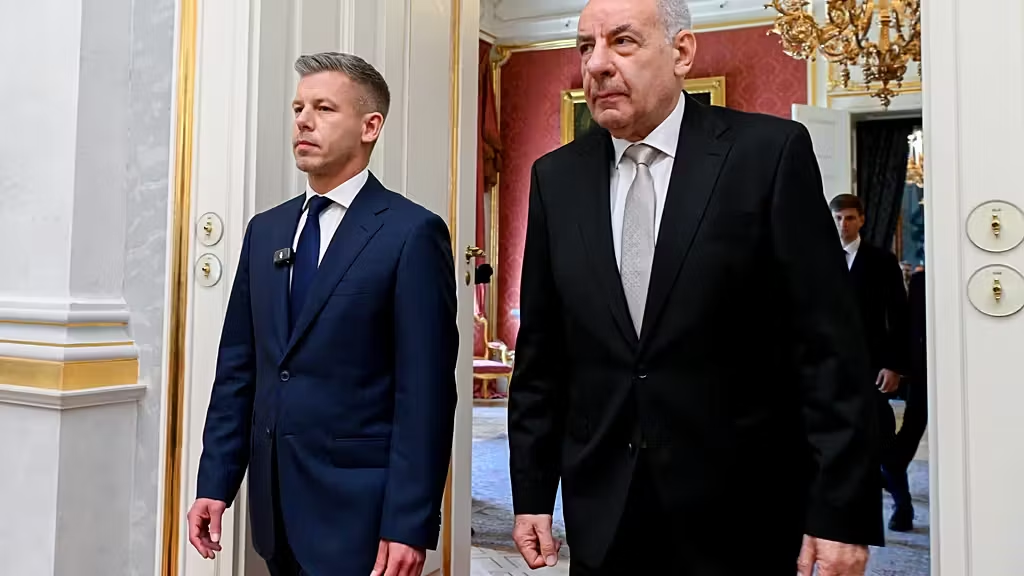
Hungarian Prime Minister Peter Magyar told parliament on 22 June his government will end President Tamas Sulyok's mandate through a constitutional amendment and open a wider rewrite of the constitution from September.
Magyar's Tisza party holds 141 of the 199 seats in the National Assembly, the two-thirds majority needed to change the Fundamental Law without opposition votes. The move against Sulyok is the sharpest step yet in his drive to clear officials appointed under Viktor Orban, whose 16-year government Tisza defeated in the election on 12 April.
The proposed 17th amendment to the Fundamental Law would end the sitting president's mandate the day after it takes effect. Parliament would then elect a replacement for up to five years, until a new constitution drafted from September with public consultation is put to a referendum.
The removal mechanism
Magyar said the amendment was a general rule that could reach other state officials rather than a measure written for one person. He put it forward alongside plans for a new anti-corruption body, telling the chamber the two belonged together because stolen assets could not be recovered while Orban-era appointees stayed in posts from which they could obstruct investigations. He likened the system built over the Orban years to the Italian mafia and said his government would take it apart criminal by criminal.
Asset recovery office
The National Asset Recovery and Protection Office would run as an independent body answerable only to parliament and would carry out what Magyar said would be the largest asset-tracing operation in Hungary's history. Its head and four deputies would hold round-the-clock police protection, and it would recruit investigators, prosecutors, auditors and tax specialists. The bill to establish it will go to public consultation before reaching parliament, Magyar said on 21 June, stepping back from an earlier plan to submit it this week.
Changes to the courts
The same amendment would let Constitutional Court judges elect their own president and would restore a retirement age of 70 for the court, ending the mandate of its president Peter Polt, a former prosecutor general, along with his legal immunity. Judges would also gain the power to recall the heads of the Kuria, Hungary's supreme court, and the National Office for the Judiciary. Magyar told parliament he would also cap membership of the National Assembly at 12 years, a limit that would bar several senior Fidesz figures from standing in 2030.
Sulyok's position
Sulyok has refused to resign and said he will fight removal by every legal means. He asked the Council of Europe's Venice Commission for an assessment of the dispute and filed a motion at the Constitutional Court on 11 June seeking an interpretation of the rules that govern the Fundamental Law. Seven of the court's judges recused themselves over a conflict of interest, the court lost its quorum, and Polt took the matter off the agenda. In an interview with Politico, Sulyok said Magyar was concentrating more power in 16 weeks than Orban had in 16 years and that no parliamentary majority could set aside the rule of law. Magyar told parliament the referral was an attempted constitutional coup that had already failed.
Fidesz, cut to 52 seats in April, opposes the plan. Its parliamentary leader Gergely Gulyas said it was "not conceivable that a president is forcibly removed" before his term ends and that the government was misusing its mandate. Sulyok, a former president of the Constitutional Court, was elected to a five-year term in 2024 by an Orban-aligned parliament. "Hungary does not belong to Tamas Sulyok nor to Viktor Orban," Magyar said on 1 June.
Magyar's earlier moves
Since taking office on 9 May, Magyar set a 31 May deadline for a slate of Orban-era officials to resign, among them Sulyok, Prosecutor General Gabor Balint Nagy, Kuria president Andras Zs. Varga, and the heads of the State Audit Office, the competition authority and the media regulator. None stepped down. Parliament has since passed the 16th amendment to the Fundamental Law, capping the prime minister's tenure at eight years, which Sulyok signed on 19 June. Magyar's government has also opened five committees of inquiry into Orban-era conduct, moved to abolish the Sovereignty Protection Office, suspended state television and radio news pending a new media law and begun the process of joining the European Public Prosecutor's Office.
European funds
The reshaping of Hungary's institutions runs alongside talks with the European Commission to unlock about €17bn in funding frozen under Orban over corruption and rule-of-law concerns. The Commission has tied the money to 27 conditions Hungary must meet by the end of August, the deadline against which Magyar's changes are now running.