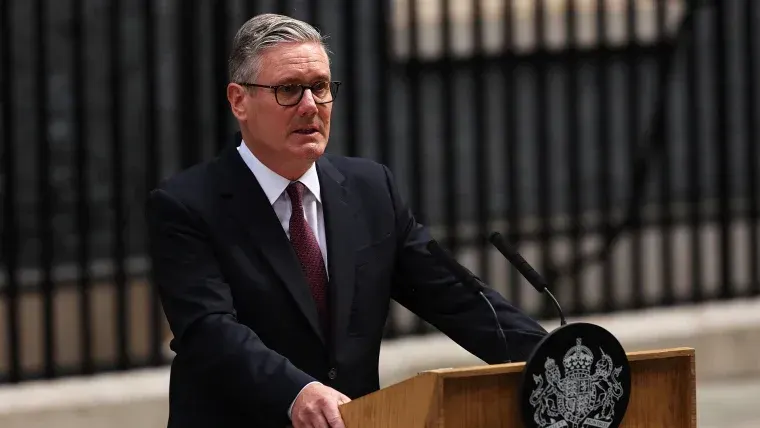
Keir Starmer said on Monday he will resign as Labour leader and prime minister, staying on as caretaker until the party picks a successor, less than two years after the landslide win that promised to end Britain's political turmoil.
His departure makes Andy Burnham, the former Greater Manchester mayor who returned to Parliament last week, the overwhelming favourite to take over and become Britain's seventh leader in 10 years. Burnham said within hours of Starmer's statement that he will stand.
Starmer told supporters and reporters outside 10 Downing Street that he had informed King Charles III of his decision.
"Every decision I have taken has been about putting the country I love first," Starmer said, his voice breaking near the end of a short statement.
Months of pressure
The collapse caps months of pressure that turned terminal in June. On 11 June Defence Secretary John Healey resigned over the government's defence spending plans, arguing the agreed investment left the armed forces under-resourced against threats including the war in Ukraine and the 2026 Iran war. Armed Forces Minister Al Carns and a parliamentary aide, Pamela Nash, quit the same day.
The pressure before that was electoral. Labour took heavy losses in local and regional elections in early May as Nigel Farage's Reform UK made record gains. More than 100 Labour MPs had called on Starmer to go by Monday, drawn from the party's centrist, soft-left and hard-left wings.
Burnham removed the last obstacle to a challenge last week, winning the Makerfield by-election with 54.8 per cent of the vote and beating a Reform UK candidate. British prime ministers are drawn from sitting MPs, and his return to the Commons made a bid viable. "I will put myself forward as part of this process," he said.
Wes Streeting, the former health secretary widely seen as Burnham's main rival, ruled himself out on Monday and endorsed him. Streeting, who resigned from cabinet in May with a sharp attack on Starmer's record, said Burnham could "win the fight of our lives against the forces of nationalism".
Leadership contest
Nominations to replace Starmer open on 9 July and close on 16 July, when Parliament rises for its summer recess. A candidate needs the backing of 20 per cent of Labour MPs, currently 81 of the party's 403, to stand. If Burnham faces no challenger the party can install him by acclamation. If a contest follows, members and affiliates will vote and a new leader will take office by 1 September.
Reform UK leader Nigel Farage, whose party has led national polls for more than a year, called for an immediate general election and wrote on X that Labour could not simply install another professional politician in Number 10. Liberal Democrat leader Ed Davey and Green leader Zack Polanski stopped short of demanding an election but said Starmer's successor must drop the caution of his tenure.
Burnham's record
Burnham, 56, was mayor of Greater Manchester from 2017 until his return to the Commons last week forced him to give up the post. He was MP for Leigh from 2001 to 2017 and held cabinet jobs under Gordon Brown, including chief secretary to the Treasury and health secretary. He ran for the Labour leadership twice, coming fourth in 2010 and second to Jeremy Corbyn in 2015.
As mayor he built a national profile, dubbed the King of the North after clashing with Boris Johnson over pandemic funding for the north of England and took Greater Manchester's buses back under public control through the Bee Network. He sits on Labour's soft left and pitches a politics he calls Manchesterism, putting place before party. Critics say his programme is vague about where the money for his pledges would come from.
Foreign policy
Burnham enters the race with almost no foreign-policy record, a gap that has drawn unease in European capitals and saw German delegates press their hosts about him at this month's Königswinter conference. Analysts expect continuity rather than rupture. On Ukraine that means holding the line Starmer coordinated with European allies, including weapons, training and the security treaties signed with Germany and France.
The unresolved question is money. Healey resigned because he judged the agreed budget too small to meet the threats set out in the government's strategic defence review, the Russian war on Ukraine among them. Burnham has said little about the trade-off, though he has favoured defence spending as a source of skilled jobs and has called for 10-year funding settlements of the kind Healey sought and did not get.
On Europe, Burnham favours closer ties and is expected to continue Starmer's reset, an area-by-area thaw that began with a UK-EU summit in May 2025 and a security and defence partnership. Those talks stalled in November over British access to the EU's SAFE defence-procurement loans, a setback his government would inherit.
Mandelson appointment
Among the scandals that shadowed Starmer's premiership was his appointment of Peter Mandelson as ambassador to the U.S. in December 2024. Starmer dismissed him in September 2025 over his association with the late convicted sex offender Jeffrey Epstein and told Parliament in February 2026 that Mandelson had lied repeatedly during vetting about the relationship. Starmer faced calls to resign over whether he had misled MPs about the appointment.
Starmer won power in July 2024 on a promise to restore stability after 14 years of Conservative government and a run of short-lived leaders. Since the 2016 Brexit referendum Britain has been led by David Cameron, Theresa May, Boris Johnson, Liz Truss, Rishi Sunak and Starmer. His successor will be the seventh. The resignation falls a day before the referendum's 10th anniversary.