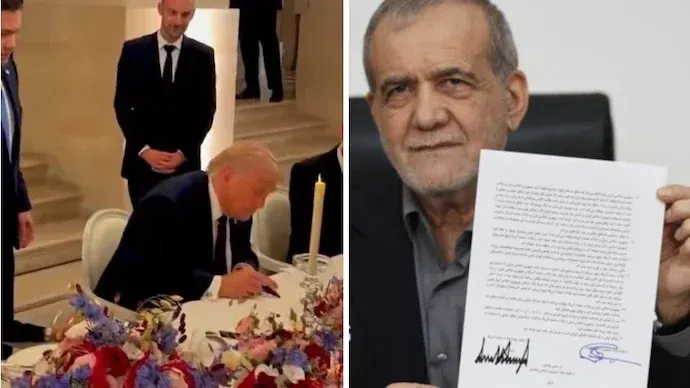
The United States and Iran signed an interim memorandum on 17 June 2026 reopening the Strait of Hormuz and ending the US naval blockade, while leaving the war's central dispute, Iran's nuclear programme, for later talks.
President Donald Trump signed the document during a dinner with French President Emmanuel Macron at Versailles, on the closing day of the Group of Seven summit at Evian-les-Bains. President Masud Pezeshkian signed for Iran. The agreement took effect immediately.
What the two presidents signed is not a peace deal but an interim arrangement that extends a ceasefire agreed in early April by 60 days, with a final settlement to be negotiated in that window and extendable by mutual consent. Senior US officials read out its 14 points to reporters on 17 June.
Trump said the text was provisional and not final, and that he would resume the war if dissatisfied.
"If I don't like it, we'll go back to dropping bombs on their head," Trump said.
Nuclear programme left to later talks
The dispute that triggered the war is the part the memorandum does not resolve. The US and Israel launched the war on 28 February 2026, in part to prevent Iran acquiring a nuclear weapon, and the programme's future now sits inside the 60-day talks rather than the signed text.
On paper the deal does address Iran's existing stockpile of highly enriched uranium. The text requires the 60 per cent material to be down-blended on site, as a minimum, under International Atomic Energy Agency supervision. IAEA Director General Rafael Grossi said on 18 June the agency would now define the "concrete steps" needed to carry that out, and said the process would be highly complex.
That provision rests on contested ground. The Council on Foreign Relations wrote that the memorandum is "best understood as mostly a ceasefire", with the substantive issues deferred to later rounds. Iran has said it will not ship its enriched uranium out of the country and does not accept the IAEA as a neutral arbiter, CFR analysts wrote. The agreement also lets Iran keep large quantities of uranium enriched to lower levels, and sets no agreed limit on future enrichment.
Strait of Hormuz and the blockade
The strait reopened on the terms the memorandum sets, not on open-ended ones. Iran agreed to free passage for commercial vessels for 60 days only, after which the route's administration is to be negotiated with Oman, and future tolls are not ruled out. The deal sets a 30-day target for traffic to return to pre-war levels, even as Iranian mines may remain in the water.
About a fifth of the world's seaborne oil and a similar share of its liquefied natural gas passed through the strait before Iran closed it to most traffic on 28 February. Roughly 140 ships transited each day before the war. Within weeks the count fell by about 90 per cent and at points to near zero, as the Islamic Revolutionary Guard Corps ordered ships away by radio, boarded merchant vessels and laid sea mines.
Iranian forces struck merchant ships repeatedly during the closure. Two fuel tankers, the Safesea Vishnu and the Zefyros, were set ablaze by explosive-laden boats off Iraq while transferring cargo. One crew member aboard the Safesea Vishnu was killed. The Thai-flagged bulk carrier Mayuree Naree was hit by two projectiles in the strait, leaving three crew members missing in its engine room and 20 others evacuated to Oman.
Trump authorised the immediate removal of the US naval blockade of Iranian ports, imposed on 13 April. The US Navy disabled Iranian tankers that tried to breach it. Trump said US forces had struck 28 Iranian mine-laying vessels. Mines that Iran laid in the strait remain in the water, and the UK and France are preparing to help clear them.
Oil prices rose faster during the closure than in any recent conflict, with Brent passing $100 a barrel on 8 March and global prices touching $126 at the peak. Petrol in California rose above $5 a gallon and parts of Asia faced fuel shortages and rationing. War-risk insurance for the strait climbed from 0.125 per cent of a ship's value per transit to as much as 0.4 per cent. The International Maritime Organization said on 21 April that about 20,000 mariners and 2,000 ships were stranded in the Gulf.
The blockade kept more than 14 million barrels a day of Middle East oil output off the market, on the International Energy Agency's estimate. The first Iranian crude cargoes in two months left the strait this week, though shipping firms have said they will keep heightened security until transits prove safe.
Prices have fallen by about 40 per cent from their wartime peak. Brent crude dropped 1.4 per cent to $78.41 a barrel on 18 June, its lowest since early March, as markets priced in the easing of supply risk. US crude fell 1.25 per cent to $75.83. The IEA said the market could move into a large supply surplus by 2027 as Gulf output returns.
Lebanon, Israel and the civilian toll
The memorandum's first point is a halt to all fighting, including in Lebanon, where Israel and the Iran-backed group Hezbollah have fought daily through the war. Israel is not a party to the agreement and has rejected withdrawing from southern Lebanon, which it continues to occupy. Iran has said an Israeli withdrawal is required, though the text released by US officials does not mention one.
The war has killed thousands. Iran's health ministry said more than 3,400 had been killed there, with the rights group HRANA documenting at least 1,701 civilians among the dead. Lebanon's health ministry said Israeli strikes had killed more than 3,750 people and wounded over 11,000 by mid-June, and Lebanese authorities said more than a million people had fled their homes. At least 13 US service members were killed, on CENTCOM's count, and dozens died in Israel, most of them civilians hit by Iranian and Hezbollah fire.
United Nations bodies have pressed for war crimes investigations. The UN human rights office said a missile that struck the Shajareh Tayyebeh primary school in Minab on 28 February, killing about 165 people, most of them schoolgirls aged seven to 12, was a grave violation of humanitarian law and should be investigated. UNICEF said more than 1,100 children had been killed or injured by mid-March. Lebanon's health ministry said an Israeli strike on a Red Cross ambulance team in April killed a paramedic, while the Israeli military said it had targeted a Hezbollah operative nearby.
Human Rights Watch said all sides had committed serious violations of the laws of war, including possible war crimes, and that a US vow of "no quarter" for enemies in Iran amounted to a war crime in itself. Amnesty International said the US-Israeli attack on Iran was unlawful and in breach of the UN Charter. A group of UN experts said the assault amounted to flagrant violations of international law and an act of aggression. The same experts said orders for civilians to leave southern Lebanon would amount to a further war crime, and that Iran's retaliatory strikes on civilian targets in the Gulf also broke the law.
Sanctions and reconstruction
Sanctions relief is partial and deferred. The US will waive some measures and permit Iranian oil sales at once, but Trump said the deal carries no immediate broader sanctions relief, with the schedule left to the talks. The text records a figure of at least $300 billion for Iran's reconstruction, though the mechanism is unresolved and Trump and Vice President JD Vance have said the US will not fund it.
What the parties have agreed is a 60-day pause with the war's defining question, whether Iran keeps the capacity to enrich uranium, carried into negotiations that have failed repeatedly since 2025. Trump has said he will return to bombing if those talks displease him. The agreement's survival is tied to a threat to break it.