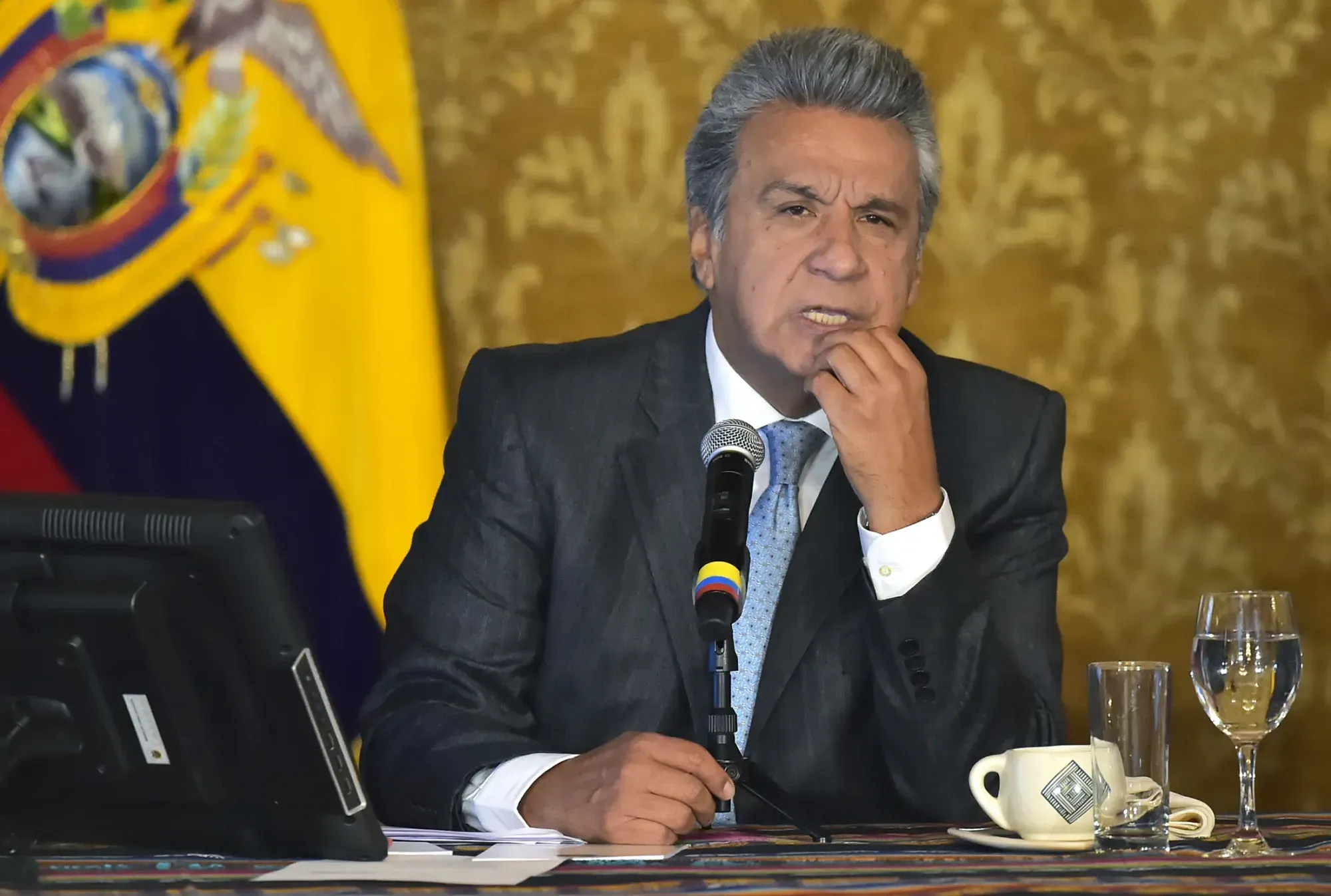
Ecuador's National Court of Justice sentenced former president Lenín Moreno to five years in prison on 28 August 2026 for taking bribes from the Chinese state builder Sinohydro in exchange for the contract to build the country's largest hydroelectric plant.
Judges Manuel Cabrera, Daniella Camacho and Julio Inga ruled unanimously that Moreno used his post as vice president to intervene in areas outside his competence and favour Sinohydro's bid for Coca Codo Sinclair, and convicted him as a direct author of cohecho, the Ecuadorian offence of bribe-taking.
Celec, Ecuador's state power company, has been counting cracks in the plant since before it was finished. A Comptroller General audit published in 2019 recorded 7,648 fissures in the eight distributors that feed the turbines. Celec's own count reached 17,661 by 2022, of which 3,570 appeared in that year alone. Ecuador signed the definitive reception papers in April 2026, 10 years after the plant started generating and four months before the court convicted Sinohydro's two senior representatives in the country of paying for the contract that built it.
The court convicted 20 people in all, and barred each of them from public office, suspended their political rights for the length of their sentences, gave them 30 days to issue public apologies and 90 days to pay reparations that together exceed $163 million, according to the attorney general's office. Moreno and his relatives must repay three times what the court found they received. The remaining defendants owe double.
Moreno has used a wheelchair since he was shot during a robbery in Quito in 1998, a disability that qualifies him for house arrest under Ecuadorian law, so he serves the five years at home rather than in a prison cell.
Who was convicted
Conto Patiño, a friend of the Moreno family who represented Sinohydro commercially in Ecuador and owned the trading firm Comercial Recorsa, was sentenced to five years as a direct author.
Cai Runguo, China's ambassador to Ecuador during the period the court examined, drew five years as a direct author, as did Song Dongsheng, legal representative of Sinohydro Corporation, and Yan Huiju, the company's general attorney in Ecuador. Prosecutors told the court that Cai held meetings with Moreno about Coca Codo Sinclair, pushed the financing and took part in the structure that moved the money, and that the conduct of the three men was determinative in securing the contract.
Rocío González, Moreno's wife, and his daughter Irina Moreno each received 30 months as accomplices, as did his brothers Edwin Ovidio and Guillermo Renán Moreno and his sister-in-law Marta González. Accomplice terms of 30 months went to 12 defendants in all. Two other men were convicted as direct authors and sentenced to three years each, and a 13th accomplice received 18 months. The attorney general's office publishes the names of everyone convicted except Moreno in abbreviated form, giving a first name and a surname initial.
Prosecutors brought 21 people to the trial phase and withdrew the charge against one of them, Priscila Burneo, during closing arguments, leaving 20 to hear the verdict read from 21:10 on 28 August.
Carlos Leonardo Alarcón, the acting attorney general, had asked for six years and six months for the seven direct authors and shorter terms for the 13 accomplices, along with $76 million in reparations. He put 29 witnesses, 20 expert reports and 90 documentary exhibits before the court, some of them obtained through international judicial cooperation.
The money
Sinohydro moved about $76.1 million out of the project between 2009 and 2018, a sum equal to roughly four per cent of a construction contract worth $1.979 billion, prosecutors told the court. Financial expert evidence traced $75.6 million of it to Comercial Recorsa between 2010 and 2017, under a representation contract that entitled the firm to precisely that four per cent of the project's value.
Comercial Recorsa changed its corporate purpose in 2009 to take in infrastructure consultancy. It had previously handled imports and exports.
More than $3.4 million reached the Panamanian company Espíritu Santo Holdings and more than $4.2 million reached Ángeles Finance, according to the financial evidence heard at trial. Of the $76.1 million, prosecutors put the amount that reached people around Moreno at more than $1 million.
The tribunal treated as proven $217,000 to Edwin Moreno, $52,000 to Irina Moreno, $15,000 to Marta González, $10,000 to Guillermo Moreno, a cheque for $1,568 to Rocío González, $19,342 of furniture shipped to Geneva through the Panamanian company INA Investment Corp and a $225,000 property in Quito.
A recorded interview from 29 March 2010, authenticated by voice and computer forensic examination, put Moreno on the record interceding with the executive branch on behalf of a person close to him linked to Sinohydro's representation.
The defence
David Meza, Moreno's lawyer, said after the verdict that not one dollar of the $76.1 million reached his client, and that responsibility for the Coca Codo Sinclair financing contract belonged to Jorge Glas, the vice president who followed Moreno, and to Alexis Mosquera, the energy minister of the time. Meza put the $1,568 cheque to Rocío González at $1,532 and dated it to 2015 sales of an agenda, and said Irina Moreno's payment came from art she sold the Patiño family in 2013, both of them transactions he told the court came years after the 2009 contract signing.
"If the sentence is unjust, we will appeal. If unfavourable, we'll file cassation, then pursue international justice," Meza said, setting out two stages of Ecuadorian appeal before any final sentence.
"There is no case, I have not received a single cent," Moreno said at a press conference during a recess in the sentencing hearing. He has held throughout that Rafael Correa's government signed the Coca Codo Sinclair contract and that Glas ran the construction on Correa's orders, and he asked reporters at what moment he was supposed to have intervened. Arriving for the hearing he said he was not a fugitive, and after the verdict he said he would stay in Ecuador rather than return to Paraguay.
Moreno flew into Quito from Asunción on 6 May 2026 to face the trial, five days before it opened, having lived in Paraguay since leaving office and worked there as the OAS commissioner for disability. Judges had let him report twice monthly to Ecuador's embassy in Asunción instead of holding him in pre-trial detention.
31 hearing days, then seven weeks
Most of the defendants followed the trial by video link. Moreno attended in person on the opening day and again on 12 May, when a woman who identified herself as Eily Cartagena, counsel for former Sinohydro workers, confronted him during a recess and demanded to know why he had not accepted the Coca Codo Sinclair works, which she said had cost the workers their benefits. Meza called it a shameful incident and said his client would attend remotely from the following morning. Moreno said Cartagena was either intoxicated or paid, and that he had refused to accept the plant because inspectors had found more than 17,000 fissures in it.
The tribunal heard 31 sessions between 11 May and 10 July 2026, then retired. Alarcón filed a motion in early August arguing that a prudent time had passed and asking the court to set a date. The verdict came seven weeks after the last hearing.
The plant
Coca Codo Sinclair has a nameplate capacity of 1,500 megawatts, entered service in late 2016 and supplies between 20 and 25 per cent of Ecuador's electricity demand. Ecuador spent about $2.763 billion on it through 2018, of which the powerhouse alone accounted for $1.011 billion, and financed the works with a $1.682 billion buyer's credit from China Eximbank covering 85 per cent of the cost.
The eight distributors carry water falling almost 600 metres. Expreso reported that inspections have now logged more than 30,000 fissures in them and that the number rises with each new inspection. The Comptroller General's 2019 report told Celec management to refuse the works unless Sinohydro replaced all eight distributors to Celec's satisfaction. Sinohydro did not replace them. Sediment forced 12 shutdowns in 2024.
Celec took Sinohydro to arbitration at the International Court of Arbitration of the International Chamber of Commerce and put its damage claim at $580 million. Ecuador withdrew that claim under an agreement reached with the Chinese government in June 2025. The tribunal issued an award on 30 March 2026 recording terms both sides had agreed, and notified them on 3 April.
Sinohydro pays Celec $200 million in four instalments of $50 million under that award, and Ecuador receives a further $200 million in Chinese supplier credit for renewable energy projects. Celec releases roughly $200 million in performance guarantees back to Sinohydro within 21 days of the reception document being signed. Sinohydro wrote to Celec on 6 April demanding the signature within 15 days, and Pedro Luis Rodríguez Romero, the plant's submanager, signed for Ecuador. Annex II of the agreement, which sets out which defects pass to the new operator, has not been published.
PowerChina, Sinohydro's parent, took the operation and maintenance contract for the plant it built. Inés Manzano, the energy minister, said the agreement obliges PowerChina to repair everything that needs repairing and to change the distributors. Negotiations opened at $60 million a year and closed at $46 million, which over the 25-year term comes to about $1.15 billion.
Correa, and where the case came from
Rafael Correa, president from 2007 to 2017 and the man Moreno served as vice president from 2007 to 2013, called his former deputy a delinquent and shameless on social media after the verdict, and said the conviction had come despite what he described as friendly media treatment. Correa was himself convicted in the Sobornos case and sentenced to eight years. He lives in Belgium, which granted him asylum and refused Ecuador's extradition request in May 2022.
Fernando Villavicencio and Christian Zurita published the reporting that became this case on 19 February 2019, under the title "El laberinto offshore del círculo presidencial". Their documents showed INA Investment Corp, registered in Belize in 2012 by Edwin Moreno, buying furniture from a Geneva antiques dealer and a flat in Alicante for 133,400 euros. An anonymous portal, inapapers.org, suggested the company's name came from the last letters of the names of Moreno's daughters, Karina, Cristina and Irina. Ecuador's attorney general opened the Sinohydro investigation in March 2023, four years later.
Villavicencio was shot dead at a campaign rally at Colegio Anderson in Quito on 9 August 2023, five months after that investigation opened, while running for president. A Quito court sentenced Carlos Edwin Angulo Lara, a leader of the Los Lobos gang, and Laura Dayanara Castillo Velin to 34 years each in July 2024 for ordering the killing, and gave three accomplices 12 years. Prosecutors charged former interior minister José Serrano, former lawmaker Ronny Aleaga and businessman Xavier Jordan as intellectual authors in September 2025. Nothing filed in that case links the killing to Sinohydro.