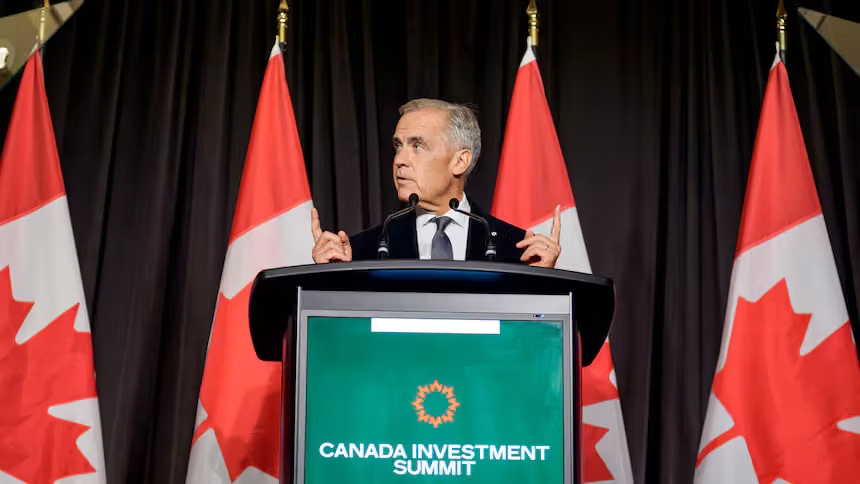
Mark Carney closed the first Canada Investment Summit on 15 September 2026 with a federal claim of nearly $500 billion in new investment, two days after opening it with a gala at the Art Gallery of Ontario and a day of sector panels at Toronto's Four Seasons Hotel. Jean Chrétien attended the Monday opening and Stephen Harper gave the closing remarks. Carney announced the event on 17 April 2026 and fixed its target then: catalysing $1 trillion of total investment in Canada over five years. "Canada is building big. Build with us," he said.
What the $1 trillion covers
Federal material defines the figure as combined public, private and institutional investment across eight sectors, of which infrastructure is one, alongside mining and critical minerals, data centres and AI, advanced manufacturing, liquefied natural gas, ports, railways and nuclear. Roughly $500 billion of that is private capital sought over five years, against about $280 billion in federal capital investment and incentives. The federal government's supporting claims are Canada's AAA credit rating, the lowest net debt-to-GDP ratio in the G7, trade access to about 1.5 billion consumers and $97 billion in foreign investment commitments secured across more than 20 economic and defence partnerships over the previous 12 months.
Carney said Canada has "what the world wants: the energy, the resources, the talent, the technology and the capital". Speaking at the Royal Ontario Museum on 13 September he said the country's "greatest strength is something that cannot be found on any balance sheet: trust", and that there is "a new consensus from Iqaluit to Victoria to Quebec City and St. John's".
The deal book: 167 projects, no airports
A 66-page federal prospectus prepared for the summit lists 167 projects. Named entries include a Port of Churchill expansion carrying a $57-billion price tag, a $10.9-billion Edmonton to Calgary high-speed rail link, E3 Lithium's Clearwater project in Alberta, the Troilus gold and copper project, NexGen Energy's $1.6-billion Rook I uranium mine in Saskatchewan, Canada Nickel's US$2-billion Crawford project in Ontario and the US$28.5-billion Ksi Lisims LNG terminal in British Columbia. Airport infrastructure appears nowhere in the document, and airports turned out to be the single largest asset class the government put on the table on day two. Ontario Premier Doug Ford brought 15 provincial projects to the floor and said the summit is "about building relationships, opening doors".
Brookfield and CPP Investments launch a $50-billion Maple Fund
Brookfield Asset Management and the Canada Pension Plan Investment Board are each committing up to $25 billion over five years to a vehicle called the Maple Fund, an equal partnership with a minimum deal size of $5 billion, 50/50 equity splits and no fees or carried interest charged between the two partners. Other investors can join deal by deal. CPP Investments president and chief executive John Graham said "Canada is entering a period of new ambition to advance major projects and build for the future". Brookfield chief executive Connor Teskey said the structure combines CPP Investments' scale and long-term capital with Brookfield's development and operating capabilities. CPP Investments co-hosts the summit alongside the federal government and the Public Sector Pension Investment Board.
Brookfield's earlier version of the idea, reported by The Logic from leaked pitch materials, proposed $4 billion from Brookfield itself, $36 billion from Canadian pension managers and $10 billion from the federal government. Nine pension managers appeared on that list, including CPP Investments, the Caisse de dépôt et placement du Québec, Ontario Teachers', AIMCo, BCI, PSP Investments, OMERS, HOOPP and IMCO, together managing about $3.3 trillion. Target sectors included housing, sized at more than $250 billion of opportunity, data centres, semiconductor supply chains, renewables, nuclear and privatisation candidates such as Crown lottery corporations and telecommunications. Board seats in the proposed structure went to Brookfield and the pensions, with no government seat described. Economist Randall Bartlett said pension funds chase higher returns and geographic diversification elsewhere, a problem a Canadian shopping list does not solve on its own.
Carney, Brookfield and the ethics screen
Carney chaired Brookfield Asset Management's board before entering politics, after 13 years at Goldman Sachs and governorships at the Bank of Canada and the Bank of England. He placed his holdings in a blind trust in March 2025. His conflict-of-interest screen, administered by chief of staff Marc-André Blanchard and Clerk of the Privy Council Michael Sabia, covers Brookfield Asset Management, Brookfield Corporation, Stripe and their subsidiaries, and permits him to take part in decisions affecting a broad class of persons. The Globe and Mail reported the screen touches more than 100 entities. Before the trust was created he held shares and options in both Brookfield entities plus stakes in more than 560 companies through a third-party managed account.
The House of Commons ethics committee recommended on 23 April 2026 that prime ministers be required to sell their assets within 60 days of taking office rather than use blind trusts, that cabinet ministers and party leaders divest from tax havens and that screens be administered by non-partisan public servants with mandatory public reporting. Committee chair John Brassard said "individuals with greater decision-making authority should be held and must be held to a higher standard". Liberal members filed a dissenting report arguing the recommendations singled out Carney and that blind trusts work.
Bell quadruples its Regina data centre to $52.5 billion
Bell Canada will expand its AI data centre near Regina from the 300 megawatts agreed in March 2026 to 1.2 gigawatts, an investment of $52.5 billion and the largest private capital commitment in Saskatchewan's history. Chief executive Mirko Bibic announced the expansion at the summit on 14 September alongside Saskatchewan Premier Scott Moe. The federal government puts the job figure at more than 4,500. The site overtakes the 1-gigawatt Meta facility in Alberta as the largest in the country. Saskatchewan requires data centre applicants to supply their own power. The agreement is non-binding. Carney said: "You can have your data sent elsewhere, or you can build it right here, on Canadian ground."
Banks and pensions pledge about $440 billion
TD Bank pledged $150 billion over five years in lending, underwriting, advisory and investment across energy, critical minerals, defence and aerospace, digital technology and infrastructure. Scotiabank committed more than $100 billion over five years, BMO up to $70 billion over 10 years, Power Sustainable more than $10 billion, Ontario Teachers' a further $10 billion by the end of 2027 on top of roughly $100 billion already in Canadian assets, Sun Life $5 billion over five years, CIBC $2 billion for defence and dual-use small and medium firms and RBC $1.5 billion for high-growth Canadian technology companies. PSP Investments added $25 billion, an increase of 30 to 40 per cent that takes its Canadian holdings to $100 billion. Bank financing accounts for about $325 billion of the total the federal government published on 15 September and pension and institutional money for about $100 billion.
Radical Ventures launched the Radical Breakouts Fund at the summit on 15 September, a multi-billion-dollar vehicle for late-stage AI companies that closed its first round at more than US$1 billion, or $1.4 billion, backed by PSP Investments, CPP Investments, HOOPP, TD Bank Group, BMO Financial Group, CI Global Asset Management and OPTrust. Co-founder Jordan Jacobs said "Canada has never had a shortage of world-class AI companies. What we have lacked is capital at the scale required to keep them here as they grow." The federal government counts the fund at $4 billion.
BMO chief executive Darryl White said it is "very important that we've turned the tone in Canada to a build-first and an open-for-business-first tone". Sun Life attached a policy ask to its pledge, calling for an amendment to the Insurance Companies Act to allow equity investments. PSP Investments chief executive Deborah Orida said "Canadian business leaders and global investors have answered the call". CPP Investments chief executive John Graham said "the real measure of this summit will be what happens next". Michel Leduc, a CPP Investments senior managing director, said "Canada is cool again".
A priority queue at the tax agency
The Canada Revenue Agency began prioritising advance income tax rulings for investments of $1 billion or more on 14 September, timed to the summit. The published service standard does not change: 90 business days from receipt of complete information, a target the agency met 91 per cent of the time in fiscal 2024-25. Finance Minister François-Philippe Champagne said "when investors are considering major projects, certainty matters". Brian Ernewein of KPMG said the threshold gives an "easily applied metric". Fred O'Riordan of EY Canada raised capacity, saying "it's not as though you need a major injection of funding, but you want to maintain the capacity of that pipeline". No funding figure accompanied the announcement, leaving open whether other rulings and advance pricing arrangements slow behind the priority queue.
Immediate write-offs take the tax rate on new investment to 6.4 per cent
Permanent immediate expensing for about two thirds of capital asset investment took effect on 15 September under a measure the federal government calls the Productivity Mega Deduction, covering machinery and equipment, manufacturing and processing equipment, clean energy generation equipment, zero-emission vehicles, computers, software, research and development, patents and data infrastructure, with buildings, franchises and licences among the exclusions. Liquefied natural gas equipment qualifies from 4 November 2025. The federal government puts the cost at $36 billion over five years and says the marginal effective tax rate on new business investment falls from about 13 per cent to 6.4 per cent, against 16.9 per cent in the United States and 19 per cent across the OECD.
Business Development Bank of Canada money of $700 million goes to defence, $500 million of it into specialised investment funds and $200 million into StrongNorth, taking that fund from $300 million to $500 million. The Canada Growth Fund is putting $140 million into Generation Mining's Marathon copper and palladium project in northwestern Ontario.
Private operators for Pearson, Trudeau, Calgary and Vancouver
Carney used his keynote on 15 September to invite private investors to run Canada's four largest airports, Toronto Pearson, Montreal Trudeau, Calgary and Vancouver, under long-term concessions. "We will unlock their true value by bringing in new capital and expertise to their operations," he said, and "we are living in different times." Federal ownership of the land and the assets stays in place, held through the Canada Strong Fund, the sovereign wealth fund created on 27 April 2026 as a Crown corporation with $25 billion of federal money over three years. "We will reinvest the tens of billions of dollars of capital that we raise into infrastructure that Canada needs," Carney said, naming regional airports, local transport and sovereign broadband. He said he is seeking "concessions, not privatization" and pointed to Heathrow as a model. Transport Minister Steven MacKinnon is expected to bring legislation in the autumn, with consultations running on 30-day windows.
Transport Canada's portfolio covers 23 large and mid-sized airports, including the six busiest, at an estimated value approaching $100 billion. The four airports named currently run as not-for-profit authorities managing federally owned land under long-term leases, an arrangement the previous Liberal government examined replacing at eight airports before dropping it. Michel Leduc of CPP Investments, one of the summit's three hosts, said large airport infrastructure is the "sweet spot" for deploying institutional capital domestically. Carney also raised federal ports, where Transport Canada runs 34 facilities directly and oversees 17 managed by Canada Port Authorities handling about 351 million tonnes of cargo a year, and said port reform ranks below airports in priority.
Liberal MPs held a call without staff on 14 September to discuss the plan, and one participant said several members voiced alarm that the sales were being presented as settled. The Canadian Labour Congress published a report warning that concessions would raise costs for travellers and damage conditions for airport workers, and said private investment "will cost Canadians". Unifor national president Lana Payne said the "sell-off of public infrastructure leaves us more vulnerable economically", and the union's aviation council demonstrated outside the summit. British Columbia Premier David Eby said he is open to discussing concessions and wants detail on support for regional airports. Conservative leader Pierre Poilievre said his party wants proof the plan saves money for travellers rather than serving corporate interests.
Who is in the room
Roughly 300 chief executives and senior executives attended from firms managing more than $120 trillion in combined assets. BlackRock chief executive Larry Fink and Blackstone president Jon Gray were both in Toronto, with delegations from Kuwait, Malaysia, the Netherlands, Singapore, Qatar, Norway, Japan, Australia, Denmark and Indonesia, and Saudi Arabia's Public Investment Fund among the institutions listed. Carney told reporters before the opening that deals had already been signed, without naming them, and federal officials have said results should be judged over 12 to 18 months.
The trade backdrop
Trade talks between the Canadian and US governments collapsed on 21 August 2026. The Trump administration imposed tariffs of 50 per cent on about $20 billion of Canadian goods, Canada retaliated, and the US government followed with import bans and restrictions on Canadian products in federal procurement. Carney has told investors they will find in Canada "a country that respects rule of law and a country that is reliable".
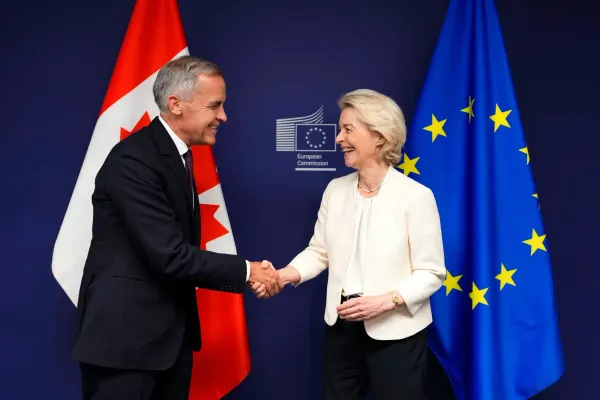
US tariffs of 50 per cent on a further 0.6 per cent of Canadian imports, among them outboard motorboats and metal and paper products, took effect on 15 September as the summit's second day ran, while the same rate came off about 0.5 per cent of imports including cement, sugar, toilet paper and fishing rods. Bans on Canadian liquor and dairy follow on 29 September. Carney said "there is a mutually beneficial deal possible" with the US government and "we can be masters in our own home". Asked in French whether visa rules for Canadians travelling to Europe could change, he said it is a possibility, and named energy, critical minerals, research and cultural exchange as areas for work with the European Union. Canadians currently get 90 visa-free days in any 180 in the Schengen area.
What Canada stands to gain
Real business investment per worker in Canada fell from $20,310 in 2014 to $16,493 in 2024, a drop of 18.8 per cent, while the equivalent US figure rose from $23,263 to $30,555, a gain of 31.3 per cent, according to a Fraser Institute study published in July 2026. Canada sat at 54 per cent of the US level in 2024, down from 87.3 per cent a decade earlier. Capital is what a worker has to work with, and the amount of it per worker is the closest thing economists have to a leading indicator of wages: more machinery, software, buildings and intellectual property per head produces more output per hour, and output per hour is what pay is drawn from.
William Robson and Mawakina Bafale found in C.D. Howe Institute Commentary 699, published on 4 December 2025, that capital per member of the Canadian labour force has fallen since 2015, leaving workers with about 9 per cent less capital by the third quarter of 2025 and 20 per cent less machinery and equipment. Canadian workers received 55 cents of new capital for every dollar their US counterparts received in 2025 and 70 cents against the OECD average. GDP per available worker in Canada stood at roughly $143,000 in 2024 against nearly $200,000 in the United States.
Canadian direct investment abroad totals $2.4 trillion against $1.6 trillion of foreign investment held in Canada, and a Royal Bank of Canada analysis found that for every dollar invested in Canada from abroad over the past decade, two dollars exited. Foreign direct investment inflows reached $96.8 billion in 2025, 47 per cent of it through mergers and acquisitions, which changes the ownership of existing assets rather than adding new plant, mines or transmission lines. Canadian pension and asset managers control roughly $10 trillion, most of it deployed outside the country.
Construction and running of the listed projects creates employment and a corporate and payroll tax base in the provinces where they sit, and Bell's Regina expansion alone is the largest private investment Saskatchewan has recorded. Projects that move critical minerals, LNG and electricity to tidewater or to new customers reduce the share of Canadian output that has to clear a US border now carrying tariffs of 50 per cent on some goods. Domestic AI and data centre capacity keeps computing, and the data held on it, under Canadian jurisdiction. Pension capital redirected home earns its returns from Canadian assets, and the retirees who own that capital are Canadian.
What the pledges do not settle
Bank commitments are lending, underwriting and advisory capacity rather than committed equity, and they make up about $325 billion of the $500 billion the federal government announced. A pledge to deploy $150 billion over five years is a statement of appetite that depends on borrowers turning up with projects. Bell's Saskatchewan agreement is non-binding. Several of the pledges in the total, including those from TD, Scotiabank, BMO, Sun Life, CIBC and Ontario Teachers', were made public before the summit opened. Federal officials have set the measuring point at 12 to 18 months.
More than 306,000 federal regulatory requirements sit between a signed intention and a built project. A Business Council of Canada survey found nearly half of chief executives named domestic regulatory burden as the single biggest factor in investment decisions, ahead of trade uncertainty. Economist Charles Lammam said that when government and opposition agree on deregulation and business leaders rank red tape above tariffs, the scale of the problem speaks for itself.
A $57-billion port and a $10.9-billion rail line earn their returns from traffic that has to materialise, and where usage falls short of the return an investor requires, the difference is met from public budgets or the project does not proceed. No published analysis accompanying the prospectus sets out projected utilisation for the largest entries.
More than 1,000 march on the gala
More than 1,000 demonstrators assembled at Nathan Phillips Square on the evening of 14 September and marched to the Art Gallery of Ontario, where between 200 and 300 Toronto police officers held barriers around the opening gala. Labour unions, housing and climate advocates, Common Horizon, the Migrant Workers Alliance for Change, the Council of Canadians, World BEYOND War and members of Poplar River First Nation and the Wet'suwet'en Nation took part, following a counter-summit and teach-in organised over the preceding two days by CUPE, the Council of Canadians, 8th Fire Rising and World BEYOND War under the banner "The Many vs The Money".
Hailey Asquin of Common Horizon said "we're here today because we represent young workers who want good jobs and a livable future". Rachel Small of World BEYOND War said "our future is not for sale". Tom Deadman, a teacher from Ottawa, said he was concerned about "giving away massive parts of our public services to American CEOs". Nik Barry-Shaw of the Council of Canadians questioned the prime minister's own line about Canada being at the table. Syed Hassan of the Migrant Workers Alliance for Change objected to subsidies and tax incentives directed at private investors. Toronto police said violence, threats, property damage or other criminal activity would not be tolerated and that arrests would follow where grounds existed. No arrests were reported.