U.S. personnel searched a U.S. Embassy employee's flat in Putney, south London, on 25 August over suspected child rape media, detained him and removed him from Britain the same day.
The Metropolitan Police said in a statement that U.S. authorities made the force aware on 25 August of "an investigation they are conducting into suspected offences in London relating to indecent images of children". The force said: "We continue to liaise with them regarding this matter." Officers did not question him before he left. No source establishes whether the notification reached the force before or after his departure, and the Met has not said whether it was told in time to act.
No formal extradition request was made before he left. He has not been publicly charged in either country, he has not been named and no UK authority has confirmed who searched the flat. U.S. officials hold no powers of arrest or search on British soil. Reports of the removal first appeared on 13 September, 19 days after he had gone.
What the embassy said
A U.S. Embassy spokesperson said the employee had been "reassigned to the United States in conjunction with an ongoing investigation". The same spokesperson said: "We quickly informed UK law enforcement and took swift action, and we will continue to work closely with our law enforcement partners."
Embassy wording describes him as an individual assigned to the embassy rather than as a diplomat. BBC News reported that he was an embassy employee rather than a diplomat but was covered by diplomatic protection. His grade, his accreditation and the immunity attaching to it have not been disclosed by either government, and the distinction decides which article of the 1961 Vienna Convention on Diplomatic Relations applied to him on 25 August.
A State Department line carried alongside the embassy statement said the U.S. government "expects all personnel to adhere to the highest standards of conduct" and that "we take these allegations seriously".
How he left Britain
BBC News, in a report by Vinny McAviney published on 13 September, said he was flown back to the United States on a commercial flight.
Flight-tracking data cited by Ynetnews and reproduced across later coverage records something else: a Kalitta Air Boeing 747 freighter flying from Chicago to RAF Fairford in Gloucestershire on 24 August as flight K49709, leaving Fairford at 5.33pm the following day as K4529 and landing at Dover Air Force Base in Delaware at 7.44pm local time, a flight of seven hours and 11 minutes. Outlets carrying that account note the airframe had not been to Fairford for at least two months.
Kalitta Air is a cargo carrier based at Willow Run Airport in Ypsilanti Township, Michigan. It operates 13 Boeing 747-400 freighters and flies charter work for the U.S. Air Force's Air Mobility Command. Its IATA code is K4 and its ICAO code CKS, so a reader pulling the record will find the two rotations under CKS rather than the K4 numbers reproduced in the coverage.
RAF Fairford is a Royal Air Force station in Gloucestershire run for U.S. use by the 420th Air Base Squadron, which the U.S. Air Force calls its preferred bomber forward operating location in Europe. Dover Air Force Base is home to the 436th Airlift Wing and to the 436th Aerial Port Squadron, a cargo and passenger hub for Air Mobility Command. A Kalitta rotation between the two would be unremarkable on its own.
Who searched the flat
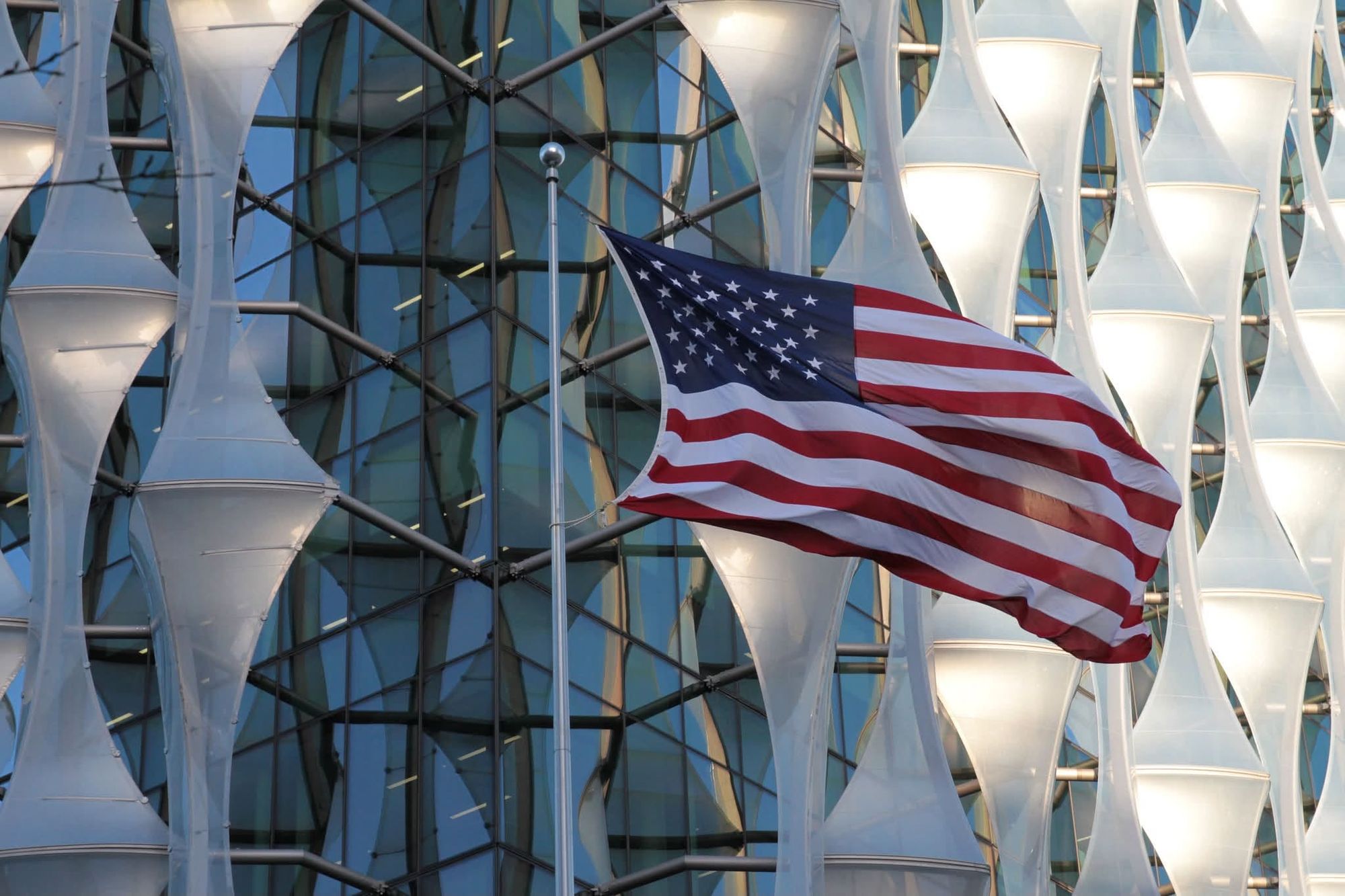
U.S. Marine Security Guards attached to the embassy at Nine Elms took part in the search, according to WION and the outlets carrying its report. The Metropolitan Police have not confirmed that detail, and no UK authority has said whether British officers attended.
A U.S. court order authorised the 25 August search, according to Law Commentary, which names neither the court nor the judge and which no other outlet follows. A warrant issued by a U.S. court has no force in England and Wales, where entry and search powers run from the Police and Criminal Evidence Act 1984 and are exercised by constables.
Edward Grange, an extradition solicitor, told Newsweek: "If someone in Britain is wanted to face criminal charges in America and will not return voluntarily, the proper route is extradition. If extradition was deliberately bypassed, that would raise very serious questions about the legality of the operation."
Immunity and jurisdiction
Article 31 of the Vienna Convention gives diplomatic agents immunity from the criminal jurisdiction of the receiving country. Article 37 extends immunity from criminal jurisdiction to administrative and technical staff and to members of their households, while limiting their civil immunity to acts performed in the course of their duties. Article 29 makes the person of a diplomatic agent inviolable. Article 30 gives the private residence of a diplomatic agent the same inviolability as the premises of the mission, which bars British officers from entering it without consent.
Article 32 allows the sending country to waive immunity and requires any waiver to be express. Article 9 allows Britain to declare any member of a mission persona non grata at any time, without giving reasons, after which the sending country must recall the person. Article 41 requires everyone enjoying those privileges to respect the laws of the receiving country.
Nothing in the convention authorises the sending country's personnel to conduct searches, detain people or remove them from the receiving country's territory.
Where the United States can prosecute
Section 7 of title 18 of the U.S. Code places within the special maritime and territorial jurisdiction of the United States, for offences committed by or against a U.S. national, "residences in foreign States and the land appurtenant or ancillary thereto, irrespective of ownership, used for purposes of those missions or entities or used by United States personnel assigned to those missions or entities".
Possession of child rape media inside that jurisdiction carries up to 10 years under section 2252A(a)(5)(A) of the same title, which covers anyone who "knowingly possesses, or knowingly accesses with intent to view" such material there. A Putney flat used by a person assigned to the embassy falls inside the definition, which is the provision that would support a U.S. warrant for the 25 August search.
Section 7 carries its own limit: "Nothing in this paragraph shall be deemed to supersede any treaty or international agreement with which this paragraph conflicts."
Where Britain can prosecute
Possession of child rape media carries up to five years under section 160 of the Criminal Justice Act 1988, which calls the material an indecent photograph of a child. Making, taking or distributing it carries up to 10 years under section 1 of the Protection of Children Act 1978. Both offences are extraditable under the Extradition Act 2003 and the 2003 UK-U.S. extradition treaty.
A British request would go to the U.S. Department of Justice and then before a U.S. court, and it requires a charge first. No charge has been brought, so no request can be made.
The annual count
Chris Elmore, a Foreign, Commonwealth and Development Office minister, told the Commons in a written statement on 19 November 2025 that UK law enforcement reported 17 serious and significant offences allegedly committed in 2024 by people with diplomatic immunity. The list records one offence as "Child Abuse" against the United States mission and one as "Distribution of Indecent Images of Children" against Turkey.
FCDO practice on receiving such a report, as the statement sets it out, is to ask the government concerned "to waive immunity, where appropriate, to facilitate further investigation", and in the most serious cases where no waiver is granted to request "the immediate withdrawal of the diplomat or dependant". Neither government has said whether a waiver was sought in August, and the statement covering 2026 is not due until late 2027.
Government response
Nick Timothy, the Conservative justice spokesperson, wrote to Justice Secretary Alex Norris to say the employee should face trial "in an English court" if the offences happened in Britain, warned of a cover-up and pointed to what he called a concerning pattern in how U.S. authorities handle cases against U.S. service members accused of offences against British civilians.
Fleur Anderson, the Labour MP for Putney, said no one should be above the law and called for an explanation of how the man was allowed to leave.
A UK government spokesperson said: "We expect all foreign diplomats in the UK to abide by our laws, in the same way we expect all UK diplomats to do so when posted overseas." Home Office ministers and the Metropolitan Police are in contact with the embassy, according to BBC News.
Earlier cases
Capt Jacob Wulfson, a U.S. Air Force pilot at RAF Lakenheath, was charged at a court-martial with sexual assault, aggravated sexual contact and strangulation, convicted of strangulation in June 2026 and acquitted of the other counts. He was sentenced to six months at a correctional facility at Lakenheath by a U.S. Air Force colonel sitting as judge, with a panel of eight male Air Force officers. Sarah Steele, the academic who reported him, said: "It was a very difficult system to be in, and at times I was treated incredibly aggressively, and I felt like I was on trial."
Steele was attacked at Wulfson's flat off base while he was off duty, which under Article VII of the 1951 NATO Status of Forces Agreement and section 3 of the Visiting Forces Act 1952 gives Britain the primary right to prosecute where the victim is a British civilian. Suffolk Constabulary's visiting forces policy puts the decision to waive that right with the Crown Prosecution Service at deputy chief crown prosecutor level. The case never reached the CPS. A spokesperson for the prime minister said it was "very concerning that a case like this never reached the CPS".
Anne Sacoolas, the wife of a U.S. intelligence officer at RAF Croughton, left Britain in September 2019 after a collision that killed 19-year-old Harry Dunn, asserting diplomatic immunity. She pleaded guilty to causing death by careless driving and received an eight-month suspended sentence on 8 December 2022, appearing by video link from the United States. Foreign Secretary Dominic Raab announced in July 2020 that the Croughton arrangements had been amended so that family members of U.S. staff there no longer held immunity from criminal jurisdiction for acts outside official duties, a change that did not secure Sacoolas's return.
British authorities publish no figures on how often they refuse U.S. requests to take over cases arising on British soil.