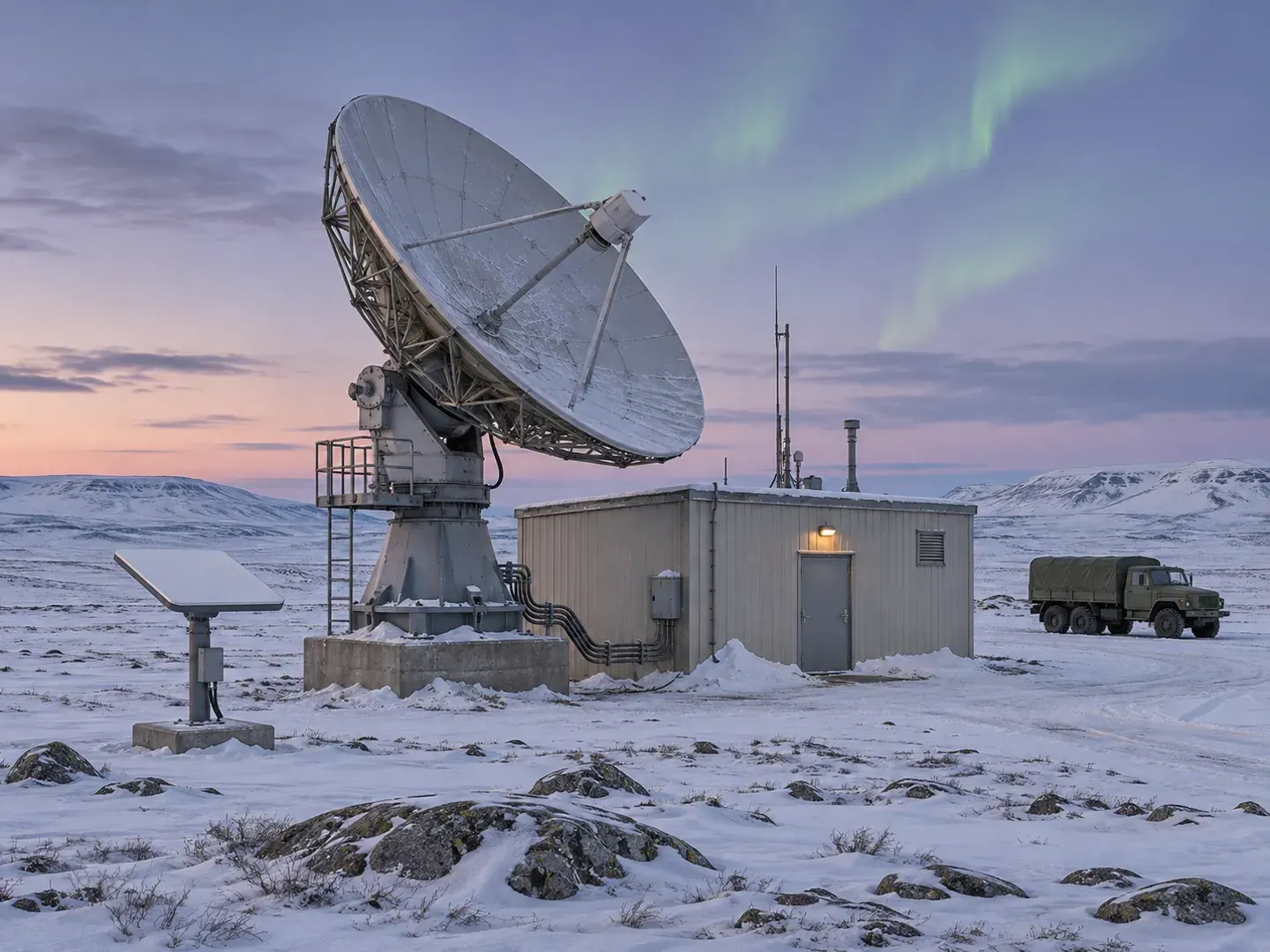
Dominion Dynamics and Telesat will develop rugged antennas linking Canadian soldiers and uncrewed military aircraft in the Arctic to a Canadian-controlled satellite network, the companies said on 19 November.
The C$2.2-million project includes a contribution to Dominion from the National Research Council's Industrial Research Assistance Program, according to the companies' announcement. Dominion, an Ottawa-based defence start-up developing an uncrewed combat aircraft called Scout, will lead the work as prime contractor. Telesat LEO, the subsidiary building the Lightspeed low-Earth-orbit constellation, is the subcontractor. Mitch Carkner, Dominion's chief operating officer, said soldiers on patrol in remote regions "should be connected to a Canadian network through equipment built here at home".
The equipment would give troops in the North a link to command centres that runs on a Canadian network instead of SpaceX's Starlink. Eliot Pence, Dominion's founder and chief executive, told CBC News the device would be "a Starlink Mini, but a Telesat Dominion Mini", built to military specifications for Arctic conditions.
Pence said the terminals would need some interoperability with Starlink, because SpaceX has far more satellites in orbit. Dominion's existing communications software manages several networks at once and lets military systems switch between them. Pence said the aim was to give commanders another route if one network became unavailable, unreliable or politically difficult.
Two prototype terminals
After the initial phase Dominion plans to design and build two prototypes: a compact terminal light enough for a soldier on foot to carry and a larger unit for uncrewed systems, including Scout. Both are to run on tactical power and use open interfaces so they can be fitted to existing military hardware. Both are also to go through cold-weather field trials and connectivity tests with Lightspeed, and the companies said the intellectual property would be created and held in Canada.
Dominion named the Canadian Armed Forces as the first intended customer. Carkner said the Canadian Rangers, the Canadian Coast Guard, the Royal Canadian Mounted Police and northern emergency services could also use the equipment. The money committed so far is a research contribution, and a procurement contract for the terminals has yet to be announced.
Lightspeed's launch schedule
Telesat pushed back Lightspeed's first launch when it reported third-quarter results on 29 October. Two Pathfinder test satellites built by MDA Space, previously planned for December 2026, will now launch no earlier than June 2027 on another customer's Falcon 9 rocket. The first batch of 15 production satellites is to follow no earlier than September 2027. About 45 satellites on three launches are enough to cover high latitudes, the company said, and it plans to have all 225 in orbit by the end of 2028.
Telesat kept its target of starting Arctic service for the Canadian military around the end of March 2028 by changing the order in which it deploys satellites, so that the far north is covered first. Global service slipped by three months, to the end of June 2028. Dan Goldberg, Telesat's chief executive, told analysts that a late Arctic start would cost the company "Zippo" under its military contract, because revenue would simply begin later.
SpaceX is booked to put Canada's alternative to Starlink into orbit. Telesat has 14 Falcon 9 launches booked and needs one more to complete its first 156 satellites.
The federal government signed a C$2.14-billion repayable loan for Lightspeed in September 2024, which also gives it warrants for 10 per cent of the Lightspeed subsidiary. In August the Defence Investment Agency awarded Telesat a C$2.3-billion contract for military satellite services, with options worth a further C$432 million. The contract adds 69 satellites to the constellation, taking the planned total from 156 to 225.
Carney and Starlink
Prime Minister Mark Carney told The New York Times in an interview published on 23 September that Canada would diversify away from Starlink. In the same interview he acknowledged that other satellite networks had yet to match its capabilities and resilience. In Istanbul on 23 October he said a slowdown of Starshield, SpaceX's military version of Starlink, had caused direct casualties in Ukraine. Ukrainian officials reported speed restrictions on Starshield terminals in motion overnight on 13 to 14 October, and the Institute for the Study of War assessed that the limits would disrupt Ukraine's interception of jet-powered drones.
Carney has been friends with Goldberg for nearly two decades. Jamil Jivani, a Conservative MP, asked Konrad von Finckenstein, the conflict of interest and ethics commissioner, in a letter reported on 3 November to examine the friendship in light of the August contract. On 13 November Carney asked von Finckenstein to impose a screen covering Goldberg, Telesat and its subsidiaries. The Prime Minister's Office has said Carney had no role in discussions or decisions involving the company, and Goldberg has said he never asked Carney for government money or contracts.
Scout
Dominion said on 17 November that Pratt & Whitney Canada would supply a Canadian-built PW300-series engine for Scout, which is designed to fly alongside crewed fighter jets. The PW300 family has more than 6,000 engines delivered and 33 million flight hours, according to Pratt & Whitney Canada. Scout is intended to fly long distances over the Arctic, conduct surveillance and potentially strike hostile targets. Dominion has named Telesat and 10 other Canadian companies, among them Thales Canada and Top Aces, as suppliers for the aircraft.
Telesat's legacy debt
Telesat's maturing debt sits in Telesat GEO, the unit that runs its older geostationary satellites, separate from the Lightspeed business that signed with Dominion. Term loans and secured notes worth about C$2.4 billion were due on 6 December, with further maturities in June and October 2027. Roughly C$3.1 billion falls due between December 2026 and October 2027.
Creditors holding legacy debt sued Telesat in New York and Ontario in January. They alleged that the September 2025 transfer of 62 per cent of the Lightspeed business's equity to another Telesat subsidiary had moved its most valuable asset beyond their reach. Telesat said the transfer complied with its debt agreements and applicable law and that it would defend itself.
Lenders to Telesat GEO agreed to postpone the 6 December maturity to 18 January 2027, Telesat said on 16 November, and the company will keep paying interest until then. The lenders have offered rescue packages twice since August, most recently a C$3.2-billion plan to repay the December debt.