
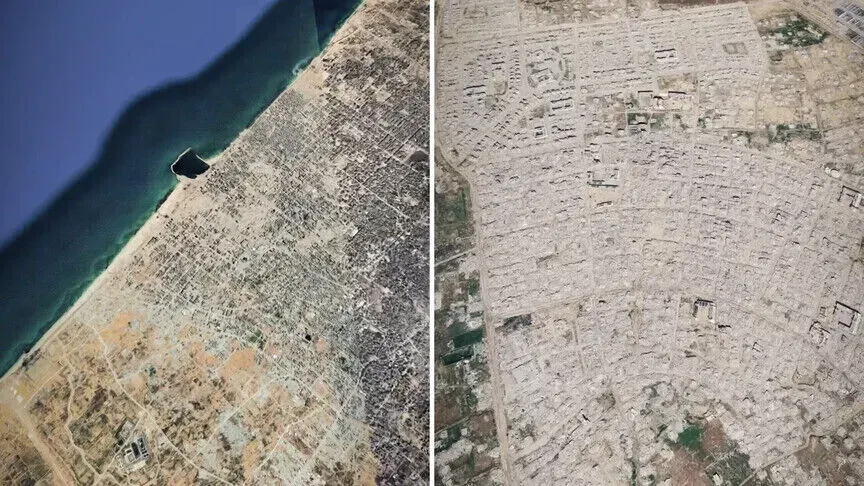
Ibtisam Malika's family in Zeitoun, east of Gaza City, has been uprooted again and again. "Every two to three months, we are forced to move and leave our belongings behind," she told UN News in September. "We can't take it anymore. We lost half of our children in the war, and only remnants of us remain." Safaa Mushtaha, who lives in neighbouring al-Tuffah, put the same experience as a question: "'Where do we go?' This is a question we've been asking ourselves for three years."
Tal as-Sultan, the western district of Rafah, is almost entirely gone from 2026 satellite imagery analysed by Al Jazeera. The 752-unit Saudi neighbourhood has been flattened. Five houses remain in the Swedish village on the coast. Along the Egyptian border the imagery shows Israeli military posts where streets used to be. North of Rafah, the coastal strip of al-Mawasi, sparsely populated before the war, is densely packed with tents.
UNOSAT, the UN satellite centre, counted 201,290 structures damaged across the Gaza Strip in imagery captured on 16 June 2026, about 82 per cent of all structures. Of those, 134,422 were destroyed. Israeli forces controlled about 53 per cent of the strip when the ceasefire took effect on 10 October 2025. By September 2026 the UN said Palestinians were left with less than 40 per cent.
Mahmoud al-Toubasi was on the road in the occupied West Bank, more than 100 kilometres north-east of Rafah, around midnight on 28 September. He had waited more than two months to go home. Israel's High Court had ordered the army to return his family to the hilltop house near the village of Jalud that settlers had driven them from in July. "My wife, my son and I went to the house in the car, accompanied by an army vehicle in front of us and another behind us," he told AFP. More than 100 Israeli settlers arrived. Within hours the family's homes were burning and the army said its mission to return them "was not completed."
Gaza's health ministry has recorded more than 74,000 people killed. The UN counted more than 1,600 settler attacks causing casualties or damage in the West Bank between 1 January and 14 September 2026, about 6.7 a day. UN Secretary-General António Guterres told a high-level meeting in New York on 22 September that "the conditions for an independent, democratic, contiguous, viable and sovereign Palestinian State are being systematically erased."
What the satellites show
UNOSAT put the number of housing units damaged at 328,627. The World Bank, European Union and UN rapid damage and needs assessment of April 2026 counted 371,888 housing units destroyed or damaged, estimated rubble at more than 60 million tonnes and priced recovery at $71.4 billion. A UNOSAT and UN-Habitat assessment found 68 per cent of the road network damaged by August 2024, including 1,190 kilometres destroyed.
Khan Younis lost Hamad City, the Qatar-funded estate of about 3,000 flats, to demolition, and the Sheikh Mohammed cemetery was replaced by an Israeli outpost, according to Al Jazeera's analysis of February 2026 imagery. Bani Suhaila, Abasan and al-Zana, home to about 120,000 people before the war, were largely emptied. In Jabalia and Beit Hanoun whole blocks have been reduced to rubble.
BBC Verify's radar analysis found more than 1,500 buildings destroyed behind the ceasefire line by November 2025, mainly in Khan Younis and Rafah. The Israeli military said it was dismantling "terror infrastructure, including tunnels." Prime Minister Benjamin Netanyahu said on Channel 12 on 28 May 2026 that Israel fully controlled 60 per cent of the strip and that he had directed the army to reach 70 per cent.
The "yellow line", set up after the Israel-Hamas ceasefire agreement of October 2025, splits Gaza into two zones. Most of the Palestinian population is confined to the western zone, and the eastern zone is under Israeli military control.
Israeli forces have gradually pushed the line inwards since it first left roughly 47 per cent of the Strip to the Palestinian population, according to the UN Office for the Coordination of Humanitarian Affairs (OCHA). Palestinians now live on less than 40 per cent of Gaza's land area, the UN said, and the advance has displaced many families living close to the line.
Mustafa Taym, 46, from Jabalia camp, told ABC in July: "The Yellow Line devours everything, leaving nothing but scorched earth."
A history that did not begin in October 2023
About 750,000 Palestinians fled or were expelled from their homes during the 1948 war that created Israel, the event Palestinians call the Nakba. Most of Gaza's 2.1 million people descend from those refugees. Israel occupied the West Bank, East Jerusalem and Gaza in 1967 and later annexed East Jerusalem, a step the UN Security Council declared null and void in 1980. Settlement followed across the occupied territory, where 700,000 to 775,000 Israeli settlers now live, depending on how East Jerusalem is counted.
Israel withdrew its settlers from Gaza in 2005 and, with Egypt, imposed a blockade after Hamas took control of the strip in 2007, keeping control of its airspace, sea, population registry and most crossings. Wars followed in 2008 and 2009, 2012, 2014 and 2021. The 2014 war killed 2,251 Palestinians, 1,462 of them civilians, and 73 people on the Israeli side, according to the UN inquiry that investigated it.
Hamas-led fighters broke through the Gaza fence on 7 October 2023 and killed about 1,200 people in Israel, most of them civilians, according to Israeli figures. They took 251 people hostage. Israel imposed a total siege on Gaza two days later. The ceasefire negotiated with US mediation took effect on 10 October 2025, and the last living hostages were released under it. OCHA reported on 25 September 2026 that 1,402 Palestinians had been killed in Gaza since the ceasefire.
The dead and the missing
Gaza's health ministry counted 74,016 people killed and 175,068 injured by 26 September 2026. Its list of identified dead, dated 7 May 2026, contained 72,835 names: 21,637 children, 29.7 per cent of the total, and 11,733 women. UNICEF counts at least 21,700 children killed. Gaza's Civil Defence estimates more than 8,000 people remain under rubble. Crews recovered more than 630 bodies and sets of remains between November 2025 and September 2026.
Fidaa Haji, 34, lost her husband, Adnan, and members of his family in Zeitoun. Their bodies have not been recovered. "I can't imagine that the people I love are still under the rubble... the thought alone breaks me every day," she told Al Jazeera in July. "What hurts me more than the loss is that I couldn't say goodbye or bury them." Civil Defence crews searching for the missing work with hammers and hand tools. "One of the hardest moments is when I'm holding only three or four bones of a human body and I go to hand them over to the family who had been waiting to find their son or daughter," Abdullah al-Majdalawi, the agency's director of public relations, told Al Jazeera. "Sometimes families tell us: bring us anything from them, any memory, any bone we can bury."
Israel has long said the ministry's figures cannot be trusted because the ministry answers to Hamas. Independent studies have found the count too low. A household survey of 2,000 families published in The Lancet Global Health estimated 75,200 violent deaths by 5 January 2025, 34.7 per cent above the ministry's figure for that date. The Max Planck Institute for Demographic Research estimated that deaths likely exceeded 100,000 by October 2025. An Israeli military official told Israeli reporters in January 2026 that the army's estimate was "around 70,000 Gazans" killed, excluding the missing. The army's spokesman said the reports did "not reflect official data."
A classified Israeli military database reported by +972 Magazine, Local Call and the Guardian in August 2025 listed about 8,900 named fighters as dead or probably dead when the ministry's total stood near 53,000, implying that about 83 per cent of the dead were civilians. The military said the figures were "incorrect." Israeli officials have publicly claimed 20,000 to 22,000 fighters killed.
The Committee to Protect Journalists counted 247 journalists and media workers killed in the war by 24 September 2026, 241 of them by Israeli fire, after a review that removed 22 names from its list. OCHA counted 593 aid workers killed by May 2026, including more than 390 staff of UNRWA, the UN agency for Palestinian refugees. Gaza's health ministry says more than 1,700 health workers have been killed.
Living in the ruins
UNICEF said in September that nearly 84 per cent of Gaza's population, more than 1.76 million people, "continue to live in overcrowded displacement sites or damaged and inadequate shelters." OCHA found 65 per cent of households in tents or makeshift shelters. The shelter cluster inspected 178,632 housing units and found 60 per cent severely damaged or destroyed, and only 627 had received basic repairs since January. About 2,000 to 3,000 of the 40,000 prefabricated units the UN said were needed had arrived by May 2026. The UN said in April that Israel was blocking durable shelter materials.
Winter storms in December 2025 and January 2026 tore through the camps. Omar Askar, a displaced father of three on the Gaza City seafront, told ABC in January: "The tent tore and collapsed, our belongings were thrown in the street. There's nothing to protect us now." Randa Hijazi said: "During storms, children freeze, especially newborns. Water comes from above and below." Ahmed Arhim, in Zeitoun, told UN News in September: "We don't sleep every night. The children can't sleep. They are scared and they wet themselves." UNICEF recorded at least 11 children dead of hypothermia. "At noon, it feels like hell here. The heat burns our skin," Mona al-Mallahi, 47, told Middle East Eye in July from a tent opposite the ruins of al-Azhar University. Rajaa Jendiya, a widow raising three children in a tent at a Gaza City school, told the same outlet that sewage overflows around the building "and many times my children have developed skin diseases."
WHO reported in February 2026 that about 18 of Gaza's 36 hospitals were partially functional and that it had recorded more than 930 attacks on health care. More than 18,500 patients were waiting for medical evacuation. Atef al-Hout, director of Nasser Hospital in Khan Younis, told The New Humanitarian in June: "Every single thing in the complex is a crisis. A shortage of just one item halts surgeries."
Save the Children found 97.5 per cent of school buildings damaged in August 2026. Palestine's education ministry says 63 university buildings have been destroyed. About 200,000 children had no access to structured learning in September, according to OCHA. A mother in Beit Lahiya told Al Jazeera of walking her seven-year-old daughter, Tulin, to a tent school within range of Israeli snipers: "Until my daughter gets to school, I honestly walk with my heart in my hand. If not for this situation, she would be in second grade now." Tulin said: "When I go to school, I am afraid of the shooting. I can't find a wall to hide behind so the shelling or stray bullets don't hit us." A boy named Ahmed, at the same school, said he keeps going because "I want to fulfil the dream of my martyred father, who wanted to see me become a doctor."
About 90 per cent of water systems are damaged, according to OCHA and WHO, and all six wastewater treatment plants are out of service, releasing more than 150,000 cubic metres of untreated sewage a day. UNICEF measured supply at about six litres per person per day in May 2026, below the emergency minimum of 15. UNESCO had verified damage to 164 cultural sites by March 2026, among them the Great Omari Mosque and the Church of Saint Porphyrius, where an Israeli strike on 19 October 2023 killed 18 people sheltering in the compound.
Hunger as a condition of war
Yoav Gallant, then defence minister, said on 9 October 2023: "I have ordered a complete siege on the Gaza Strip. There will be no electricity, no food, no fuel, everything is closed." Israel decided which goods could enter, inspected every truck and from May 2024 held the Rafah crossing with Egypt. It shut all crossings to aid from 2 March to 19 May 2025, saying Hamas had rejected an extension of the first ceasefire. WFP reported that all 25 bakeries it supported had closed by 31 March and that food prices had risen by up to 1,400 per cent.
The Integrated Food Security Phase Classification, the global hunger monitor, confirmed famine in Gaza Governorate on 22 August 2025, with 514,000 people in famine conditions, the first famine it had confirmed in the Middle East. Israel's foreign ministry said: "There is no famine in Gaza." Gaza's health ministry recorded 459 deaths from malnutrition, 154 of them children, by 23 October 2025.
Israel's main stated justification for restrictions was that Hamas stole aid. A US Agency for International Development review of 156 incidents of theft or loss found no evidence of systematic Hamas theft, Reuters reported in July 2025. The New York Times reported the same month that senior Israeli military officials said the army never found evidence that Hamas systematically stole UN aid.
The Gaza Humanitarian Foundation, an Israeli and US-backed operation, replaced about 400 UN distribution points with four militarised sites from 27 May 2025. OHCHR counted 1,373 Palestinians killed while seeking food by 31 July 2025, 859 of them near foundation sites. Soldiers told Haaretz in June 2025 of being ordered to fire on crowds. "It's a killing field," one said. The military said it "did not instruct the forces to deliberately shoot at civilians." Netanyahu and Defence Minister Israel Katz said the report contained "malicious falsehoods."
The IPC found in December 2025 that no area remained in famine. Its July 2026 update placed all five governorates in crisis and projected that 75,000 children would need treatment for acute malnutrition by April 2027. In September food parcels covered about half of minimum caloric needs for 730,000 people, OCHA reported. The UN counted an average of 94 trucks a day in the first days of the ceasefire against 600 agreed. COGAT, the Israeli body that controls the crossings, has said 600 to 800 trucks entered daily without publishing its method. Israel ordered 37 international aid groups, among them Médecins Sans Frontières, to stop work by 1 March 2026 under new registration rules. Aid groups said those organisations delivered all treatment for severe acute malnutrition.
FAO and UNOSAT found in imagery from 24 June 2026 that only 3 per cent of Gaza's cropland, 448 hectares, was both accessible and undamaged. In Rafah 97.2 per cent was out of reach. An OHCHR-led assessment in May 2025 found 94 per cent of trawlers destroyed and the catch at 7.3 per cent of pre-war levels. Suhaila al-Sultan, 52, a farmer from east Beit Lahia, told The New Arab of her plot: "This is not land for farming. This is space for survival."
The International Court of Justice advised on 22 October 2025 that Israel must ensure Gaza's population has food, water, shelter, fuel and medical supplies and must facilitate UN relief, including UNRWA's. It found Israel had not substantiated its claim that UNRWA was infiltrated by Hamas. Israel rejected the opinion.
Strikes on homes, camps and people seeking aid
Israeli troops on 29 February 2024 opened fire near an aid convoy at the Nabulsi roundabout in Gaza City. The health ministry counted 118 killed. Yehia al-Masri, a doctor who reached the scene, said he saw "dozens of dead and injured people lying on the street with gunshot wounds to the head, neck, and groin, who were soaked in flour and blood." Al-Awda Hospital reported that 142 of the 176 wounded it treated had gunshot injuries. The military said most victims were trampled and fewer than 10 were killed by its fire. CNN found that automatic fire began about seven minutes earlier than the military's timeline and that the military's drone video had been edited.
An Israeli strike on the Kuwaiti Peace Camp in Tal as-Sultan on 26 May 2024 killed at least 45 people as fire swept through tents, two days after the ICJ ordered Israel to halt its Rafah offensive. The military said it targeted two Hamas officials with "the smallest bombs we have" and suggested secondary explosions caused the blaze. CNN and the New York Times identified US-made GBU-39 bombs. Netanyahu said it was a "tragic mishap." On 13 July 2024 eight 2,000-pound bombs hit al-Mawasi, the zone Israel had designated as humanitarian, killing at least 90 people in an operation that killed Hamas military chief Mohammed Deif.
Israeli troops killed 15 medics and rescue workers of the Palestine Red Crescent, Civil Defence and the UN in Tal as-Sultan on 23 March 2025 and buried their bodies and vehicles in a mass grave. A phone video recovered from one of the dead showed marked ambulances with lights on under fire. Munther Abed, a Red Crescent volunteer who survived, told Drop Site News: "We were directly and deliberately shot at. The car is clearly marked with 'Palestinian Red Crescent Society 101.'" The military's inquiry cited "professional failures" and poor night visibility and dismissed a deputy battalion commander. On 25 August 2025 two strikes on Nasser Hospital, the second hitting rescuers, killed 22 people including at least five journalists, among them contributors to Reuters, AP and Al Jazeera. On 28 and 29 October 2025, after an Israeli soldier was killed in Rafah in an attack Hamas denied carrying out, strikes across Gaza killed 104 people including 46 children. "What kind of a ceasefire is this?" Amna Qrinawi said. "They burned children while they were asleep," Haneen Mteir said.
Israeli intelligence officers described the army's targeting methods to +972 Magazine and Local Call in April 2024. An AI system called Lavender marked about 37,000 Palestinians as suspected militants with a known error rate of about 10 per cent. Officers said it was permissible to kill 15 or 20 civilians for every junior Hamas operative and more than 100 for a senior commander. The military said AI was an "auxiliary tool."
Hind Rajab, five, was in a car in Gaza City with six relatives on 29 January 2024 when it came under fire. Her cousin Layan, 15, called the Palestine Red Crescent. "They are shooting at us. The tank is right next to me," she said, before gunfire cut her off. Hind, the only one left alive, stayed on the line for hours. "I'm so scared, please come. Come take me. Please, will you come?" she said. The Red Crescent sent an ambulance with two paramedics, Yusuf al-Zeino and Ahmed al-Madhoun. Twelve days later, after Israeli forces withdrew, her family found Hind, Layan and the paramedics dead, the ambulance destroyed a few metres away. Forensic Architecture counted 335 bullet holes in the car and placed Israeli tanks beside it. The blast at al-Ahli Arab Hospital on 17 October 2023 remains contested: Human Rights Watch found that evidence pointed to a misfired Palestinian rocket, and Forensic Architecture disputed that finding.
The genocide question: what has been found and by whom
Article II of the 1948 Genocide Convention defines genocide as any of five acts "committed with intent to destroy, in whole or in part, a national, ethnical, racial or religious group, as such." The acts are killing members of the group, causing serious bodily or mental harm, deliberately inflicting conditions of life calculated to bring about its physical destruction, imposing measures to prevent births and forcibly transferring children. The ICJ has held that intent inferred from conduct must be "the only inference that could reasonably be drawn." Article I obliges every state party to prevent genocide once it learns of a serious risk.
South Africa filed its case against Israel at the ICJ on 29 December 2023. On 26 January 2024 the court wrote that "at least some of the rights claimed by South Africa" were plausible, including "the right of the Palestinians in Gaza to be protected from acts of genocide." By 15 votes to two it ordered Israel to prevent acts under Article II, and by 16 to one to prevent and punish incitement to genocide and to enable aid. Joan Donoghue, who presided, told the BBC in April 2024 that the court "didn't decide... that the claim of genocide was plausible." On 28 March 2024 the court found that "famine is setting in" and unanimously ordered unhindered aid at scale. On 24 May it ordered Israel to halt its Rafah offensive insofar as it could inflict conditions of life that could bring about the group's destruction. None of these orders is a finding that genocide occurred, and all are binding. Israel filed its counter-memorial on 12 March 2026. South Africa's reply is due on 22 November 2027 and Israel's rejoinder on 22 May 2029.
The UN Independent International Commission of Inquiry on the Occupied Palestinian Territory found on 16 September 2025 that Israel had committed genocide in Gaza. "Israel has committed genocide against Palestinians in the Gaza Strip," the commission wrote. It found four of the five acts and concluded that intent to destroy was the only reasonable inference from Israel's conduct. It found that President Isaac Herzog, Netanyahu and Gallant had incited genocide. In June 2026 the commission, now chaired by Srinivasan Muralidhar, reaffirmed the finding in a report on children. "The evidence shows that Palestinian children have been deliberately targeted and killed by the Israeli security forces," Muralidhar said. Commissioner Florence Mumba said: "The deliberate targeting of children is one of the key elements establishing specific intent... to destroy the Palestinian group as such, in whole or in part in Gaza." Israel's mission in Geneva said: "Israel dismisses this libelous sham."
Francesca Albanese, the UN special rapporteur on the occupied territory, wrote in March 2024 that there were "reasonable grounds to believe that the threshold indicating that Israel has committed genocide has been met." The US government sanctioned her in July 2025. Amnesty International wrote on 5 December 2024 that "Israel has committed and is continuing to commit genocide against Palestinians in the occupied Gaza Strip," after reviewing 102 statements by Israeli officials. Human Rights Watch found in December 2024 that deliberate deprivation of water amounted to the crime against humanity of extermination and to an act of genocide, and said the policy "may amount to the crime of genocide." B'Tselem and Physicians for Human Rights Israel concluded in July 2025 that Israel is committing genocide in Gaza. Al-Haq, Al Mezan and the Palestinian Centre for Human Rights have alleged genocide since late 2023. The International Association of Genocide Scholars resolved in August 2025, with 86 per cent of voting members in favour, that Israel's conduct meets the legal definition.
Israel rejects the charge, and its lawyers told the ICJ in January 2024 that South Africa had presented a "grossly distorted factual and legal picture," that the war targets Hamas and that the statements South Africa cited were random remarks and not policy. The governments of Germany and the US have rejected the accusation. Israel and its defenders argue that evacuation orders, aid deliveries and Hamas's use of civilian areas mean destruction is not the only reasonable inference from its conduct. Sara Brown, a former board member of the genocide scholars' association, said its vote "was not transparent."
The International Criminal Court issued arrest warrants for Netanyahu and Gallant on 21 November 2024 for the war crime of starvation as a method of warfare and the crimes against humanity of murder, persecution and other inhumane acts. The chamber wrote that there were reasonable grounds to believe both men "intentionally and knowingly deprived the civilian population in Gaza of objects indispensable to their survival." The prosecutor did not seek a genocide charge. The Appeals Chamber upheld the admissibility of the case by three votes to two on 15 December 2025, and the warrants remain in force. Israel's challenge to the court's jurisdiction is pending.
The words investigators cited
Israeli ministers, legislators and officials made statements after 7 October 2023 that the ICJ, South Africa, the commission of inquiry, Amnesty and rights groups cited when assessing intent, or that other governments condemned. The ICJ quoted four of them in its January 2024 order. Several called for Gaza to be erased, burned or emptied of its people.
- Nissim Vaturi, deputy speaker of the Knesset, 7 October 2023: "erasing the Gaza Strip from the face of the earth" (South Africa's ICJ filing; AP)
- Yoav Gallant, defence minister, 9 October 2023: "complete siege... no electricity, no food, no fuel" (ICJ, CoI, Amnesty)
- Gallant, to troops on the Gaza border, 10 October 2023: "I have released all restraints... We are fighting human animals... We will eliminate everything" (ICJ, CoI)
- Isaac Herzog, president, 12 October 2023: "It is an entire nation out there that is responsible." (ICJ; CoI found incitement)
- Israel Katz, energy minister, 13 October 2023: "They will not receive a drop of water or a single battery until they leave the world." (ICJ)
- Ariel Kallner, Likud member of the Knesset, October 2023: "Nakba that will overshadow the Nakba of '48" (AP, PBS)
- Galit Distel-Atbaryan, Likud member of the Knesset, October 2023: "Erase Gaza from the face of the earth. Let the Gazan monsters rush to the southern border and flee into Egypt, or die." (Haaretz; post removed by X)
- Benjamin Netanyahu, prime minister, 28 October 2023: "You must remember what Amalek has done to you, says our Holy Bible. And we do remember." (South Africa, CoI, Amnesty)
- Amichai Eliyahu, heritage minister, 5 November 2023: Asked on radio whether a nuclear bomb on Gaza was an option: "That's one of the possibilities." (South Africa; suspended from cabinet meetings)
- Avi Dichter, agriculture minister, 11 November 2023: "We are now rolling out the Gaza Nakba." (South Africa)
- Itamar Ben Gvir, national security minister, 1 January 2024: The war was an "opportunity to concentrate on encouraging the migration of the residents of Gaza." (Condemned by the US State Department)
- Vaturi, January 2024: "Gaza must be burned... There are no innocents there." (Knesset Ethics Committee found no breach, May 2025)
- Bezalel Smotrich, finance minister, 5 August 2024: No one would let Israel cause two million people to die of hunger, "even though it might be justified and moral, until our hostages are returned." (Condemned by the EU, UK and Germany)
- Katz, defence minister, April 2025: "No one is currently planning to allow any humanitarian aid into Gaza, and there are no preparations to enable such aid." (Issued during the total blockade of 2 March to 19 May 2025)
- Smotrich, 6 May 2025: Gaza will be "totally destroyed" and its residents "totally despairing" and ready to leave for third countries (Speech to a settlement conference)
- Moshe Feiglin, Zehut party leader and former member of the Knesset, holding no office, May 2025, Channel 14: "Every child, every baby in Gaza is an enemy. The enemy is not Hamas... We need to conquer Gaza and colonise it." (UN Commission of Inquiry, June 2026)
- Katz, 7 July 2025: Plan for a "humanitarian city" on the ruins of Rafah to hold 600,000 people at first and eventually the whole population, as a step towards emigration (Former prime minister Ehud Olmert likened it to a concentration camp)
- Ben Gvir, August 2026: Said some Palestinians in Gaza were "not worthy of life" and "not even people" (Condemned by Guterres, Friedrich Merz and Jean-Noël Barrot)
Herzog, in his remarks of 12 October 2023, also said Israel was operating "according to rules of international law." Israel told the ICJ that "human animals" referred to Hamas. Netanyahu suspended Eliyahu from cabinet meetings. Katz's phrase "until they leave the world" is South Africa's translation from Hebrew, and other renderings exist. Israel's attorney general warned in January 2024 that calls to harm civilians could be criminal offences. The Knesset Ethics Committee ruled in May 2025 that Vaturi's repeated calls to burn Gaza did not breach its rules, and the attorney general declined to prosecute him. Feiglin held no office when he spoke. Before the war, on 1 March 2023, after settlers rampaged through the West Bank town of Huwara, Smotrich said: "I think the village of Huwara needs to be wiped out."
The West Bank: a measured escalation
OCHA said in its situation report of 18 September 2026 that there had been "more than 1,600 settler attacks resulting in Palestinian casualties, property damage or both" between 1 January and 14 September 2026, "averaging 6.7 attacks per day compared with five per day in 2025." The attacks hit 275 communities, close to the 279 affected in all of 2025. OCHA's annual totals rose from 1,291 in 2023 to 1,449 in 2024 and 1,835 in 2025. October 2025 was the worst month since OCHA began recording in 2006, with 264 attacks.
OHCHR counted 1,001 Palestinians killed in the West Bank between 7 October 2023 and mid-October 2025, 213 of them children and 968 of them by Israeli forces, 43 per cent of all Palestinians killed in the territory in 20 years. Oxfam, citing OCHA, counted 1,244 Palestinians killed in 2023, 2024 and 2025, against 1,036 in the 17 years from 2006 to 2022. Israeli forces and settlers killed 76 Palestinians, 18 of them children, between 1 January and 10 August 2026, the UN told the Security Council. Palestinian attackers also killed Israelis in the West Bank during the period, including a settler in the week of 15 September. Three sons of Um Muhammad Muammar, 72, were shot in settler attacks on Qaryut, and two died, Human Rights Watch reported. "I have known war in this region for all my life, but never like this," she told Human Rights Watch. "My sons' children are now fatherless; their wives are now widows."
More than 4,300 Palestinians have been displaced in the West Bank in 2026, more than 2,600 of them by settler violence and access restrictions, OCHA reported, and Israeli authorities demolished 1,164 Palestinian structures by mid-September. Operation Iron Wall, launched in January 2025, forced more than 33,000 people from the Jenin, Tulkarm and Nur Shams refugee camps. OHCHR reported in September 2026 that 33,362 were still unable to return and said the displacement raised concern of the "crime against humanity of forcible transfer." OCHA counted 925 checkpoints, gates and other movement obstacles in December 2025, up from 645 in 2023. At least 92 Palestinians died in Israeli custody between October 2023 and September 2026.
Abu Najjeh, the elder of the Bedouin community of Ein Samiya, has been expelled twice since 2023, first from Ein Samiya and then from the Area B land where the community sought refuge. "I'm afraid every night, every moment. They are right there. A kilometre, half a kilometre, three hundred metres," he told Al Jazeera in May. "The Nakba of 1948, the Nakba of 1967, the Nakba of 2023. This is the third Nakba."
Jalud, 29 September
The Tubasi family built two homes between 2017 and 2019 on a hilltop they own between Jalud and Qusra, south of Nablus, in Area B, where the Palestinian Authority is nominally responsible for civil affairs. Settlers pitched a tent beside the house on 19 April 2026. In June the access road was blocked and water and electricity were cut. "The first night the settlers came, they poured fuel on the doors of the houses, set them on fire," Mahmoud al-Toubasi told Ynet. He said settlers told the family: "We will burn you like the Dawabshe family." Settlers set fire to the Dawabshe home in Duma in July 2015, killing 18-month-old Ali Dawabshe and his parents. "No water, no flour, no rice. Nothing. Just my wife and me, and we are 60 years old," al-Toubasi said. "We knew it was over, and we left." The family walked away on 22 July. Settlers took over the house, Al Jazeera's Arabic service reported, and a Times of Israel liveblog reported that the homes were "taken over by settlers in July."
Israel's High Court, in a panel of President Yitzhak Amit and Justices Alex Stein and Yechiel Kasher, ruled on 6 September 2026 that the state must coordinate the family's return within 14 days with the army securing it, allow in repair equipment and restore water and electricity. The court said conditions were "very bleak" and that the "repeated incidents and their duration raised serious questions about the response by authorities." The Times of Israel reported that the ruling criticised Katz. Settler accounts published by J-Wire describe an eight-year dispute over the hilltop and contest the family's claim to it.
Civil Administration officials called the family around midnight on 28 September to say they could go home. Alerts on settler WhatsApp groups called on people to stop the return, the Times of Israel reported. The military said "more than 100 Israeli rioters were present in the village, blocking roads, setting tires on fire, and throwing stones at security forces." Palestinian sources told Al Jazeera and the Palestinian Information Centre that settlers set fire to the homes of Wael and Qais Tubasi and to the family's car. The homeowner told the Times of Israel, which named him as Mohammed, that his house was burned "completely" and that troops pulled the family into a military vehicle. Palestinian sources cited by Anadolu said Israeli forces protected the settlers and forced the family out "at gunpoint." The two accounts have not been reconciled. "We were not physically injured, but we suffered some choking from the pepper spray," Mahmoud al-Toubasi told AFP.
Three Border Police officers were lightly injured. Police arrested two settlers aged 15 and 17 overnight and an 18-year-old from Jerusalem the next morning, whose car held "balaclavas and a club." Netanyahu said: "I strongly condemn the violent riots in Samaria last night and the assault on the security forces." Herzog said the attack was "a moral stain" and "deeply contradictory to the values of Judaism." No named settler statement had been published by the time of filing. The same night in al-Mughayyir, north-east of Ramallah, settlers threw a Molotov cocktail through a window while a family slept and set fire to the home of a prisoner, Fikri Abu Alia, and two cars. Middle East Eye reported attacks near Beitunia without further detail. The state's response to the High Court is due on 8 October.
Settlers and the state
The commission of inquiry wrote in its June 2026 report to the UN Human Rights Council that settler violence "functions as a means of implementing Israeli State policy, with the State and violent settler groups and individuals working towards the same strategic objectives." It wrote that "Israeli authorities have enabled such attacks through financial and military support" and that "the army routinely accompanies settlers in attacks." It recorded a 130 per cent rise in settler attacks in 2025. The phrase "unprecedented and sustained," widely attributed to the commission, does not appear in the report text published by OHCHR. Ramiz Alakbarov, the UN deputy special coordinator, told the Security Council on 11 August 2026 that "settler violence has reached unprecedented levels."
The commission traced state money for farms and outposts through the Settlement Division of the World Zionist Organization. Human Rights Watch reported in August 2026 that the government approved 50 million shekels for outposts in March, that the settlement ministry's budget rose 122 per cent and that 248 new outposts had appeared under the current government, 65 of them in 2026. National Security Minister Itamar Ben Gvir's office said in September 2025 that about 230,000 new gun licences had been issued since late 2023. The commission wrote that thousands of settlers were armed "at the instruction of the Minister of National Security" and recruited into rapid response and regional defence units.
Yesh Din, an Israeli rights group, found that 93.6 per cent of police investigation files into settler violence from 2005 to 2025 closed without indictment and 3 per cent ended in conviction. Soldiers or police were present at 16 of about 30 organised mass attacks between 2023 and November 2025. Human Rights Watch found that one Israeli has been charged with killing a Palestinian in the West Bank since 2019.
E1, East Jerusalem and annexation by decision
Israel's cabinet approved 34 new settlements on 9 April 2026, its largest single batch, bringing the number approved by the current government to 103. Finance Minister Bezalel Smotrich, who also holds authority over civil affairs in the West Bank, said: "This is an historic decision... We are applying sovereignty in law and in practice." On 8 February 2026 the security cabinet extended Israeli civil and enforcement powers into Areas A and B and opened land registries to Israeli buyers. The UN special rapporteur said the decision amounted to "deliberate, incremental steps toward permanent annexation." The Knesset passed a preliminary reading of a sovereignty bill by 25 votes to 24 in October 2025. No formal annexation law has been enacted.
Smotrich announced on 14 August 2025 the approval of 3,401 housing units in E1, a 12 square kilometre area between East Jerusalem and the Ma'ale Adumim settlement. "This reality is what will permanently bury the idea of a Palestinian state, because there is nothing to recognise and no one to recognise," he said. Building in E1 would close the corridor between Ramallah, East Jerusalem and Bethlehem, cutting the northern West Bank from the south and East Jerusalem from both. About 3,700 Palestinians, most of them Bedouin, live in 18 communities in and around the area, including Khan al-Ahmar. A tender for the first 1,234 units was published on 18 August 2026. Peace Now says a planned Sovereignty Road, funded with 335 million shekels in March 2025, would allow Israel to close about 3 per cent of the West Bank to Palestinians.
Ir Amim, an Israeli group that monitors Jerusalem, reported in June 2026 that 33 Palestinian families, about 160 people, were evicted from the Batan al-Hawa area of Silwan in 18 months and that 17 homes in neighbouring al-Bustan were demolished in 2026. Peace Now counted 27,941 settlement housing units advanced in 2025.
What the law says and what has followed
The ICJ advised on 19 July 2024 that Israel's continued presence in the occupied Palestinian territory is unlawful and must end "as rapidly as possible," that settlement breaches Article 49 of the Fourth Geneva Convention and that all states must not "render aid or assistance" in maintaining the situation. The Fourth Geneva Convention prohibits collective punishment, forcible transfer and destruction of private property not required by military necessity. The Rome Statute lists an occupier's transfer of its own population into occupied territory as a war crime. The ICJ affirmed Palestinians' right to self-determination in 2004 and 2024.
The US has provided at least $21.7 billion in military aid to Israel since October 2023, according to Brown University's Costs of War project, and cast its sixth veto of a Gaza ceasefire resolution on 18 September 2025. Germany partially suspended arms exports in August 2025 and lifted the suspension in November. The Dutch Supreme Court ordered the government in October 2025 to reassess F-35 parts exports, and a British court dismissed a challenge to such exports in June 2025. Germany and Italy blocked a proposal in April 2026 to suspend the EU-Israel Association Agreement. Britain, France and Canada announced bans on goods from settlements on 8 September 2026, and Israel closed the British consulate in Jerusalem in response. Secretary of State Marco Rubio said: "Obviously, we're not going to do what the UK did." About 157 of the 193 UN member states recognise Palestine.
The US government has sanctioned ICC judges, both deputy prosecutors, the court's president and the Palestinian rights groups Al-Haq, Al Mezan and the Palestinian Centre for Human Rights. Middle East Eye reported that the ICC prosecutor's office filed a sealed application in April 2026 for a warrant against Smotrich on charges including forcible transfer and apartheid. Smotrich confirmed on 19 May that he had been told of it and said it was "a declaration of war." Israel's military prosecutors cancelled the indictment of five reservists in the Sde Teiman detainee abuse case on 12 March 2026, citing procedural difficulties. Israel dismissed two officers over the World Central Kitchen strike and one over the killing of the medics. No senior Israeli official has faced trial for conduct in Gaza or the West Bank.
Gaza, the West Bank and self-determination
Guterres said on 22 September that "we have witnessed policies and practices amounting to unlawful and invalid annexation" and that E1 "would deal a deathblow to the prospect of a contiguous and viable Palestinian State." In Gaza, 134,422 structures are destroyed, 3 per cent of cropland is accessible and undamaged and Israeli forces hold more than half the territory behind a line that has moved deeper into the strip since the ceasefire. More than 1.7 million people live in tents, damaged buildings or overcrowded sites, and 627 homes had received basic repairs by September.
The Board of Peace, the body set up under the ceasefire to oversee Gaza's reconstruction, presented a plan in New York on 23 September with an immediate budget of $2.4 billion, conditional on Hamas disarming, against assessed needs of $71.4 billion. Its high representative, Nickolay Mladenov, said "we are not bound by a calendar." Negotiations on the ceasefire's second phase have stalled over disarmament and Israeli withdrawal. Israeli fire killed 24 people in Gaza in the week to 23 September, OCHA reported. Edouard Beigbeder, UNICEF's regional director, said in August, after at least 300 children were reported killed in the ceasefire's first 300 days: "A ceasefire that leaves an average of one child dead each and every day is failing children."
West Bank settlement approvals under the current government have reached 103, and a tender for 1,234 homes in E1 is open. Settler attacks are about a third more frequent than in 2025's record year, 925 obstacles divide Palestinian towns and more than 33,000 refugees remain barred from their camps. Britain's foreign secretary, Ed Miliband, said on 8 September: "Today we refuse to be bystanders to further suffering and to the destruction of the two-state solution." OCHA recorded 185 settler attacks on 70 communities during the 2025 olive harvest. Israelis vote in a general election on 27 October.
The ICJ genocide case will not reach judgment before 2029. The ICC warrants for Netanyahu and Gallant have not been executed, and the US has sanctioned judges of the chamber that issued them and both deputy prosecutors. The olive harvest on which West Bank villages depend begins in October, and bids for the first 1,234 housing units in E1 are due on 19 October. The army's attempt to return the Tubasi family to their hilltop was not completed. "We thought the world would stand by us," Mahmoud al-Toubasi told Ynet after the family was driven out. "It turns out nobody cares about us."
More than 8,000 people remain under Gaza's rubble, by Civil Defence's estimate. Abdullah al-Majdalawi told Al Jazeera that his hardest moments come during downtime, "because that's when the voices of children under the rubble come back in my mind: 'Uncle, why did they kill us? Uncle, where are we?'"