Trump's naval blockade, declared hours after peace talks collapsed in Islamabad, doesn't just escalate the Iran war. It transforms a regional conflict into a direct challenge to every nation that refused to pick a side.
Donald Trump announced Sunday that the US Navy will begin blockading all ships attempting to enter or leave the Strait of Hormuz, hours after talks in Pakistan to end the Iran war ended without resolution. The declaration didn't come with a diplomatic note to allies which have been left out in the dark by the Trump administration. It came via Truth Social, in capital letters, and it takes effect immediately.
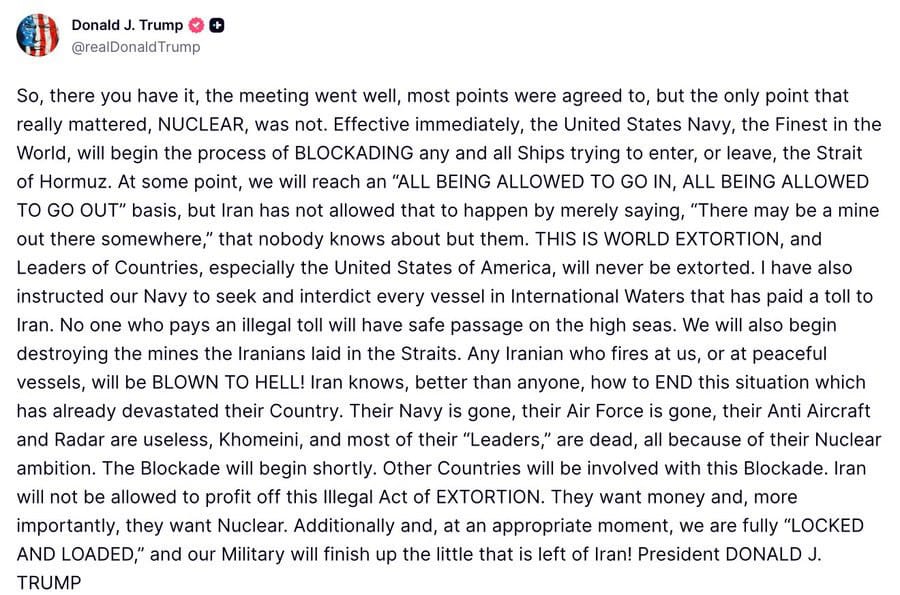
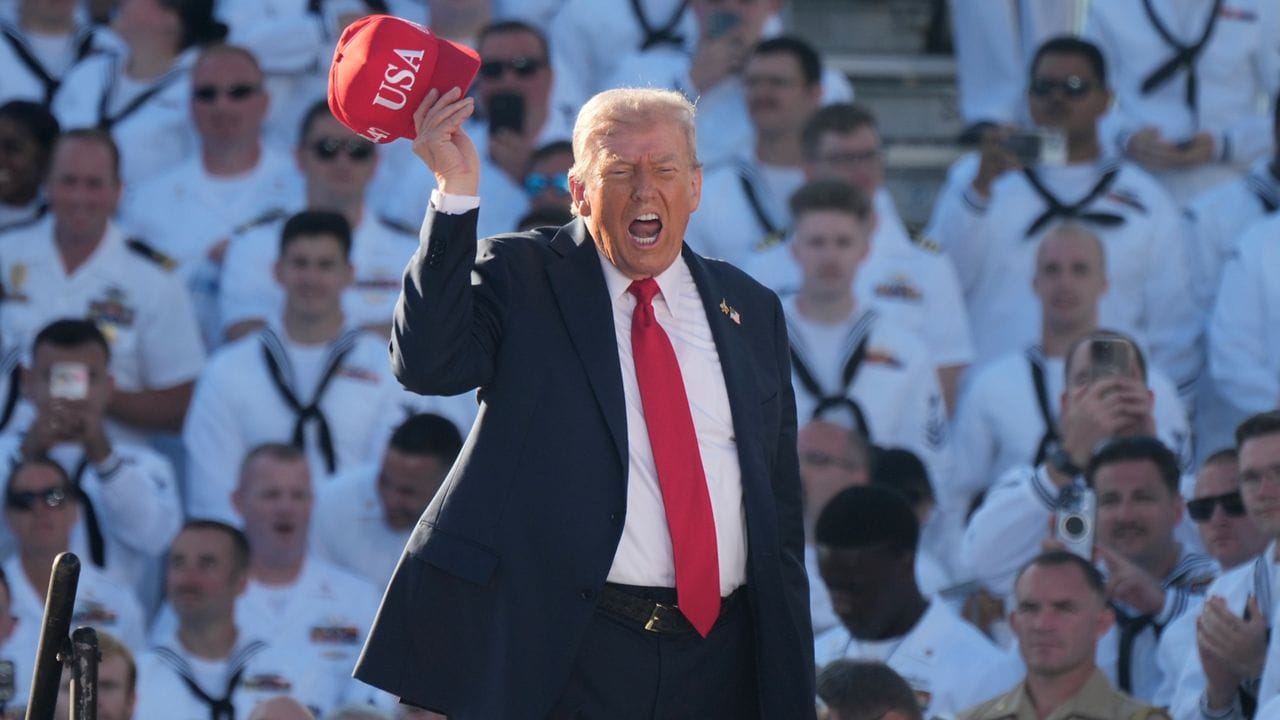
Trump, speaking on Fox News' Sunday Morning Futures with Maria Bartiromo, said the effort will be a "complete blockade" and "all or none," meaning no ship will be allowed to pass until Iran relents. He also said that any country, potentially including China, that assists Iran will be slapped with a 50 percent tariff. That is a direct rejection of the arrangement Iran had engineered over the preceding six weeks: selective passage for friendly nations, a toll system for others, and a wall for the US and its Western allies.
This is a breaking development with consequences that will unfold over days and weeks. What's already clear is that the geography of the crisis has shifted dramatically.
How We Got Here
Shipping traffic through the Strait of Hormuz has been largely blocked by Iran since 28 February 2026, when the United States and Israel launched an air war against Iran and killed Supreme Leader Ali Khamenei. In retaliation, Iran launched missile and drone attacks on Israel, US military bases, and US-allied Gulf states. The IRGC issued warnings forbidding passage, launched at least 21 confirmed attacks on merchant ships, and reportedly laid sea mines throughout the strait.
The human cost is already severe. On 1 March, the oil tanker Skylight was struck by a projectile north of Khasab, Oman, killing two Indian crew members and injuring three others. The MKD VYOM was struck by a drone boat, sparking a fire and explosion in its engine room. An Indian sailor was killed and 21 crew evacuated. These deaths have received relatively little international attention, crowded out by the strategic noise. They shouldn't be.
The restriction of shipments by more than 90 percent (around 10 million barrels per day) raised energy and agricultural input costs worldwide. Roughly 20 percent of the world's oil and natural gas normally passes through the strait, and disruptions caused Brent crude prices to jump 10 to 13 percent in early trading. Brent reached a 52-week high of $119.50 per barrel before pulling back after the ceasefire announcement. As of April 10 it trades at $95.20, still roughly 47 percent above where it sat before the war began.
A fragile two-week ceasefire announced on the night of April 7 offered a flicker of hope. Only a handful of ships transited the waterway since the truce took effect, with dozens of laden oil tankers amassing near the strait's southern entrance awaiting clarity on safe passage. Abu Dhabi National Oil Company CEO Sultan Al Jaber confirmed on April 9 that 230 loaded oil tankers remain trapped inside the Gulf.
The Talks That Failed and What Iran Wanted
The Islamabad negotiations were the highest-level direct US-Iran talks since the 1979 Islamic Revolution. The Iranian delegation arrived dressed in black, in mourning for Supreme Leader Khamenei and others killed in the war. It was a deliberate signal about how Tehran frames the conflict, and it set the tone for what followed.
After 21 hours of face-to-face talks, Vice President JD Vance told reporters that an agreement was not reached. "We've had a number of substantive discussions with the Iranians. That's the good news. The bad news is we have not reached an agreement," he said. "They have chosen not to accept our terms." He added that the US required a firm commitment that Iran would not seek a nuclear weapon, and that it had not received one.
Iran arrived in Pakistan presenting four conditions it described as non-negotiable: full sovereignty over the Strait of Hormuz, complete war reparations from the United States, unconditional release of frozen Iranian assets abroad, and a region-wide ceasefire encompassing Lebanon. These were not opening bids. Iran's refusal to separate Lebanon from the Hormuz question gave the US and Israel, who reject any linkage between the two theatres, no obvious path forward.
Iran's Foreign Ministry spokesman Esmaeil Baghaei confirmed on X that the two sides discussed the Strait of Hormuz, the nuclear issue, war reparations, lifting of sanctions, and a complete end to the war. Trump claimed "most points were agreed to" but said the nuclear question was the only one that really mattered: "IRAN IS UNWILLING TO GIVE UP ITS NUCLEAR AMBITIONS."
Mohammad Bagher Ghalibaf, speaker of Iran's parliament and head of its delegation, said his negotiators raised "forward-looking" initiatives during the talks but that the US failed to gain the trust of the Iranian delegation. Tehran's tone was not that of a side that felt it had lost. That confidence is rooted in the fact that Iran's leverage over the strait remains largely intact, even after six weeks of US airstrikes.
Al Jazeera's correspondent characterised the outcome as "neither a breakthrough nor a breakdown," noting that talks can continue remotely and that Vance's departure may be a hard stance rather than a final door-closing. Iran's Foreign Minister Araghchi has separately stated his intention to speak with European counterparts in Berlin, Paris, and London.
The Blockade's Real Target Isn't Just Iran
Iran had built a selective passage system. Ships from China, Russia, India, Iraq, Pakistan, and later Malaysia, Thailand, and the Philippines were granted access. Iran set up its own shipping channel north of Larak Island. One ship paid $2 million to use it. According to Lloyd's List, payments were being assessed by the IRGC in Chinese yuan. Analysts confirmed the IRGC has imposed a de facto toll booth regime in the strait, requiring vessels to submit full documentation, obtain clearance codes, and accept IRGC-escorted passage through a single controlled corridor.
Iran wasn't just controlling oil flow. It was running a parallel financial architecture denominated in the currency of its most important partner, while simultaneously demonstrating that the US dollar couldn't guarantee safe passage in one of the world's most critical waterways. Wall Street warned this would threaten US dollar dominance in global trade.
Trump's blockade is designed to end that arrangement. "It's going to be all or none," he told Fox News, referring to Iran's practice of granting passage to friendly nations like China and India while blocking others or charging tolls of up to $2 million. Chinese, Indian, and Pakistani ships have been among the few to transit the strait under deals with Tehran, meaning Trump's interdiction order could put the US on a collision course with every nation that depends on Iran for oil access. Iran has also indicated it intends to make the toll a permanent feature of any peace arrangement.
China: Intelligence Frictions, Tanker Risk, Delayed Visit
In 2024, an estimated 84 percent of crude oil shipments through the strait were destined for Asian markets. Roughly 45 to 50 percent of China's crude oil imports transit the Strait of Hormuz. China holds around a billion barrels in reserve, which buys it time but not indefinitely.
Despite that exposure, Beijing refused to join any US-led coalition or take sides openly. China adopted a strategy of securing passage through bilateral channels. But the relationship is becoming harder to manage. China is suspected of supplying Iran with shoulder-fired anti-aircraft missiles, according to a New York Times report citing US intelligence officials, though the report noted the shipment had not been confirmed as delivered or used against US or Israeli forces. Trump warned on Saturday that China would have "big problems" if confirmed.
Trump had already delayed a planned visit to Beijing because of the Iran conflict. The blockade announcement could delay it further, with the visit now set for mid-May. Beijing has invested considerable political capital in keeping that summit on track. China's Foreign Ministry spokesperson said the two countries are "maintaining contact over President Trump's visit," adding that "head of state diplomacy plays an irreplaceable role in the strategic guidance of China-US relations." That framing, placing the summit above the immediate crisis, reflects Beijing's preference: preserve the long game, avoid a direct confrontation in the strait.
What happens when a US destroyer intercepts a Cosco tanker is a question nobody wants answered. Beijing has invested years in proving it doesn't need to fight the US over proximate military confrontations. It has also invested years in the symbolism of the yuan-denominated oil trade. Walking away from Chinese vessels in the strait is domestically humiliating. Confronting the US Navy there is existentially dangerous. The arms intelligence story, if confirmed, complicates Beijing's ability to present itself as a neutral party.
India: Dead Sailors, Two Parallel Operations, No Clean Exit
India's position is arguably more exposed than China's, and more incoherent. New Delhi maintained its strategic autonomy posture, neither endorsing the US-Israeli air campaign nor condemning it loudly. That ambiguity bought access.
Iran confirmed it had allowed some Indian vessels to pass through the strait. Two Indian-flagged tankers carrying liquefied petroleum gas bound for ports in western India had safely crossed. Between 14 and 24 March, five Indian-flagged LPG carriers were evacuated from the strait in three separate incidents and escorted by Indian Navy warships through the Gulf of Oman under Operation Sankalp.
That was the emergency phase. Since then, the Indian response has grown considerably. The Indian Navy launched Operation Urja Suraksha, deploying more than five frontline warships to escort 22 high-priority India-bound vessels carrying crude oil, LNG, and LPG. Multiple vessels have successfully crossed the strait under naval escort, including tankers navigating close to the Iranian coast between the islands of Larak, Qeshm, and Hormuz. As of April 9, 16 to 17 Indian-flagged vessels and approximately 460 Indian seafarers remain in the western Persian Gulf. India has explicitly stated it will not join any US-led naval coalition in the strait.
Indian sailors have been killed in at least three separate attacks on commercial vessels. The Indian Navy has been operating in a combat-adjacent environment for six weeks without India officially being at war with anyone. The US blockade ends India's bilateral passage arrangement with Iran. If Indian-flagged vessels try to transit under prior Iranian clearance, they now face both an IRGC that controls one shore and a US Navy with orders to stop them. New Delhi will have to choose a lane, and there isn't a good one.
Europe's Refusal and Its Costs
When Trump called on countries to militarily reopen the strait on 15 March, several US-aligned nations rejected the request, including Germany, Spain, Italy, Estonia, the UK, Australia, South Korea, and Japan, as well as the European Union. German Defence Minister Boris Pistorius dismissed Trump's request: "What does Trump expect a handful or two handfuls of European frigates to do in the Strait of Hormuz that the powerful US Navy cannot do? This is not our war; we have not started it."
That response was defensible in mid-March. It becomes harder to sustain now.
On 19 March, France, Germany, Italy, the Netherlands, the United Kingdom, and Japan announced in a joint statement that they are ready to participate in efforts to reopen the strait. The statement was joined by the UAE, Bahrain, Canada, South Korea, New Zealand, Denmark, Latvia, Slovenia, Estonia, Norway, Sweden, Finland, Czech Republic, Romania, Lithuania, and Australia by 21 March. Their preference was clear: wait, build consensus, operate under international mandate. The ceasefire came. The talks collapsed. The US acted unilaterally. That framework is already obsolete.
France's position deserves particular scrutiny. A French ship crossed the Strait of Hormuz on 3 April, apparently with Iranian permission, suggesting Paris was quietly negotiating its own bilateral access even as it publicly backed multilateral approaches. That arrangement is also now void.
The UNSC route is firmly closed. Russia and China vetoed the Bahrain-proposed resolution on April 7, just hours before Trump's 8 p.m. deadline for Iran to reopen the waterway. The vote was 11 in favour, two against, with abstentions from Pakistan and Colombia. The initial proposal had authorised "all necessary means" to ensure transit. It was progressively stripped of references to offensive action, Security Council authorisation, and adjacent waters, and Russia and China vetoed it anyway. US Ambassador Waltz said: "No one should tolerate that they are holding the global economy at gunpoint, but today, Russia and China did tolerate."
The UK and at least two other countries are now sending minesweepers to assist the US, the most concrete allied commitment yet, announced by Trump on Sunday morning. It is a narrow contribution, focused on mine-clearing rather than ship interdiction, and was not accompanied by any broader commitment to enforce the blockade.
The Mines Problem
One detail continues to be underreported. According to one report, Iran lost track of mines it planted in the Strait of Hormuz and is therefore unable to fully open the strait even if it wanted to. This has a direct bearing on the ceasefire's credibility: Iran can't simply agree to reopen the waterway and make it happen.
US Central Command said two destroyers, the USS Frank E. Peterson and USS Michael Murphy, began setting conditions for clearing mines on Saturday, with underwater drones joining the effort. In the short term, it is possible to escort three to four commercial ships a day with seven to eight destroyers providing air cover, depending on the risk from Iranian midget submarines. Doing so sustainably for months requires significantly more resources.
The mine-clearance operation and the blockade are happening simultaneously in a 34-kilometre-wide channel contested by IRGC fast boats, drones, and shore-based anti-ship missiles. Iran's Revolutionary Guard insists the strait is open for civilian vessels, but says military ships "will be dealt with severely." That is a direct threat to US mine-clearance vessels operating under military command.
Pakistan: From Pariah to Mediator
One development running beneath the main story deserves attention in its own right. Pakistan's mediating role represents a remarkable transformation for a nation that was a diplomatic outcast a year ago. The Islamabad lockdown for the talks, with thousands of paramilitary personnel and army troops on the streets, reflected the weight Pakistan's government placed on its role as host. Army chief Field Marshal Asim Munir, who has a close relationship with Trump, was central to bringing both sides to the table. Foreign Minister Ishaq Dar, after the talks ended without a deal, urged both sides to continue upholding their commitment to the ceasefire and said Pakistan would continue to facilitate engagement, signalling Islamabad's intention to remain in the game regardless of Sunday's outcome.
The Price Is Paid in Khartoum, Dhaka, and Kabul
There are two separate crises unfolding here, and the second one is moving slower and will last far longer than the first.
The immediate disruption is logistical. As US Ambassador Waltz told the UN Security Council on April 7, 80 UN and international humanitarian organisations delivering medical aid, shelter, supplies, and food to crises in the Congo, Sudan, and Gaza cannot pass through the strait. That figure covers groups working in some of the worst humanitarian environments on earth. The World Food Programme says 10,000 tonnes of food meant for hundreds of thousands of children in Afghanistan has yet to arrive. The World Health Organisation has been held up in sending a $6 million shipment of medicine to Gaza. Save the Children warns that 90 primary health care facilities in Sudan could be left without essential supplies. These aren't projections. They're already happening.
The International Rescue Committee has reported that approximately $130,000 worth of pharmaceutical supplies intended for its humanitarian response in Sudan are currently stranded in Dubai. What the dollar figure obscures is what those supplies mean in practice: medications that don't arrive on time in a conflict zone aren't delayed, they're lost.
The workarounds are expensive, slow, and expose just how much of the global aid architecture was quietly built around the assumption that the Strait of Hormuz would always be open. WFP has been rerouting Afghanistan-bound aid from Dubai overland through Saudi Arabia, Jordan, Syria, Turkey, Azerbaijan, and Turkmenistan, adding roughly €1,000 per tonne and three additional weeks in transit time. WFP's Director of the Global Supply Chain Support Centre put it plainly: "What's happening now is on par with COVID-19 and the Ukraine war. It's a global supply chain disruption, not a localized issue."
WFP has already been forced to suspend assistance for 135,000 Syrian refugees in Jordan and halt support for 250,000 Sudanese refugees in Egypt due to funding shortfalls compounded by the crisis. In Gaza, the price of flour in the local market has increased by 270 percent. WFP is now being forced to consider reducing food rations to approximately 25 percent of an individual's daily needs.
UN Under-Secretary-General for Humanitarian Affairs Tom Fletcher warned in early March that humanitarian supplies now face potential six-month delays, that food prices will rise, health systems will be squeezed, and that crises from the DRC to Sudan to South Sudan will slip further down the list of global priorities. He noted the war is reportedly costing $1 billion a day in destruction while aid budgets are being cut. The compounding logic of that is brutal.
The second crisis is agricultural, and its effects will take months to arrive but are already locked in. It begins with a fact that rarely makes the lead paragraph of any oil story: the Strait of Hormuz carries an estimated 30 to 40 percent of the world's traded nitrogen fertilizers. Nitrogen fertilizer is the foundation of modern crop yields. Without it, harvests fall. The strait isn't just an oil pipeline. It's a food pipeline, and it's been closed since late February.
Natural gas determines 70 to 90 percent of the cost of producing nitrogen fertilizer. Gas production in the region has seen a 20 percent decline due to the war, and prices have risen by up to 70 percent. In response, Russia has suspended exports of ammonium nitrate, and China, the world's largest phosphate producer, has blocked phosphate exports, removing roughly 25 percent of global supply. Those two decisions, taken by governments protecting their own domestic agricultural positions, have amplified a disruption that was already severe.
The FAO's chief economist has said that Middle East granular urea prices rose 19 percent in the first week of March alone, while Egyptian urea prices surged 28 percent. FAO projects global fertilizer prices could average 15 to 20 percent higher across the first half of 2026 if the crisis persists. By late March, urea prices had already risen 50 percent since the conflict began. In the US, some fertilizers rose more than 40 percent in just one month after the war's start.
The timing is the specific cruelty. The FAO has predicted no more than a three-month window for action before risks escalate significantly, affecting global planting decisions for 2026 and beyond. That window opened in late February. It closes soon. Countries currently in the most acute danger include Sri Lanka, where the Maha rice harvest is underway; Bangladesh, in its critical Boro rice season; India, facing reduced domestic fertilizer production ahead of the Kharif monsoon planting season; and Egypt, highly exposed through reliance on wheat imports. In Sub-Saharan Africa, Somalia, Kenya, Tanzania, and Mozambique face particular exposure due to their high dependence on Middle Eastern fertilizer imports.
The transmission from fertilizer shortage to empty plate is direct and fast. A farmer in Thailand who is 90 percent import-dependent, buying urea made from gas, shipped through Hormuz, and priced in strengthening dollars, faces a cost shock on every dimension simultaneously. Multiply that farmer across South and Southeast Asia, sub-Saharan Africa, and Latin America and the scale becomes clear. Malawi gets over 60 percent of its fertilizer from the Persian Gulf region. Brazil imports approximately 85 percent of its fertilizer and accounts for more than 50 percent of global soybean exports. India is the world's largest rice exporter. When input use declines in these countries, the consequences extend across all borders, tightening global supply and amplifying price volatility.
WFP's modelling, based on sustained oil prices above $100 per barrel, projects that almost 45 million more people could fall into acute food insecurity by mid-year if the conflict does not end. West and Central Africa could see a 21 percent increase in food-insecure people. East and Southern Africa face a 17 percent rise. Asia faces a projected 24 percent increase. Sudan, which imports around 80 percent of its wheat, is particularly exposed. Somalia, already contending with severe drought, has seen prices for some essential commodities rise at least 20 percent since the conflict began.
These projections were made before Trump's blockade announcement this morning. They were based on the closure that already existed. A US naval blockade that extends the disruption shifts every one of these numbers upward. The FAO's three-month window for action, already partially elapsed, is now a countdown that runs alongside the blockade with no visible mechanism to stop both clocks at once. The world spent fifty years building strategic oil reserves for exactly this kind of scenario. It spent zero years building fertilizer reserves. That gap in preparedness, invisible in peacetime, is now visible in the form of a farmer in Malawi watching input prices rise beyond what he can afford to pay, a week before the planting window closes.
What Happens Next
Three scenarios are live, and they're not mutually exclusive.
If Iran blinks and agrees to full, unilateral reopening without tolls or controls, the US blockade achieves its objective. Every analyst tracking this conflict rates this as the least likely short-term outcome. Iran's deputy parliamentary speaker Ali Nikzad said in the 40 days of war, the US has "learned that the victorious side is determined by the will of nations and superiority on the battlefield, not by rhetoric on social media." That framing, offered hours after the talks collapsed, doesn't suggest a side preparing concessions.
If the US and Iran reach a negotiated arrangement after further pressure, the blockade becomes leverage rather than a terminal state. Vance kept that door open: "We leave here with a very simple proposal, a method of understanding that is our final and best offer. We'll see if the Iranians accept it." But Iran has now watched Trump issue and delay multiple deadlines without consequence. Its willingness to treat this blockade as a genuine ultimatum is limited. Senator Mark Warner put the central problem bluntly on CNN: "I don't understand how blockading the strait is somehow going to push the Iranians into opening it."
The third scenario is the one nobody wants to name. US intelligence agencies suspect China may be supplying Iran with advanced weaponry. Trump has threatened a 50 percent tariff on any country that assists Iran. If a US destroyer stops a Chinese tanker, or if the IRGC fires on US mine-clearing vessels, the conflict's geography expands in ways that no ceasefire framework covers.
China has not responded officially to Sunday's blockade announcement. Trump's Beijing visit, now set for mid-May, could be delayed further. How Beijing responds to the blockade, and whether it chooses to test it with a Cosco tanker, may determine whether this remains a US-Iran confrontation or becomes something considerably larger.
This story will be updated as developments continue. The conflict has now entered its forty-fourth day. Updated 2026-04-12: Added context and details of how the blockade is affecting the most vulnerable worldwide.