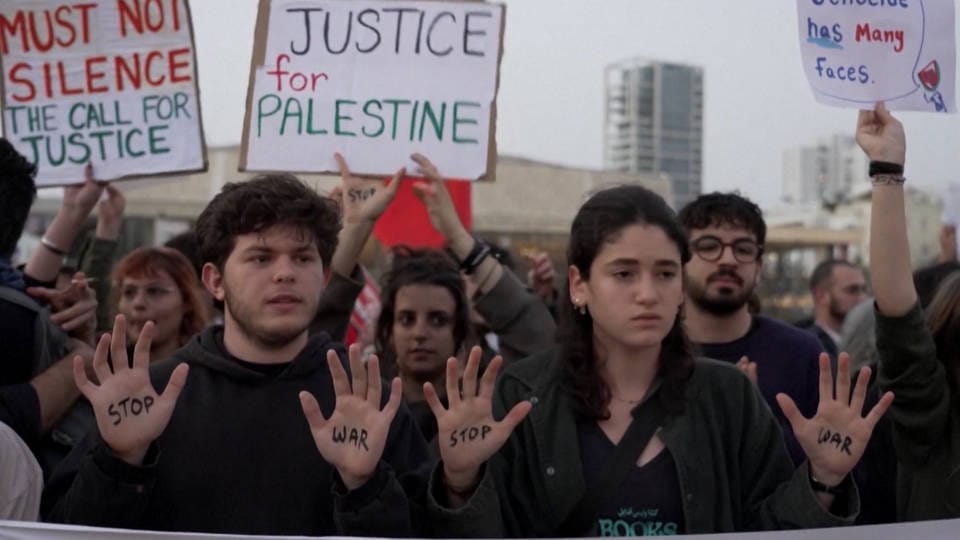
Israel's High Court authorised the demonstration. Police dispersed it anyway.
Israeli police forcibly dispersed an antiwar demonstration in Tel Aviv this week, arresting 17 people. The protest had been explicitly authorised by Israel's High Court of Justice. Police dispersed it anyway, violating the Israeli constitution and international law.
The demonstration was part of a sustained antiwar movement inside Israel that has grown in visibility over the past year, drawing together hostage families demanding a ceasefire deal, civil society organisations, and citizens across the political spectrum who oppose the continuation of military operations in Gaza. Protestors demand an end to the multi-front Israeli war against Gaza, Iran, and Lebanon. The movement has faced repeated restrictions on assembly, permit denials, and police interventions.
The Judicial Override
This is not the first time tensions between Israel's judiciary and its current governing coalition have surfaced in acute form. The 2023 judicial reform crisis, which drew hundreds of thousands of Israelis into the streets over months, centred precisely on the question of whether the legislature could strip the Supreme Court of its ability to override government decisions. That crisis was ultimately suspended rather than resolved. The events in Tel Aviv this week sit inside that unresolved constitutional tension.
Rights advocates have noted that the pattern being established, in which security forces treat court authorisation as advisory rather than binding when it comes to political demonstrations, creates a precedent with implications well beyond this particular protest. If the court's authorisation of an assembly can be overridden on the day by a police commander's assessment of public order, the right to demonstrate in Israel becomes dependent not on legal protection but on executive discretion. Those are categorically different things.
Antiwar Dissent Inside Israel
The international coverage of the Gaza genocide has, with some notable exceptions, struggled to represent the full spectrum of political opinion inside Israel. The existence of a sustained, organised, and publicly visible antiwar movement within the country complicates narratives that frame Israeli society as monolithically supportive of the military campaign and genocide.
Demonstrators have faced permitting obstacles, police intervention, and in some documented cases, harassment by violent counter-protesters. Certain forms of speech about the conflict have been prosecuted under Israeli security legislation in ways that civil liberties organisations have described as politically selective. Several Israeli academics and journalists who have publicly criticised the conduct of military operations have faced professional consequences, criminal complaints, or both.
The 17 people arrested in Tel Aviv this week join a growing list of Israeli citizens who have faced legal consequences for antiwar activities. Their cases are, in the first instance, a domestic Israeli civil liberties matter. They are also, given the international legal context in which the Gaza genocide is being examined, a data point in a broader evidentiary picture about the conditions under which dissent operates inside Israel during wartime. Hostage families have been among the most prominent voices in the antiwar movement, arguing that continued military operations reduce rather than increase the chances of their relatives being returned alive. Their participation in demonstrations gives the movement a political character that is difficult to dismiss as external or ideologically marginal.
The International Legal Framework
The right to peaceful assembly is protected under international human rights law, specifically Article 21 of the International Covenant on Civil and Political Rights, to which Israel is a state party. The UN Human Rights Committee's General Comment 37, adopted in 2020, establishes that states may impose restrictions on assemblies only where those restrictions are necessary, proportionate, and non-discriminatory. The dispersal of a demonstration that a state's own supreme court has authorised does not meet any of those criteria.
Rights defenders have identified the arrests as appropriate for documentation and submission in Israel's Universal Periodic Review before the UN Human Rights Council. The UPR is a peer review mechanism through which all UN member states are assessed on their human rights record at regular intervals. Israel's most recent UPR cycle produced recommendations on freedom of assembly and the treatment of civil society that the government accepted in partial or full terms. The gap between those accepted recommendations and the events in Tel Aviv this week is precisely the kind of implementation failure the UPR mechanism is designed to surface.
Separately, the Special Rapporteur on the rights to freedom of peaceful assembly and of association holds a UN mandate to document and report on exactly this category of incident. Communications to the Special Rapporteur's office from civil society organisations documenting the Tel Aviv arrests would, under standard mandate procedures, result in an official communication to the Israeli government requesting a response.
The European Court of Human Rights has no direct jurisdiction over Israel, which is not a Council of Europe member state. However, comparative jurisprudence from the ECHR on the dispersal of lawful assemblies, developed extensively in cases involving Turkey, Russia, and other states, provides a normative benchmark against which Israeli practice can be assessed and which European institutions regularly apply in their human rights reporting.
EU Policy Obligations
The European Union's relationship with Israel is governed by the EU-Israel Association Agreement, which includes an Article 2 human rights clause conditioning the partnership on respect for democratic principles and fundamental rights. That clause has been invoked with varying degrees of seriousness over the years. It has not, to date, been invoked in response to the Gaza genocide or the domestic civil liberties conditions associated with it, despite formal calls from civil society organisations and some members of the European Parliament to initiate a review.
The EU has designated the protection of civil society space as a priority in its democracy and human rights external action framework. The European Instrument for Democracy and Human Rights funds work in third countries precisely to support the conditions under which protest, journalism, and civic advocacy can operate freely. The tension between that framework and the EU's continued full operation of trade, research, and diplomatic agreements with Israel, without conditioning them on measurable benchmarks, has become a recurring point of contention in European Parliament debates.
Several EU member states maintain their own bilateral human rights dialogues with Israel. The content of those dialogues, and whether they have addressed the conditions facing antiwar protesters inside the country, is not publicly available in most cases. Advocates have called for those dialogues to be conducted with greater transparency and for their outcomes to be reported to the European Parliament's Foreign Affairs Committee.
The EU's own internal coherence on this question is imperfect. Member states hold divergent positions on the Gaza genocide and on how forcefully European institutions should engage with Israel on human rights. Germany, France, and the Netherlands have taken different public positions on arms transfers and diplomatic pressure. That divergence has consistently prevented the EU from speaking with a single, enforceable voice, a dynamic that Israeli authorities have, in the assessment of several European diplomats speaking on background, factored into their calculus about international consequences.
Canada's Position
Canada's formal policy on the Gaza genocide has evolved since October 2023, moving from early declarations of unconditional support through a series of adjustments, including a pause on some arms export permits, that reflected both domestic political pressure and changing conditions on the ground.
The treatment of antiwar protesters inside Israel falls within the human rights scope that Global Affairs Canada is mandated to monitor in countries with which Canada maintains close bilateral ties. Canada is an active participant in the UN Human Rights Council and co-sponsors resolutions on freedom of assembly in numerous country contexts annually. Whether those commitments extend consistently to Israel, including in respect of the events this week, is a question that civil society organisations in Canada, including those representing Jewish diaspora communities with a range of views on the conflict, have begun to press more explicitly.
Canada's large and politically engaged Jewish diaspora includes communities with divergent perspectives on the Israeli government's conduct. Organisations representing Israelis and Israeli-Canadians opposed to the current government's policies have become more vocal in calling on Ottawa to distinguish between criticism of a specific government's conduct and any broader judgment about the legitimacy of Israeli civil society. The argument, made with increasing sophistication by diaspora groups across Canada and Europe, is that supporting antiwar voices inside Israel is not a hostile act toward Israel. It is a recognition of Israeli democracy's internal complexity and a form of solidarity with the citizens being arrested for exercising it.
The Domestic Politics of Dissent in Wartime
There is a long and difficult history of democratic governments suppressing antiwar dissent during military operations, invoking national security, social cohesion, or the welfare of troops as justifications. That history includes democracies that are not Israel, and it includes periods that are now assessed critically by the countries that lived through them.
The specific conditions of the Gaza genocide make the domestic dissent question more acute than it might otherwise be. The International Court of Justice's provisional measures ruling, the International Criminal Court's arrest warrant proceedings, and the volume of documentation assembled by UN bodies, NGOs, and investigative journalists have collectively produced an international legal and political environment unlike any that has surrounded a previous Israeli military operation. Domestic dissent inside Israel, including the protests that were dispersed this week, exists in conversation with that international environment. Citizens who oppose the conduct of the war are doing so with awareness of what is being documented and adjudicated externally.
The government's decision to suppress that dissent, including in defiance of its own supreme court, is therefore not only a domestic civil liberties question. It is also a signal about how the current Israeli government assesses the relationship between internal accountability and external pressure. Governments that restrict domestic criticism during periods of intense international legal scrutiny are not, historically, the ones that emerge from such periods with their institutional credibility intact.
What the Arrests Represent
Seventeen people arrested at a protest their own country's highest court said could proceed.
Each of those 17 arrests is a legal case that will move through Israel's court system, generating documentation, hearings, and potentially rulings that will themselves become part of the record of this period. The lawyers who represent them, the judges who hear their cases, and the organisations that document their treatment will collectively contribute to an evidentiary archive that exists independently of the political positions of any party.
Rights organisations working on freedom of assembly in Israel have called for the documentation to be comprehensive and the legal challenges to be pursued through every available domestic and international avenue. The logic is straightforward. Accountability for the suppression of lawful protest, like accountability for other human rights violations, begins with preservation of the record. The record, in Tel Aviv this week, was made in public.
For advocates in the EU and Canada, the immediate available action is to support the organisations doing that documentation, to raise the specific events in bilateral human rights dialogue with Israeli counterparts, and to insist that the UPR mechanism and the relevant UN special procedures receive the submissions that would bring these cases into the formal international human rights review cycle.
The dispersal of a court-approved protest is not a footnote. In a country whose government has spent the past two years arguing that it remains a functioning democracy under extraordinary security pressure, a police force that overrides the supreme court to stop citizens from demonstrating in the street is providing the most precise possible evidence of what that argument is worth.