Viktor Orbán has been defeated by Péter Magyar. After sixteen years of brazen corruption and a steady dismantling of democratic institutions, packing courts, strangling independent media, and running Hungary as a personal patronage network while rebranding it as a "sovereign Christian democracy", he has been voted out in the most emphatic electoral rebuke in the country's post-communist history.
With 97.35 percent of precincts counted, Péter Magyar's Tisza Party has secured 138 seats in Hungary's 199-seat parliament on 53.6 percent of the vote. Fidesz, the machine Orbán built to be unlosable, took 55 seats and 37.8 percent. That is a two-thirds supermajority for the opposition on the first attempt. Orbán called Magyar personally to concede, then stood before his supporters and called the result "painful" but "clear." He said his party would serve Hungary from the opposition, and that they were "not giving up. Never, never, never."
Magyar told tens of thousands of supporters packed along the Danube, parliament illuminated across the water, that "tonight, truth prevailed over lies." Budapest, as Al Jazeera's correspondent put it from the ground, "absolutely exploded into celebrations." People sang traditional Hungarian songs in the streets. Young Hungarians with EU flags painted on their faces wept. A 22-year-old named Mark Szekeres, flags painted on his cheeks, waved a blue-and-gold EU flag and told CBC News: "This election was about a clash of civilizations. Either you belong in a Western-type democracy or an Eastern-type dictatorship." Others in the crowd chanted, repeatedly: "Russian, go away."
How It Got Here
Orbán returned to power in 2010 with a two-thirds parliamentary majority and spent the next sixteen years turning that majority into a system. He rewrote the constitution within his first term, cracked down on the free press, and built a media apparatus in which pro-government oligarchs now own approximately 500 outlets, with roughly 80 percent of the country's media controlled by or aligned with Fidesz. He packed the judiciary with loyalists, redrew constituency boundaries to favour his rural base, and in late 2024, reduced Budapest's districts from 18 to 16 while adding two in the countryside, deliberately diluting the capital's political weight. He eliminated the second-round runoff that had previously forced opposition parties into coalitions, creating a system where a single dominant party captures far more seats than its vote share suggests as long as its opponents remain fragmented.
The plan worked for three elections. In 2018, Orbán won a two-thirds supermajority with only 49 percent of the vote. In 2022, he won again with 54 percent, that result again amplified enormously by how the system converts votes into seats. Analysts estimated Tisza needed to win by three to five points nationally just to secure a simple majority of 100 seats. The two-thirds threshold required something closer to a generational landslide.
Freedom House ranks Hungary as only "partly free." Transparency International ranks it the most corrupt country in the European Union. Those aren't abstract designations. They describe a country where public contracts flow overwhelmingly to Orbán's associates, where Brussels froze roughly $18 billion in EU cohesion funds over rule-of-law violations, and where a generation of Hungarians grew up knowing nothing but one party, one leader, and a state apparatus designed to reward loyalty and punish dissent.
The crack in the wall appeared in February 2024, when it emerged that Hungary's then-president, Katalin Novák, had quietly pardoned a man convicted of helping cover up sexual abuse of children at a state care facility. Justice Minister Judit Varga had countersigned the pardon. Both resigned. Varga's ex-husband, Péter Magyar, then posted publicly that his years inside the Fidesz government had convinced him the idea of a "national, sovereign, bourgeois Hungary" was a "political product" concealing massive corruption and transfers of wealth to those with the right connections.
Magyar announced the formation of Tisza at a rally in Budapest on 15 March 2024, attended by tens of thousands. By June 2024, the party had finished second in European Parliament elections with nearly 30 percent of the vote, the highest result for any non-Fidesz party since 2006. By 2025, independent polls had Tisza ahead of Fidesz nationally for the first time in over a decade. The machine was losing its grip, and everyone could see it.
The Machine Underneath
Magyar's campaign focused almost entirely on corruption. Fidesz does have an ideology, but what kept Orbán and his inner circle in power for sixteen years was control over who gets money. Public procurement is the engine. State contracts flow to companies owned by Orbán's associates, the rules governing how those contracts are awarded get rewritten whenever necessary, and the courts that might challenge any of it are stacked with Fidesz-aligned judges.
Orbán's childhood friend Lőrinc Mészáros is the clearest illustration of how the system works in practice. He was a gas fitter and village mayor when Orbán returned to power in 2010. He is now one of Hungary's richest men, having accumulated that wealth almost entirely through public contracts awarded under Fidesz governments. His companies have won tenders for road construction, sports stadiums, and agricultural land. The EU's anti-fraud office, OLAF, examined several of these contracts and found procurement rules had been bent or ignored. None of it produced a prosecution inside Hungary. The courts that would handle such a prosecution were, by that point, staffed with Fidesz appointees.
The documentary film "The Price of the Vote," released on 26 March and based on a six-month investigation, moved further down the food chain and documented how the system functions at the local level. Local Fidesz mayors in poor rural communities were allegedly offering cash, work, firewood, transport to polling stations, access to medicine, and synthetic drugs in exchange for votes. One opposition candidate dropped his bid for office after a child protection office run by Fidesz-linked officials threatened to take his children into care.
The corruption infrastructure reaches into Hungary's interior ministry itself. An archived affidavit from a former Budapest-based security consultant describes cash transfers in the 1990s from Semyon Mogilevich, the Solntsevskaya crime boss on the FBI's most-wanted list, to Sándor Pintér, who has been serving as Hungary's Interior Minister. Those allegations circulated in investigative journalism circles for years without producing a criminal case in Hungary, which tells you everything you need to know about the state of the country's justice system.
The War That Wasn't Supposed to Be on the Ballot
Ukraine and Hungary share a 137-kilometre border and the same headache from Orbán Kremlin friendly government, which often spoke out against Zelenskyy and Ukraine's defenders. Despite this, Péter Magyar said almost nothing about Ukraine throughout the entire campaign, and that silence was one of his most deliberate strategic decisions.
In 2022, Orbán had run almost the same playbook and won easily. Russia's invasion of Ukraine had just begun, and Orbán framed the election as a choice between his cautious neutrality and the opposition's alleged recklessness. The framing worked. Voters were frightened. Fidesz took 54 percent.
By 2026, Orbán tried to run that same campaign again, only harder. The Hungarian word for war, "háború," was everywhere. Billboards, rallies, government leaflets delivered to Hungarian households, online adverts. Posters featuring Volodymyr Zelenskyy's face were plastered across cities and towns, paired with Magyar's image as if the two were running together on a war ticket. One poster depicted Zelensky begging for money. Another placed him in the "pro-war lobby" in Brussels. Orbán told a rally in Győr that "we and only we are capable of saying no to the Ukrainians, to preserve Hungary's peace, security, and the possibility of economic development." At his final rally in Székesfehérvár, he pledged he would not give Ukraine "our children, weapons or freedom." He also claimed, without evidence, that Ukraine was planning to attack Hungary. Precisely why a country trying to fend off a Russian invasion would attack a NATO member was never explained.
By 2025, government-aligned media had expanded the anti-Ukraine narrative beyond the war itself. Ukrainian EU accession, they argued, would destroy Hungarian agriculture, undermine pensions, and flood Hungary with crime. A Fidesz politician staged a stunt locking a colleague in a car boot to dramatise alleged Ukrainian human trafficking. The state news agency published, without challenge, a Russian intelligence statement claiming Brussels and Kyiv were conspiring to replace Orbán with Magyar.
The problem was that by 2026, Hungarian voters had been living with this narrative for four years and their material conditions had not improved in proportion to the threat being managed. Wages had grown on paper but purchasing power had been eroded by inflation. The healthcare system was visibly deteriorating. EU cohesion funds worth billions remained frozen because of Orbán's rule-of-law violations. Orbán's argument was that Brussels was diverting those funds to Ukraine. The European Commission's own proceedings told a different story: Hungary couldn't access them because its courts and procurement systems failed basic standards.
Then came the TurkStream incident. On 6 April, Serbian police found approximately four kilograms of explosives at the TurkStream pipeline, which carries Russian gas through Serbia into Hungary. Orbán immediately blamed Ukraine. Serbian intelligence said Ukraine was not involved. Magyar called it a false flag. The timing, eleven days before the vote, targeted a pipeline supplying Russian energy to Hungary, and Orbán and Szijjártó used it immediately to claim Ukraine was trying to cut off Hungary's energy supply to influence the election. Ivan Krastev, a Bulgarian political scientist who has known Orbán personally since the 1990s, told CNN the strategy had overreached. "He is always talking about sovereignty," Krastev said, "but to believe that the major threat to Hungarian sovereignty is Ukraine is becoming comical."
Magyar's response to all of this was to say almost nothing about Ukraine at all. He understood that engaging with Orbán's war framing on Orbán's terms would cost him votes in exactly the constituencies he needed to win. So he ran on wages, corruption, hospitals, and frozen EU money, and let the "party of peace" message exhaust itself. At his final major rally, Magyar told the crowd that Hungarian history was being written in the streets and squares. "Not in Moscow," he said. "Not in Brussels. Not in Washington." The line named all three of the external forces Orbán had spent the campaign either embracing or invoking as threats, and placed Hungarian voters' own choices above all of them.
Espionage
While Orbán was running the "party of peace" campaign, recordings were emerging that showed what Hungarian foreign policy actually looked like behind closed doors. A consortium of outlets including VSquare, Frontstory, Delfi Estonia, The Insider, and the Investigative Centre of Ján Kuciak published leaked phone recordings of Hungarian Foreign Minister Péter Szijjártó in conversation with Russian Foreign Minister Sergei Lavrov.
The recordings span 2023 to 2025 and were reportedly obtained by European intelligence services. In a call from 30 August 2024, Lavrov asked Szijjártó to have Gulbahor Ismailova, sister of sanctioned oligarch Alisher Usmanov, removed from the EU sanctions list. Szijjártó agreed without hesitation, outlining steps he planned to take jointly with Slovakia. Lavrov speaks with calm authority throughout the recording. Szijjártó rushes ahead, interrupting and anticipating, in a way that resembles a subordinate briefing a superior rather than two foreign ministers conducting diplomacy between equals.
A second set of recordings from a December 2023 EU summit shows Szijjártó stepping out of the meeting to brief Lavrov on the state of negotiations in real time. Another 2024 call captures Szijjártó arranging Orbán's visit to Putin in Moscow, asking whether Putin would receive Orbán "anywhere in Russia" and noting that the Hungarian leader was "absolutely flexible." One senior EU official, cited in the reporting, said the recordings made them "want to vomit." Another described the conduct as that of a "mole."
Bloomberg separately published transcripts of an October 2025 phone call between Orbán and Putin, conducted while Budapest was being considered as a potential venue for a Trump-Putin summit.
The Hungarian government's response was to charge the journalist. On 26 March, the Justice Ministry announced plans to file espionage charges against Szabolcs Panyi, the VSquare and Direkt36 reporter who broke the story, accusing him of spying for Ukraine. Panyi, who was among five Hungarian journalists targeted by Pegasus spyware deployed by Hungarian intelligence between 2018 and 2019, rejected the accusations as "typical of Putin's Russia, Belarus, and similar regimes." Charging a journalist with espionage the week after recordings showed the foreign minister leaking EU summit proceedings to Moscow was a move so brazen it became its own argument for removing the government.
VSquare also reported that the Kremlin had assigned Sergey Kiriyenko, a deputy chief of staff to Putin and a key architect of Russia's influence operations in Moldova, to covertly support Orbán's campaign. On 10 April, digital forensics experts reported a coordinated Telegram influence operation in which dozens of channels previously used to spread Kremlin-aligned narratives about Ukraine simultaneously shifted focus to the Hungarian election, promoting pro-Fidesz messaging and accusing the opposition of being "warmongers." The timing and synchronization suggested a bot farm or centralized command structure. According to reporting cited by the Washington Post, drawing on an SVR document authenticated by a European intelligence agency, Russian foreign intelligence had even considered staging a fake assassination attempt on Orbán to boost his electoral odds.
Trump, Vance, Netanyahu, and Why the Cavalry Backfired
The degree of foreign intervention in this election was extraordinary, and not only from Moscow. Orbán spent the final months assembling an international parade of endorsements. What he got instead was a demonstration of how badly miscalibrated the strategy was for a domestic Hungarian audience that had, by this point, stopped listening to the foreign-affairs framing entirely.
Trump posted his "complete and total endorsement" of Orbán on Truth Social in February, calling him a "truly strong and powerful Leader." On the Friday before the vote, he posted again, promising to bring the "full Economic Might of the United States" to Hungary if Orbán won and declaring he was "excited to invest in the future Prosperity that will be generated by Orbán's continued Leadership." Secretary of State Marco Rubio had visited Budapest in February to tell Orbán directly that "your success is our success." In March, Netanyahu sent a video message to CPAC Budapest calling Orbán "like a rock" and declaring "Viktor Orbán means safety, security, stability." Netanyahu also dispatched his son Yair to Budapest to praise Orbán in person. Italy's Giorgia Meloni, France's Marine Le Pen, and Germany's AfD co-leader Alice Weidel added their endorsements, as did Argentina's Javier Milei.
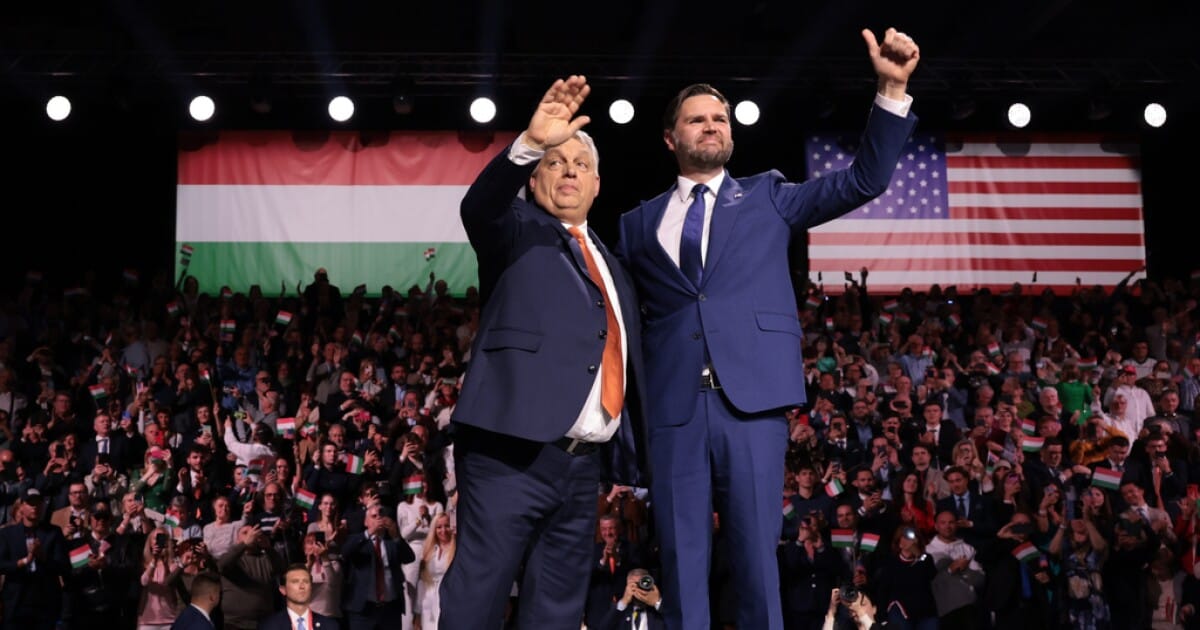
Then came Jinx Dispenser Vance, widely known for the apparent misfortune that befalls world leaders that meet him. In a two-day visit arrived on 7 April, he met Orbán at the Carmelite Monastery headquarters above the Danube, then appeared as the headline act at a rally inside the MTK Sportpark arena. The event was billed as a "Day of Friendship." It was, in practice, a USian vice president showing up to a foreign election rally and telling the crowd how to vote. Vance praised Orbán as "a defender of western civilisation" and "a man who has done more than any leader in Europe to bring about a successful resolution to the war between Russia and Ukraine." He concluded with a direct appeal to the crowd: "We've got to get Viktor Orbán re-elected as prime minister of Hungary." On stage, he called Trump by speakerphone. Trump told the roughly 5,000 Fidesz supporters present that he loved Hungary and that Orbán was "a fantastic man."
The second day brought another rally and a visit to the Mathias Corvinus Collegium, a Fidesz-linked think-tank. Vance called on voters to "stand against the bureaucrats in Brussels," accused the EU of doing "everything that they can to hold down the people of Hungary," and framed the vote as a choice between "sovereignty and democracy" and the forces arrayed against it. He simultaneously insisted he was not interfering in Hungarian elections while telling Hungarians how to vote. He attempted to resolve this contradiction by accusing the EU of being the real foreign interference, which he delivered without any apparent awareness that he was a sitting USian vice president at a campaign rally in another country.
The JD Vance two day visit cost Hungarian taxpayers roughly $1.2 billion; in addition Hungary's state energy company MOL agreed to purchase $500 million worth of US crude oil during the trip. The Hungarian army separately agreed to purchase $700 million in HIMARS rocket systems. This was awkward because Orbán had spent years arguing that buying US weapons and energy was economically ruinous compared to cheap Russian supplies. He then agreed to exactly that in exchange for a pre-election photo opportunity, and billed it to the Hungarian public.
Vance also carefully avoided mentioning the US-Israeli war with Iran, because Orbán has cultivated close ties with Tehran including a nuclear energy cooperation agreement, and any suggestion that NATO allies were expected to support US operations against Iran would have destroyed Fidesz's "party of peace" message on the spot. The full picture was stranger still: a USian vice president endorsing a prime minister whose foreign minister had been recorded briefing Moscow in real time from EU summits, while not mentioning that Orbán's government had reportedly offered Iran intelligence on Israel's pager attack against Hezbollah. Each relationship made sense in isolation. Together, they described a government running foreign policy as a series of parallel deals with mutually hostile actors.
The electoral effect was the opposite of what Orbán hoped for. According to Budapest think-tank Policy Solutions, the visit had a probable electoral effect "close to zero," and Orbán had "overestimated the likely impact" of Vance's presence. Analyst Zoltán Ranschburg was blunter: "A Trump visit could have had a visible influence on the campaign. Vance is much less known, or cared for, among Hungarian voters." Tisza's polling actually improved in the days after Vance left. The spectacle of foreign leaders arriving to campaign for the incumbent reinforced exactly the argument Magyar had been making.
Netanyahu's endorsement carried its own logic, though not the kind Orbán would want advertised. Hungary has been one of the few EU member states willing to use its veto to block EU measures against Israel, which under EU rules require unanimity across all 27 members. A Tisza government removes that protection immediately. Tisza has already announced it would halt Hungary's withdrawal from the International Criminal Court, a process Orbán had initiated specifically so that Netanyahu could visit Budapest without risk of arrest under the ICC's standing warrant against him. That option now closes. Netanyahu's calculation was about access and legal cover, not ideology, and Hungarian voters appear to have understood that.
On stage in Budapest, Orbán announced Hungary would launch a "reconquista" of European institutions, invoking a 700-year military campaign by Catholic states to recapture the Iberian Peninsula from Muslim rule. It was the most extravagant rhetorical escalation of his career, delivered to 5,000 people in a handball arena five days before a majority of his compatriots voted him out by twenty points.
The Challenger
Péter Magyar, 45, ran a deliberately narrow campaign. He focused on corruption, healthcare, wages, and the frozen EU funds that Orbán's rule-of-law violations had made inaccessible. He said almost nothing about Ukraine or foreign policy, denying Orbán his preferred attack line. He supported continued EU and NATO membership and pledged judicial independence and a genuine anti-corruption drive. He also avoided opposing Orbán's anti-immigration record, positioning himself to win voters who had supported Fidesz out of cultural conservatism but were exhausted by economic stagnation and the daily reality of a system rigged against ordinary people.
Three-quarters of those under 30 voted for Tisza. Among those aged 30 to 40, the figure was 63 percent. Fidesz's support in those two age groups sat at 10 and 17 percent respectively. His coalition isn't ideologically unified. It's generationally unified. Young Hungarians who grew up under Orbán, the only prime minister they had ever known, turned out in the largest numbers ever recorded in a Hungarian election and voted him out.
Turnout reached 77.8 percent by 6:30 p.m., before counting was complete. The final figure is expected to push close to 80 percent. The previous record was 70.5 percent, set in 2002. The regional breakdown is telling: Budapest and Pest county both hit 80.96 percent. Győr-Moson-Sopron county reached 81.95 percent. Even the rural counties that form Fidesz's base, Borsod-Abaúj-Zemplén and Szabolcs-Szatmár-Bereg, came in above 71 percent. Orbán's structural advantages were designed to work at normal turnout levels. This was not a normal turnout.
Magyar ran in 94 of Hungary's 106 single-member districts. He won all 94.
What a Tisza Government Actually Inherits
The celebrations are real and fully earned. What comes after will require patience and determination in roughly equal measure.
The two-thirds majority changes the most important variable. Tisza can now amend Orbán's 2011 constitution without coalition partners. The gerrymandered districts, the laws protecting Fidesz's systemic advantages, the constitutional provisions Orbán wrote specifically to entrench his position, all of it is now within reach of legislative reversal. Magyar has committed to a two-term cap for prime ministers, an asset recovery office, membership in the European Public Prosecutor's Office, and the restoration of judicial independence. He has also said he will suspend public media news programming until balanced reporting standards are met and restore.
The judiciary will not transform immediately. Fidesz-aligned judges have lifetime appointments in many cases, and the culture of a captured legal system doesn't change on an election night. But with constitutional amendment power, Tisza can reshape the institutional framework over time rather than trying to govern within the one Orbán deliberately designed to defeat them.
The media environment also won't shift overnight. Pro-Orbán oligarchs own hundreds of outlets. A change of government doesn't redistribute those assets. But a government that stops directing state advertising exclusively to loyal outlets, and stops pressuring private businesses to pull advertising from critical ones, begins to change the financial ecology that kept those outlets alive.
Hungary imported the vast majority of its oil from Russia in 2025, a dependency that grew substantially after 2021. Unwinding that requires alternative infrastructure, supply agreements, and pipeline capacity that doesn't currently exist in sufficient volume. Magyar can move toward it, but it will take years.
And Orbán, despite his concession, is not going quietly. His parting line, "we are not giving up, never, never, never," was a signal. He spent sixteen years building a network of loyalists across every institution in Hungarian public life. From opposition, he will obstruct, litigate, and organise. A man who once rewrote the constitution to stay in power will not become a passive backbencher. Magyar's government will need to be faster, smarter, and more legally precise than Orbán at every step.
What Actually Just Happened, and Why It Matters
The results, when they came, were not close. Tisza won 138 seats. Fidesz took 55. That is a 25-point swing from the last election, producing a two-thirds supermajority on the first attempt from a party that did not exist two years ago.
For Hungary itself, the most immediate practical consequence is money. The roughly $18 billion in EU cohesion funds Brussels froze over rule-of-law violations can now begin moving again. These represent road infrastructure, hospital equipment, regional development, and public transport investment that Hungarian citizens have been denied for years while Orbán used the frozen disbursements as a grievance against Brussels rather than a problem of his own government's making. A Tisza government that restores judicial independence and brings procurement rules into compliance with EU standards unlocks that pipeline, and the European Commission has already signalled it is ready to move quickly.
The €90 billion EU loan to Ukraine that Orbán blocked in March, demanding resumption of Druzhba pipeline oil flows as his condition, is now unblocked. Magyar has made clear he will drop the veto immediately. That package had been held hostage for months with real consequences for Ukrainian defence capacity.
Hungarian membership in the European Public Prosecutor's Office, which Orbán refused to join, also becomes possible. The EPPO has direct jurisdiction to investigate and prosecute fraud involving EU funds. For the Hungarians who watched Lőrinc Mészáros accumulate a fortune through public contracts, and watched OLAF flag irregularities that Hungarian prosecutors then ignored, that institution represents the first genuine mechanism of accountability their country has seen in a decade and a half.
On the streets of Budapest on Sunday night, the reaction was about all of this, and about something harder to quantify. "We are celebrating because this is a moment that will go down in history," one Budapest resident told CBS News. "This regime, this system has been broken." Tisza's vice-president, Márk Radnai, struck a tone of reconciliation. "We can't be each other's enemies," he said. "Reach out, hug your neighbours, your relatives. It's the day of reunification." Magyar's own victory speech framed the moment in terms of democratic ownership: "Today, we won because Hungarians didn't ask what their homeland could do for them; they asked what they could do for their homeland."
The international response was immediate and euphoric. European Commission President Ursula von der Leyen, who had spent years locked in legal proceedings against Budapest, posted: "Europe's heart is beating stronger in Hungary tonight. Hungary has chosen Europe. Europe has always chosen Hungary. Together, we are stronger. A country reclaims its European path. The Union grows stronger." European Parliament President Roberta Metsola congratulated Magyar directly: "Hungary's place is at the heart of Europe."
French President Emmanuel Macron said he called Magyar personally to congratulate him, writing that "France hails a victory for democratic turnout, the Hungarian people's attachment to European Union values, and for Hungary in Europe. Together, we will make Europe more sovereign, for the security of our continent, our competitiveness and our democracy." German Chancellor Friedrich Merz said: "The Hungarian people have decided. I am looking forward to working with you. Let's join forces for a strong, secure and, above all, united Europe." Lithuanian President Gitanas Nauseda called it a "Big win for Hungary! Big win for Europe!" British Prime Minister Keir Starmer called it "a historic moment, not only for Hungary, but for European democracy." Norwegian Prime Minister Jonas Gahr Store said Magyar's success was of "great importance" to Europe. Polish Prime Minister Donald Tusk and Ukrainian President Volodymyr Zelensky both sent congratulations. Zelensky wrote that it was "important when constructive approach prevails" and that "Ukraine has always sought good-neighborly relations with everyone in Europe." Even Giorgia Meloni, who had been among Orbán's loudest European cheerleaders, posted congratulations to Magyar. Hillary Clinton posted on X that the result was "a victory for everyone who values democracy."
For EU security, the implications are structural and significant. Hungary under Orbán had been the bloc's most consequential single point of failure for collective decisions. The Szijjártó recordings established this was not passive failure but active sabotage, with Budapest passing information from EU deliberations directly to Moscow. Other member states had begun excluding Hungary from sensitive discussions entirely, creating a formal crack in the bloc's internal trust architecture. That crack begins closing now. A Hungary under Magyar re-engages with EU intelligence coordination, stops vetoing Russia sanctions, and stops providing Moscow with advance warning of European negotiating positions. Sanctions packages that Orbán had been watering down or blocking for three years can now pass. The multilateral architecture of pressure on Russia gets stronger overnight.
The Losers: Putin, Trump, Netanyahu
Three men outside Hungary invested heavily in Orbán staying in power. All three lost badly tonight, and the consequences for each are concrete.
Putin has lost his most reliable and most institutionally embedded asset in the European Union. Orbán was not merely sympathetic to Russian interests. He was, as the Szijjártó recordings demonstrated, actively useful to them, passing real-time information from EU deliberations to Lavrov, lobbying to delist Russian-connected oligarchs from EU sanctions, blocking Ukraine aid packages, and maintaining Hungary's energy dependency on Russia as leverage against the rest of the bloc. Losing that asset inside the EU's unanimity-based decision architecture is a genuine strategic setback for Moscow. The sanctions packages Orbán had vetoed or weakened will now pass. The Ukraine loan he blocked is now freed. The intelligence flow from Brussels to Moscow stops. Putin also invested directly in this election, assigning Sergey Kiriyenko to run influence operations and deploying bot farms on Telegram. All of it failed, against a 25-point margin.
Trump loses his most visible proof of concept. Orbán was not simply a Trump ally. He was the operating model. The MAGA movement studied him explicitly: how to use electoral victory to capture institutions, how to control media, how to rewrite constitutional rules to stay in power indefinitely. Tucker Carlson flew to Budapest to produce fawning documentaries. Stephen Miller and figures across the USian hard right cited Orbán as demonstrating what conservative governance could look like if it was willing to be ruthless enough. Trump himself sent Rubio, then Vance, then called in by speakerphone to a rally in a handball arena, dangling the "full economic might of the United States" on Truth Social the Friday before the vote. He got a 25-point loss, a $1.2 billion bill for Hungarian taxpayers, and the most embarrassing foreign endorsement failure since the concept of foreign endorsements was invented. The model Orbán provided the international right, the idea that a captured electoral system could hold indefinitely against popular will, has now been disproven in the most public way possible, in a country everyone was watching.
Netanyahu loses his firewall inside the EU and his ability to visit Budapest. Hungary was the only EU capital willing to host him despite the ICC's arrest warrant. Tisza has already announced it will halt Hungary's withdrawal from the ICC, which Orbán had initiated, meaning Budapest is no longer a safe haven. More significantly, Israel loses Hungary's reliably deployed veto against EU measures that require unanimity. Orbán had used that veto to block or weaken EU sanctions and resolutions on Israel, including the suspension of the EU-Israel Association Agreement, which has been one of the most serious tools other member states wanted to deploy. A Magyar government will not adopt positions more critical than Berlin or Rome, but it will stop being the instrument that blocked every collective EU action Jerusalem found inconvenient. Netanyahu sent a video, dispatched his son, called Orbán "like a rock." The rock is gone.
The broader significance extends beyond the specific losses of specific powerful men. Orbán spent sixteen years as the living proof that a leader inside a liberal democratic institution could systematically dismantle that institution's foundations and remain indefinitely in power. The theory had inspired imitators. Sunday's result does not disprove it in every context. What it does demonstrate, unmistakably, is that even the most thoroughly engineered electoral system in Europe can be defeated when turnout is high enough, the opposition is unified enough, and voters decide they have run out of patience. The ripples of that demonstration are already travelling well beyond Budapest.
Why Brussels, and Ottawa, Care
For the EU the arithmetic changes immediately. Hungary under Orbán was the bloc's most reliable internal veto on Ukraine aid packages, sanctions rollover against Russia, and any decision requiring unanimity. The Szijjártó recordings confirmed what Polish officials had been saying for two years: Hungary was sometimes excluded from sensitive EU negotiations because other member states couldn't trust that Budapest wasn't briefing Moscow. A Tisza government re-engages with EU institutions. The frozen cohesion funds get unlocked. The Article 7 procedure against Hungary, triggered over rule-of-law concerns, loses its most acute justification.
For Canada, the implications are more indirect but real. Canada's sanctions framework, built on SEMA and the Justice for Victims of Corrupt Foreign Officials Act (the Magnitsky Act), operates in coordination with EU designations. Hungarian obstruction of EU Russia sanctions meant that sanctioned individuals including members of Usmanov's family retained EU-wide freedom of movement and financial access they shouldn't have had. A Hungary that stops lobbying for oligarchs' delistings is a Hungary that stops undermining the multilateral sanctions architecture that Canada's framework depends on.
USian civil society and diaspora communities, particularly those with Hungarian and Ukrainian roots, have been watching this vote as a test of whether democratic backsliding inside an EU member state can be reversed through the ballot box. The answer, tonight, is yes. With record turnout and a generation of voters for whom Orbán represents not tradition but exhaustion, yes.
The full count will be certified by 18 April, with diaspora and mail-in ballots still to be confirmed. But Péter Magyar stood on the banks of the Danube tonight and told his supporters the question wasn't whether Tisza had won. The question was by how much. The answer turned out to be: by enough to rewrite the constitution, dismantle the system, and send a message that echoed from Brussels to Kyiv to Moscow. Sixteen years. Done.