
Between January and April 2026, drones killed at least 880 civilians in Sudan, accounting for more than 80 per cent of all documented conflict-related civilian deaths, according to the UN human rights office. The actual toll is higher.
On 11 May, UN Human Rights High Commissioner Volker Türk issued a high-alert warning, condemning the rising use of armed unmanned aerial vehicles in Sudan and warning of intensified and widening violence that could trigger more displacement and disrupt critical aid flows. The two parties fighting for control of the country, the Sudanese Armed Forces (SAF) and the paramilitary Rapid Support Forces (RSF), are both using these weapons against civilians, and both are being armed by foreign governments and the companies those governments protect.
The conflict in Sudan has killed at least 59,000 people, displaced some 13 million and pushed many parts of the country into famine. More than 30 million people are in need of humanitarian assistance.
ACLED's April 2026 analysis records 515 drone strikes in Sudan in 2025 alone, killing at least 2,670 people, combatants and civilians combined. That figure represents an 81 per cent increase in strike events compared to 2024 and a nearly 600 per cent increase in drone strike-related fatalities over the same period. Drone warfare has become the dominant operational logic of the conflict, a way to sustain offensives without the manpower constraints, logistical exposure or seasonal limitations of ground combat.
Türk warned that this reliance on drones allows hostilities to continue during the approaching rainy season, which in previous years brought a lull in ground operations. Armed drones operate regardless of road conditions or flood levels, removing a constraint that previously gave civilians partial, temporary relief. An intensification of hostilities risks conflict expanding further to central and eastern states, with lethal consequences for civilians across enormous areas, Türk said.
"Drone attacks against civilians will only worsen if met with utter impunity, with this violence increasingly normalised as a go-to tactic." (Volker Türk, UN, 11 May 2026)
What drones are hitting
Drones in Sudan are not surgical. They are hitting markets, hospitals, water wells, displacement camps, humanitarian convoys and residential streets.
On 19 May 2026, a drone struck a crowded market in Ghubaysh in West Kordofan, an area controlled by the RSF, killing 28 people and injuring 23 others. Medical sources and witnesses told AFP the dead and wounded were taken to the local hospital. Medical personnel at the scene warned that at least 25 of the wounded remained in critical condition. Witnesses described a two-stage attack: a first strike on an RSF vehicle, then a second blast seconds later that tore through a crowded restaurant. Emergency Lawyers, a local rights group that tracks violations committed during the conflict, blamed the army for the strike. A Sudanese army official told the Associated Press the army doesn't target civilians or civilian infrastructure. Another military source said an army drone struck two RSF combat vehicles near the market while they were refuelling, destroying both and killing those inside, and that no civilians were harmed.
Both officials spoke anonymously. Thousands of people across West Kordofan and neighbouring areas rely on the Ghubaysh market for food and essential supplies, and SAF denials consistently follow the same pattern as the strikes themselves.
According to figures cited by MSF from the International NGO Safety Organisation (INSO), nearly 350 drone attacks were recorded across Sudan since the start of 2026, mainly affecting Kordofan, Darfur, White Nile and Blue Nile states. Of those incidents, 31 struck roads, 28 hit commercial facilities and 11 targeted health facilities, with displacement camps and schools also affected.
MSF said its teams have witnessed attacks occurring within 100 metres of humanitarian workers.
On 2 April, an RSF drone struck Al-Jabalain hospital in White Nile state, twice. The first strike hit the operating theatre. The second hit the maternity ward. At least 10 people were killed, including seven medical staff, some of whom had previously worked with MSF. The attack occurred during a children's immunisation campaign.
Thirteen days earlier, a SAF strike hit El-Daein Teaching Hospital in East Darfur on the night of 20 March, on the first day of Eid al-Fitr, killing at least 64 people including 13 children, two nurses and one doctor. The WHO confirmed the toll and said the strike rendered the hospital entirely non-functional. It was the only major referral facility for the entire state.
On 8 May, drone strikes on Al Quz in South Kordofan and near El Obeid in North Kordofan killed 26 civilians and injured others. In February, an RSF drone hit a vehicle carrying displaced families near Rahad in North Kordofan, killing at least 24 people including eight children, among them two infants. The Sudan Doctors Network said those aboard had fled fighting and were trying to reach safety.
In the first two weeks of February alone, MSF teams treated 167 patients with drone-related injuries, including penetrating wounds to the chest and abdomen, shrapnel damage and limb fractures.
Attacking hospitals is a war crime under international humanitarian law. Articles 18 through 22 of the Fourth Geneva Convention explicitly protect civilian medical facilities. Health workers are shielded under Additional Protocol I. OHCHR said these patterns of strikes on civilian infrastructure raise serious concerns about compliance with IHL's fundamental principles of distinction, proportionality and precaution, and may amount to war crimes. Article 51(5)(b) of Additional Protocol I prohibits attacks expected to cause civilian harm disproportionate to any anticipated military gain. Targeting a restaurant in a food market serving tens of thousands of people during morning hours does not meet that bar. Neither does striking an immunisation campaign in a maternity ward.
Who is supplying the weapons, and who profits
Sudan has no domestic drone manufacturing. Every aircraft killing civilians arrived courtesy of a foreign government working through a defence company that made money on the transaction.
Turkey, Baykar
Turkey's Baykar, the country's largest defence contractor, signed a $120 million contract with Sudan's military in November 2023 to supply at least eight TB2 drones, 600 warheads and in-country technical support. The weapons were delivered through August to November 2024, routed through intermediaries despite US sanctions on Sudan's procurement agency, the Defence Industries System, which signed the contract with Baykar five months after those sanctions were imposed. The deal was documented in a Washington Post investigation based on leaked documents, messages and financial records. Baykar is co-owned by Selçuk Bayraktar, son-in-law of Turkish President Recep Tayyip Erdoğan. The company has not publicly commented on the reported sales.
Baykar's TB2 deal with Sudan may violate US and EU sanctions. No enforcement action has been taken against the company.
Egypt also operates Turkish-made drones in Sudan. Satellite imagery, flight logs, field videos and interviews with US, European and Arab officials, documented by The New York Times, confirmed that Turkish-made Akinci drones have struck RSF supply convoys and fighter positions inside Sudan, operated from an Egyptian military base at East Oweinat Airport in Egypt's Western Desert. The Akinci has a range exceeding 4,500 miles and carries three times the munitions payload of a Bayraktar TB2. Each aircraft costs up to $25 million.
Iran, Qods Aviation Industries (IRGC-linked)
The SAF has been equipped with the Mohajer-6, manufactured by Qods Aviation Industries in Iran, an organisation linked to the Islamic Revolutionary Guard Corps. The drone carries up to four air-to-surface missiles and is documented to have been used in battles across the Sudanese conflict.
Cost estimates run $2 to $4 million per system including the ground control station and initial support, making it one of the cheapest armed drones on the global market, less than a TB2 and a fraction of the cost of a US MQ-9. The low cost lets Iran absorb combat losses without financial strain and offer the system to buyers that either can't acquire Western drones due to sanctions or that prefer suppliers who don't ask questions about human rights.
The commercial pipeline is documented in a recent US prosecution. Court documents filed in April 2026 describe a contract worth more than $70.6 million for Mohajer-6 aircraft sold to Sudan's Ministry of Defense. An Iranian-American operative was arrested at Los Angeles International Airport, accused of running the transaction. A Sudanese broker reportedly reached her over WhatsApp in July 2024. Money flowed through a mix of cash in crates of $100 bills, hawalas and banks in Dubai.
The Mohajer-6 is not entirely Iranian. Its propulsion relies on a Rotax 912 engine manufactured by BRP-Rotax in Austria, and its navigation and avionics reportedly incorporate Western-manufactured chips and modules. European components are inside the aircraft killing Sudanese civilians.
China, CASC and AVIC
The RSF has no air force of its own. It built one with Chinese hardware, delivered via the UAE.
The RSF has no air force of its own. It built one with Chinese hardware, delivered through the UAE.
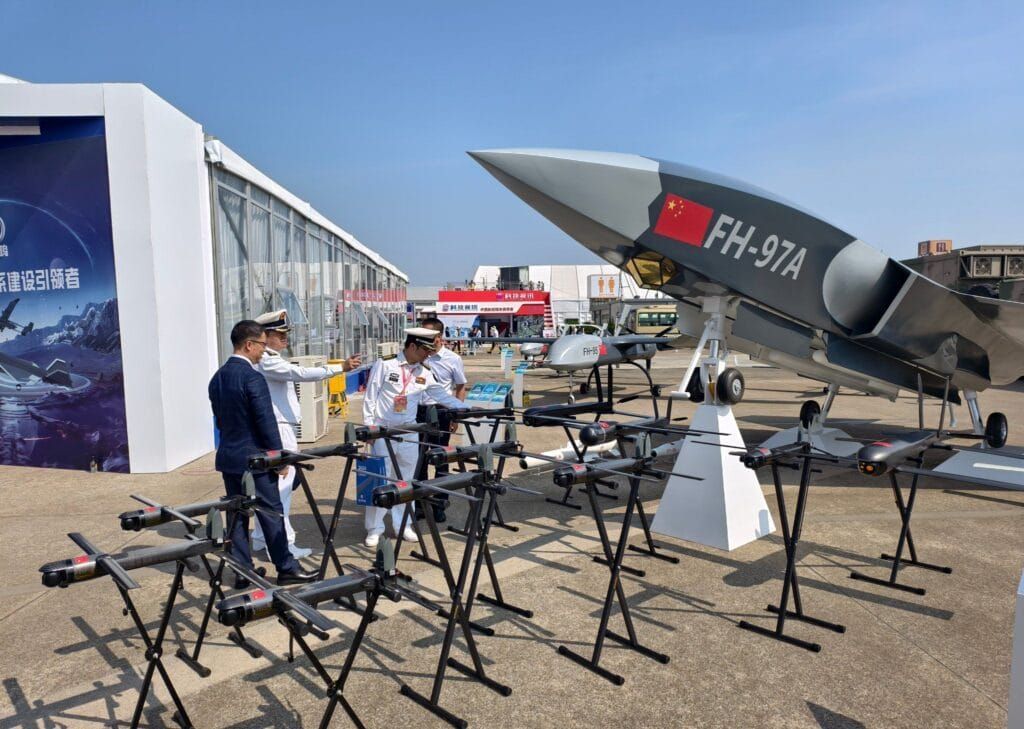
Yale University's Humanitarian Research Lab first observed three FH-95 drones at RSF-controlled Nyala Airport between December 2024 and January 2025, alongside 43 shipping containers consistent with large-scale cargo delivery. The FH-95 is manufactured by China Aerospace Times Feihong Technology Company, a state-owned enterprise. Its sibling model, the CH-95, is produced by China Aerospace Science and Technology Corporation (CASC), also state-owned. Both are fixed-wing UAVs with a service ceiling of 7,000 metres, a combat radius of 250 kilometres within line of sight, and endurance of six to 12 hours. They can carry precision-guided bombs, guided anti-tank missiles and electronic warfare equipment. The defence intelligence company Janes confirmed the drones at Nyala as Chinese-manufactured CH-95s. Satellite imagery tracked the construction of three hangars at the airport over five weeks in early 2025 to house them.
By May 2025, Yale and Reuters had identified 13 additional delta-wing drones at Nyala alongside launching gear. These are assessed as long-range kamikaze systems, likely Chinese-manufactured, with a range of approximately 2,000 kilometres, enough to reach anywhere in Sudan. China's foreign ministry said Beijing "has always adopted a prudent and responsible attitude in military exports." China's defence ministry did not reply.
The UAE has also flown Wing Loong II drones, manufactured by Aviation Industry Corporation of China (AVIC), in support of RSF operations since at least July 2024, according to the Critical Threats Project at the American Enterprise Institute. The Wing Loong II is a medium-altitude long-endurance strike drone capable of carrying precision-guided munitions across Sudan's full width.
In October 2025, the Wall Street Journal reported that the US Defense Intelligence Agency and the State Department's Bureau of Intelligence and Research had both assessed, independently, that the UAE had increased its supply of Chinese drones to the RSF. US legislators Representative Sara Jacobs and Senator Chris Van Hollen confirmed in January 2025, following a Biden administration intelligence briefing, that the UAE was providing weapons to the RSF in direct contradiction of assurances Abu Dhabi had given to DC.
Russia, Africa Corps
The UAE and Russia, through the Africa Corps mercenary organisation formerly known as Wagner, have also supplied the RSF with quadcopter-style drones modified to drop 120mm mortar shells. The quadcopters are commercially available; the modification is not. They represent the low-cost end of a supply network that spans multiple countries, several proxy actors, and an illicit fuel economy running into billions of dollars.
Africa Corps' original stake in the Sudan conflict was financial. Wagner Group, its predecessor, began supporting Hemeti and the RSF in exchange for access to gold mines in Darfur. The RSF smuggled the bullion to the Middle East, primarily through Dubai, where it was sold on world markets. Those proceeds funded Russia's war in Ukraine, according to researchers tracking the financial flows. In exchange, Wagner supplied the RSF with surface-to-air missiles that enabled them to shoot down SAF fighter jets.
The logistics corridor ran through eastern Libya, where Africa Corps is aligned with Haftar's Libyan National Army. Africa Corps personnel deployed along Sudan's 382-kilometre border with Libya, and the network ran fuel across it at scale. Between April and October 2024, Russia supplied 2.8 million barrels of diesel and gasoline to Sudan, accounting for nearly half the country's fuel imports over that period, according to Bloomberg. That fuel sustained RSF vehicle operations across Darfur and Kordofan.
Russia's strategic calculus shifted in 2024. The RSF had opened contacts with Ukrainian intelligence to explore additional weapons supplies, which Moscow read as a betrayal. Simultaneously, the stalled 2017 agreement to give Russia a naval base at Port Sudan became newly attractive: the SAF controlled Port Sudan, and by late 2024 Russia's only other foreign naval installation, at Tartus in Syria, had been lost when the Assad regime collapsed in December and the new Syrian government terminated the basing treaty. Turkey's closure of the Bosphorus and Dardanelles under NATO pressure had compounded Russian naval constraints further.
The switch from RSF to SAF was formalised in early 2025. On 12 February 2025, Sudan's Foreign Minister Ali Youssef Ahmed al-Sharif confirmed at a joint press conference with Sergei Lavrov in Moscow that the two governments had reached complete agreement on a Russian naval base at Port Sudan. The terms: a 25-year lease, 300 Russian military personnel, and the right to dock up to four warships, including nuclear-powered vessels. In exchange, the SAF would receive advanced air defense systems and access to Su-30 and Su-35 fighter jets at preferential prices. Russia also retained mining concessions in Sudan. Al-Sharif expressed explicit gratitude for Russia's veto of the November 2024 UN Security Council resolution on civilian protection.
In practice, Russia is managing both sides of the conflict simultaneously: officially arming and politically protecting the SAF through the Security Council, while the Haftar network it controls in Libya continues providing fuel and logistics to the RSF. The revenue from gold that originally drew Russia to the RSF has not stopped moving. Whoever holds the mines will need a buyer, and the buyer has not changed.
UAE
The UAE's role extends well beyond drone procurement. Abu Dhabi has sustained the RSF's battlefield mobility through a fuel pipeline running through eastern Libya that the investigative watchdog The Sentry describes as a "persistent flow of diesel and gasoline" enabling the RSF's operations in Darfur. Libya loses approximately $6.7 billion a year to fuel smuggling; the RSF is among the primary foreign beneficiaries of that trade, according to The Sentry's November 2025 investigation.
The logistics route has shifted over time. Through much of 2024, weapons and supplies from the UAE transited through eastern Chad, using Amdjarass airport and the porous Chad-Sudan border into Darfur. Domestic opposition within Chad to that arrangement, combined with SAF threats to strike cross-border supply sites, pressured N'Djamena to scale back its cooperation in 2025. Air traffic then moved north to Kufra in eastern Libya. Satellite imagery from Copernicus taken on 12 July 2025 showed at least two Russian-made transport aircraft at Kufra, which European analysts said indicated "with reasonable certainty" the movement of military equipment or specialised personnel. From Kufra, supplies move overland into RSF-controlled areas of Darfur. The RSF's capture in June 2025 of the border zone where Sudan, Libya and Egypt converge, supported by a Libyan militia aligned with Field Marshal Khalifa Haftar's Libyan National Army, opened additional ground corridors for that flow.
Haftar is the connecting node between the UAE and the Africa Corps in this network. Abu Dhabi has backed him since before the Sudan war, and his forces have stored weapons at al-Khadim airbase and provided medical treatment for wounded RSF fighters in Benghazi, according to UN expert and Human Rights Watch documentation. His denials follow Abu Dhabi's in form and credibility.
The arms embargo nobody enforces
The UN Security Council has maintained a Chapter VII arms embargo on Darfur since 2004, renewed most recently in September 2025. Supplying arms to either party for use in Darfur constitutes a clear violation of that binding embargo, and those violations are continuing.
No state has been sanctioned specifically for violating the Darfur arms embargo in the context of the current conflict. Baykar's reported TB2 shipments may violate US and EU sanctions regimes, according to the Washington Post investigation, but no enforcement action has been taken against the company. Iran's drone transfers to Sudan violate both the arms embargo and US Iran-related sanctions, but the pipeline operated for years before an arrest. The UAE continues to deny supplying Chinese drones to the RSF despite satellite evidence and forensic documentation.
OHCHR has called on all states, particularly those with influence over the parties, to do everything in their power to end arms transfers that are fuelling the conflict and being used in manifest disregard of civilian protection obligations.
The genocide finding
The drone war does not exist in isolation. In a report presented to the UN Human Rights Council on 19 February 2026, the Independent International Fact-Finding Mission for Sudan said the evidence establishes that at least three underlying acts of genocide were committed in and around El Fasher: killing members of a protected ethnic group, causing serious bodily and mental harm, and deliberately inflicting conditions calculated to bring about the group's physical destruction in whole or in part.
"The RSF acted with intent to destroy, in whole or in part, the Zaghawa and Fur communities in El-Fasher. These are the hallmarks of genocide," the Mission concluded.
Mission chair Mohamed Chande Othman said the scale, coordination and public endorsement of the operation by senior RSF leadership demonstrate that the crimes in and around El Fasher were not random excesses of war.
The ICC Prosecutor assessed in January 2026 that crimes against humanity and war crimes had been committed in El Fasher. The ICC has existing jurisdiction over Darfur under UN Security Council Resolution 1593. No arrest warrants for the current conflict's principal commanders have been publicly issued.
Rainy season, no reprieve
Historically, Sudan's rainy season, running roughly June through September, slowed ground offensives. Roads flooded, supply lines broke, and civilians in contested areas got a partial, temporary reprieve. Armed drones don't require either.
Türk said this increasing reliance on remote weapons allows hostilities to continue without interruption as the rainy season approaches, removing what in the past had been a natural restraint on operations. The High Commissioner specifically warned that SAF-controlled cities of El Obeid and Dilling in South Kordofan, both under siege-like conditions, face a likely intensification of hostilities that will put civilians at greater risk of retaliatory attacks and further large-scale displacement.
The food situation is already catastrophic. On 15 May 2026, the FAO, WFP and UNICEF jointly warned that nearly 19.5 million people, two in every five Sudanese, are facing crisis levels of acute food insecurity. An estimated 825,000 children under five are expected to suffer from severe acute malnutrition in 2026, a 25 per cent increase over pre-conflict levels. Nearly 135,000 people face catastrophic food insecurity across 14 hotspots in Darfur, South Darfur and South Kordofan, with those areas assessed at imminent risk of famine in the coming months.
Drone strikes on fuel markets, aid convoys and roads are part of the mechanism producing that crisis, not separate from it. Türk warned that heightened violence will disrupt critical humanitarian assistance, and that much of the country, including Kordofan, now faces increased risk of famine, exacerbated by fertiliser shortages linked to the Middle East war.
What accountability looks like here
Under the Geneva Conventions, deliberate attacks on civilians, medical facilities and humanitarian workers are war crimes. Both the SAF and RSF have committed documented attacks meeting that definition. The ICC has jurisdiction over Darfur. The UN Fact-Finding Mission has documented genocide. The arms embargo has been violated, openly and repeatedly, by Turkey, Iran, Russia and the UAE.
For Canada, the Fighting Against Forced Labour and Child Labour in Supply Chains Act and the SEMA sanctions framework give Ottawa legal tools to act against entities supplying weapons to parties committing genocide. Canada has not applied them here. The EU's Magnitsky mechanism has not been deployed against any of the principal drone suppliers to Sudan. The Darfur arms embargo has no enforcement mechanism with teeth.
Baykar is a private Turkish company with offices, partnerships and ambitions in European and NATO-adjacent markets. CASC and AVIC are Chinese state enterprises whose products move through UAE government procurement chains. Qods Aviation Industries is IRGC-linked, already under broad sanctions, yet still closing $70 million contracts. Africa Corps operates across at least six African states with documented impunity.
Advocates tracking this conflict can file documentation with OHCHR, support on-the-ground monitors including the Sudan Doctors Network and Emergency Lawyers, and pressure their governments to apply existing legal tools to the companies and states named here. Türk's warning was explicit: the international community is on notice that unless action is taken without delay, this conflict is on the cusp of entering yet another new, even deadlier phase.