Ibrahim Traoré's declaration that democratic governance is culturally unsuited to his country marks a significant escalation in the Sahel's authoritarian drift and tests the limits of Western partnership conditionality
A Sentence, and What It Means
Burkina Faso's military head of state, Captain Ibrahim Traoré, declared publicly this week that democracy is simply not suited to his country, a position he has now translated into policy by extending his hold on power until 2029. The announcement drew swift condemnation from human rights organisations and democratic governance advocates, but it drew something else too. A notable silence from the international partners who have for years continued funding development and security programmes in Ouagadougou while the country's civic space has systematically contracted.
Traoré, who seized power in a second coup in September 2022, is 36 years old. He commands one of West Africa's most resource-rich states in gold, manganese, and zinc, and one of its most acute humanitarian crises. He has expelled French forces, deepened ties with Russia, aligned Burkina Faso with Mali and Niger inside the newly formed Alliance of Sahel States, and presided over a period of military governance that Human Rights Watch has documented with devastating specificity. More than 1,800 civilians killed by the country's own armed forces and allied militias, in conduct the organisation characterises as crimes against humanity.
Why Though?
Understanding why this rhetoric is dangerous requires understanding how it works. The claim that liberal democracy is a Western imposition unsuited to African political traditions is not new, and it is not without a contested intellectual history. Versions of it have circulated in post-independence African political thought since the 1960s. What distinguishes Traoré's deployment of this argument from the academic debate is the institutional context in which it appears. A military government that has suspended the constitution, dissolved the legislature, banned political parties from public activity, restricted independent journalism, and created a body of armed auxiliaries accused of mass killing.
Rights organisations have been precise about this. The argument functions to recast political repression as cultural authenticity, to make the suppression of opposition parties sound like the defence of tradition, to make the silencing of civil society sound like the rejection of foreign interference. It relocates the conversation from accountability to identity. Once that relocation succeeds, external criticism becomes, almost by definition, an act of cultural aggression.
Mali's Colonel Assimi Goïta has employed similar framing. Niger's General Abdourahamane Tchiani has gestured toward it. What the three leaders of the Alliance of Sahel States have collectively constructed is something close to a shared ideological grammar, one that borrows selectively from pan-Africanist critique of Western double standards while installing governance structures that have more in common with twentieth-century military dictatorships than with any indigenous political tradition.
Russia's complicity
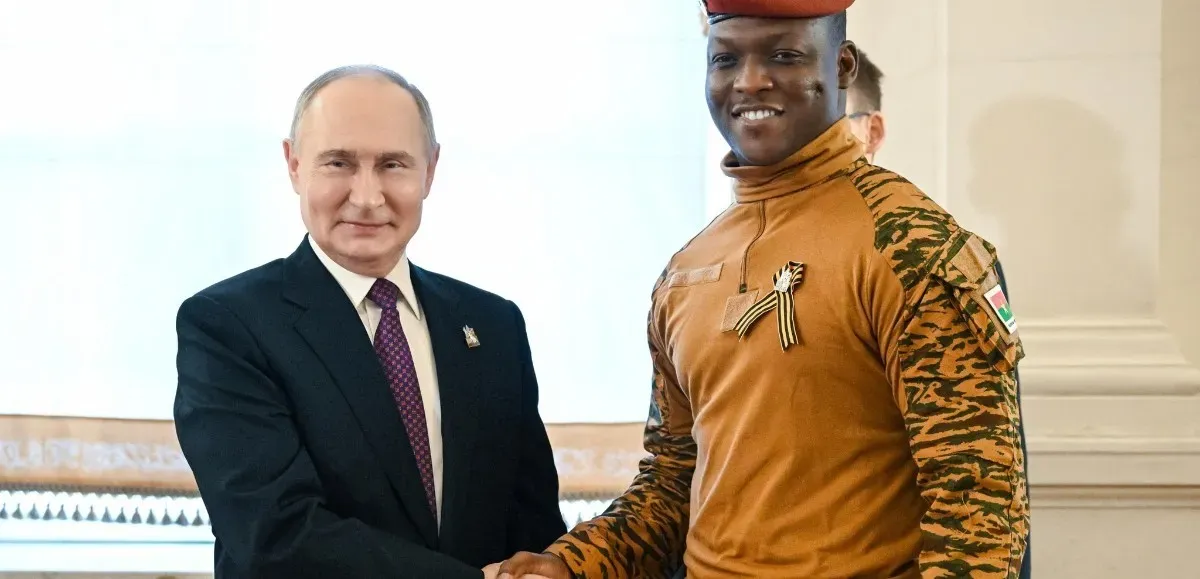
The ideological confidence with which Traoré dismissed democratic governance this week was not self-generated. Russia's engagement with Burkina Faso accelerated sharply following the September 2022 coup. What Moscow offered was not merely a security arrangement. It was an alternative model. Armed support without human rights conditions, a diplomatic shield at the UN Security Council, and a media infrastructure capable of producing and distributing counter-narratives faster than Western institutions can fact-check them.
Wagner Group personnel, now operating under the Africa Corps designation following Yevgeny Prigozhin's death in August 2023, embedded with Burkinabè armed forces and their allied VDP auxiliaries in the months after Traoré's consolidation. Their operational role has been reported across multiple provinces. Their presence in theatres where civilian massacres subsequently occurred has been documented by researchers and journalists working under severe access constraints. Whether Africa Corps personnel participated directly in atrocities, enabled them, or simply operated alongside the forces that committed them is a distinction that matters for future accountability purposes, and one that the evidentiary record being assembled now will eventually need to answer.
The security dimension is only part of it. Russia supplies the juntas of the Alliance of Sahel States with a media amplification network that operates at a scale no Western partner has matched. Sputnik Africa, RT's French-language programming, and a network of affiliated social media channels and local FM stations have built substantial audiences across Burkina Faso, Mali, and Niger. The content they produce serves a single strategic purpose. Discrediting Western criticism as neo-colonial interference, reframing military governance as sovereign self-determination, and elevating pan-Africanist grievances against France as justification for rejecting democratic accountability altogether.
When Traoré declares that democracy is not suited to Burkina Faso, he is not improvising. He is delivering a message tested across multiple platforms and refined over two years of intensive information operations. It did not originate with him. It originated with a communications project funded and directed from Moscow, adapted for local resonance, and now so thoroughly embedded in regional political discourse that it reads, to many audiences, as authentic popular sentiment.
The Sahel playbook has also become exportable. Russia has demonstrated to military governments watching from elsewhere in Africa that the combination of Wagner-successor forces, anti-Western media, and UN Security Council veto protection constitutes a viable route to consolidated power without democratic legitimacy. Each junta that survives on this model makes the template more attractive for the next.
For EU and Canadian policymakers, this complicates the response in ways that have not been honestly addressed. Bilateral engagement with Ouagadougou now takes place in an information environment that Moscow actively shapes. Development partnerships operate in a security environment where Africa Corps personnel may be embedded within the same institutions those partnerships are designed to support. The assumption that Western aid can function neutrally inside that context, slowly improving governance through patient engagement, is one that deserves harder scrutiny than it has received.
What the Evidence Shows
The documented human rights situation in Burkina Faso is severe, and it predates Traoré's consolidation by months. The country has been fighting a jihadist insurgency linked to al-Qaeda-affiliated Jama'at Nusrat al-Islam wal-Muslimin and Islamic State Sahel Province since at least 2015. That insurgency is real, it is deadly, and it has displaced more than two million people. The military has consistently used it as justification for emergency powers, suspended democratic processes, and the expansion of armed auxiliaries known as the Volunteers for the Defence of the Fatherland.
Those volunteers, the VDP, are at the centre of Human Rights Watch's most serious documentation. Across multiple provinces, the organisation has recorded coordinated massacres of civilians from Fulani communities, who have been disproportionately targeted on the basis of alleged sympathy for jihadist groups. The methodology employed, cross-referencing survivor testimony with satellite imagery and field investigation, is the same rigour the organisation applied to earlier documentation of comparable patterns in Mali.
The 1,800 civilian deaths attributed to state and state-allied forces reflect a pattern of conduct. The geographic spread and temporal clustering of the killings led HRW to conclude the threshold for crimes against humanity may have been crossed.
Burkina Faso is not a party to the Rome Statute. The ICC has no direct jurisdiction. International humanitarian law applies regardless, and the documentation now in existence will matter for any future accountability process.
Freedom of the press has collapsed alongside it. Independent radio stations and newspapers have been shuttered. The national journalists' union has been placed under effective government control. Foreign correspondents face severe restrictions. The BBC and Radio France Internationale have been suspended. What remains of independent reporting operates under direct threat.
The Sahel's Future
Burkina Faso's trajectory is bound up with a regional reconfiguration that has moved faster than most analysts predicted. The Alliance of Sahel States, formed in 2023, formally exited the Economic Community of West African States in January 2025. ECOWAS had served, imperfectly and inconsistently, as a regional framework for democratic norms and election monitoring. Its loss removes one external accountability mechanism from an environment that has few left. The AES states have since established a joint military force and signalled intent to build their own monetary and trade architecture, reducing dependence on CFA franc arrangements and French monetary institutions.
China has taken a more cautious line than Russia, continuing infrastructure investment while avoiding overt political alignment. Beijing's consistent opposition to external accountability mechanisms in UN Security Council deliberations nonetheless reinforces the juntas' position.
France's formal military withdrawal from the region, accelerated by junta expulsions from Mali in 2022 and Burkina Faso in early 2023, ended three decades of security partnership. The exits were broadly popular domestically. They also removed, regardless of one's assessment of French policy in the Sahel, a significant layer of on-the-ground intelligence capacity and counter-insurgency coordination that has not been replaced.
What Europe Is Doing and What It Is Not
The EU's Sahel posture is caught between competing imperatives it has not resolved. The bloc has formal commitments to democratic governance conditionality in its development frameworks. The Global Gateway initiative carries embedded governance benchmarks. EU development instruments include conditionality clauses. The bloc has condemned the coups, applied targeted sanctions against named military figures in Mali, and suspended budget support to several partner governments following unconstitutional changes of government.
At the same time, European security interests in the Sahel are not trivial. The region sits at the intersection of migration routes into North Africa, arms trafficking corridors that feed conflicts further east and north, and an expanding jihadist insurgency that security analysts in Brussels have described with increasing frequency as a long-term strategic threat. Engagement, the argument runs, is preferable to isolation.
The tension between these positions has produced policy incoherence. Budget support has been suspended in some cases while humanitarian and development aid through non-governmental channels has continued. Security sector cooperation has been wound down in some areas while diplomatic contact has been maintained. The EU is neither fully engaged nor fully conditional, a posture that manages internal disagreement among member states while providing little practical leverage in Ouagadougou.
Advocacy organisations working in Brussels have pressed, with limited success, for explicit civilian protection benchmarks as a condition of any resumed cooperation. The Corporate Sustainability Due Diligence Directive, now entering implementation phases, does not directly apply to state security partnerships, but its underlying logic of documented harm triggering legal liability has been cited by some advocates as a model for restructuring aid conditionality.
Canada's Stake
Canada's relationship to the Burkina Faso crisis is less immediately operational than Europe's, but it carries obligations that have received too little public attention.
The Francophone West African diaspora in Canada is substantial, concentrated notably in Montreal and Ottawa, and politically engaged. Organisations within that community have been among the most consistent documenters of what is happening in Burkina Faso and among the most vocal in demanding that Canadian policy respond accordingly.
Global Affairs Canada has made public statements condemning the coups and calling for a return to democratic governance. Canada participates in G7 coordination on Sahel policy and contributes to multilateral development frameworks that remain operative in the region. The question advocates are pressing is whether any of this constitutes a coherent, conditional policy, or whether it amounts to rhetorical commitment while material flows continue unchanged.
Canada's Magnitsky framework, through the Special Economic Measures Act and the Justice for Victims of Corrupt Foreign Officials Act, provides legal tools for targeted sanctions against individuals responsible for gross human rights violations. Those tools have been applied to cases in Russia, Belarus, and elsewhere. They have not been applied to named individuals in Burkina Faso's military government, despite documented evidence that would appear to meet the relevant threshold.
The Fighting Against Forced Labour and Child Labour in Supply Chains Act, which entered force in 2024, requires Canadian companies to report on forced labour risks in their supply chains. Canadian mining interests have historically been active in West Africa. Whether the conflict dynamics and labour conditions in Burkina Faso's artisanal and industrial mining sectors generate obligations under that legislation has not been formally examined in public.
The Civilians Inside All of This
Policy analysis has a tendency to abstract. The people it concerns do not have that option.
Burkina Faso's humanitarian situation is among the most deteriorated in sub-Saharan Africa. The UN classifies millions of people as facing acute food insecurity. Roughly 2.1 million are internally displaced, the vast majority as a result of insurgent violence and, in documented cases, military operations. In the country's north and east, where jihadist territorial control has expanded despite years of counter-insurgency operations, entire communities have been cut off from markets, schools, and health services.
The military government has imposed information blackouts in conflict-affected provinces. Journalists who have attempted to report independently from the north have been expelled or detained. Humanitarian organisations report access constraints with no operational justification. The combination of active violence, displacement, and restricted information flow creates conditions in which abuse can occur with minimal documentation, precisely the conditions in which the historical record becomes hardest to reconstruct and accountability most difficult to pursue.
Women and children bear the sharpest edge. Displacement camps run at capacity. Reports of sexual violence in conflict-affected areas have been documented by UNFPA and by NGOs operating in the country, though the full scale is impossible to assess given access limitations. Child recruitment by both armed groups and, in some documented cases, by VDP forces has been reported.
What Happens Next
No immediate mechanism exists to reverse Traoré's consolidation. ECOWAS, already weakened by the AES withdrawal, has shown limited appetite for collective action that might exert real pressure. The UN Security Council is structurally blocked by the Russia-China dynamic. The ICC has no jurisdiction. Regional civil society, while present and courageous, operates under severe constraint.
What does exist is documentation. The evidentiary record being assembled by Human Rights Watch, Amnesty International, UN rapporteurs, and local researchers is the foundation for whatever accountability processes eventually become possible. The gap between atrocity and accountability is usually measured in decades. Accountability, when it comes, depends on whether the record was preserved.
For advocates in the EU and Canada, the most immediately available terrain is not in Ouagadougou. It is in Brussels, Strasbourg, and Ottawa, in the committee rooms where aid budgets are set, the regulatory bodies where Magnitsky designations are assessed, the parliamentary chambers where governments are held to account for the distance between what they say and what they do.
Traoré's declaration was a test. Not of Burkina Faso. Of whether the institutions and partner governments that built their foreign policy on human rights language are prepared to act on it when acting is inconvenient. The record, so far, suggests they are not.