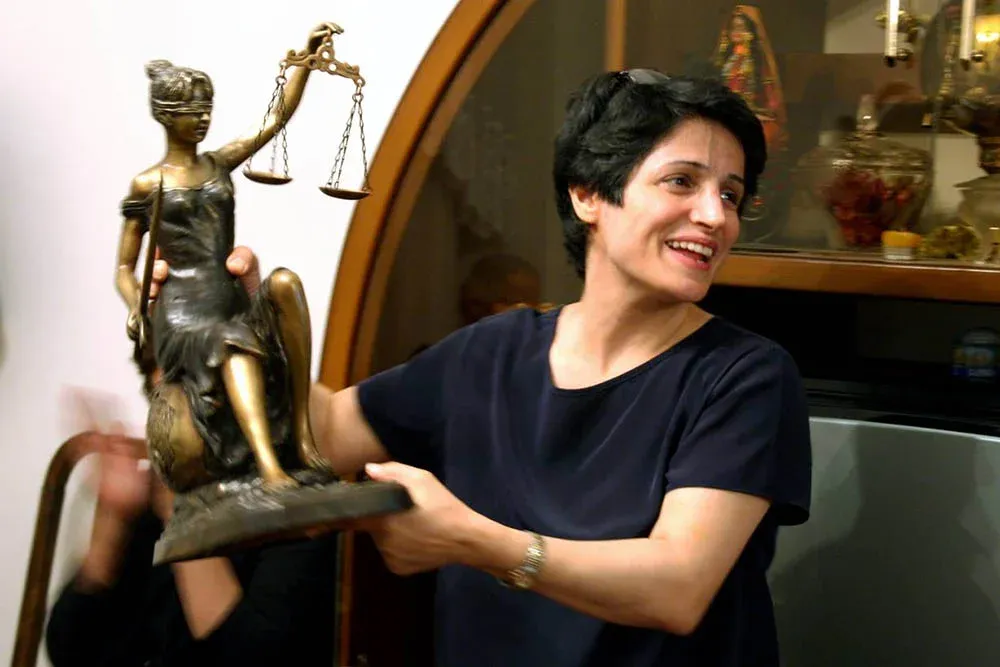
Lawyer seized without warrant from her home on 1 April; anti-death penalty human rights defender simultaneously disappeared from prison
The Arrest
Iranian security forces raided the home of human rights lawyer Nasrin Sotoudeh in the early hours of 1 April, arrested her without a judicial warrant, and transferred her to an undisclosed location. Agents seized her phones and laptops. No legal authorisation was produced for the search or the seizure. Sotoudeh was home on medically supervised leave from prison at the time of the raid.
On 31 March, she gave an interview to an overseas media outlet criticising Iranian authorities for failing to provide adequate civilian protection during US and Israeli military strikes, citing the absence of functioning public shelters. She was arrested the following day.
Her daughter confirmed that Sotoudeh's husband, Reza Khandan, is held in Ward 7 of Evin Prison alongside other political prisoners. Prison staffing has been reduced since the conflict began. Ill prisoners are facing shortages of medication and medical care, according to the family.
The Disappearances
The day before Sotoudeh's arrest, anti-death penalty campaigner Ahmadreza Haeri was transferred from Qezel Hesar Prison to an unknown location along with 22 other political prisoners. The transfer followed two executions at the facility. No receiving location was disclosed to families or legal representatives.
Under the UN Declaration on the Protection of All Persons from Enforced Disappearance, transferring individuals to unknown locations and refusing to disclose their whereabouts constitutes enforced disappearance. As of the time of publication, the location of all 23 prisoners remains unknown.
The transfer came immediately after the executions. Iranian authorities have previously moved prisoners following deaths at the same facility to prevent prisoner organising. The pattern here is the same.
Who Is Sotoudeh?
Nasrin Sotoudeh is one of the most recognised human rights lawyers in the world. She has spent much of the past fifteen years in prison or under conditions that restrict her practice. Her cases have included women prosecuted for removing the hijab in public protest, juvenile offenders facing execution, and political dissidents. She has been disbarred, imprisoned, held in prolonged solitary confinement, and hospitalised following hunger strikes. Sotoudeh has received several international honors for her human rights work, including the Sakharov Prize for Freedom of Thought. In 2019, she was sentenced to 38 years in prison and 148 lashes, one of the harshest sentences recorded against a human rights defender in Iran in recent years
In 2012, the European Parliament awarded her the Sakharov Prize for Freedom of Thought, the institution's highest human rights honour. Previous laureates include Nelson Mandela and Malala Yousafzai. The prize creates a formal institutional relationship between the laureate and the European Parliament that carries ongoing political obligations.
Each time she has been arrested, the charges have followed the same narrative of endangering national security, spreading propaganda against the state. Iranian courts have imposed sentences that Amnesty International and other organisations have documented as politically motivated.
Narges Mohammadi
Mohammadi won the Nobel Prize in 2023 for documenting torture in Iranian detention, conducted from inside prison through communications passed to her family and legal team. Iran did not release her following the award.
Both the Nobel Peace Prize laureate and the Sakharov Prize laureate are currently held in Iranian prisons simultaneously. Rights organisations say this reflects a deliberate policy of targeting internationally recognised civil society figures during a period when the government judges that international attention is elsewhere.
A Pattern Across Authoritarian States
Rights analysts and documentation from multiple human rights organisations have identified a consistent pattern in authoritarian states during periods of armed conflict. Military developments dominate international news coverage. Diplomatic engagement focuses on security. That environment is used by domestic security services to move against civil society figures who would otherwise attract immediate international attention.
The pattern has been documented in Russia during its military campaigns in Ukraine and Syria, in Myanmar following the 2021 coup, and in Sudan since 2023. In Iran's case, the circumstances are specific. Two internationally recognised prize laureates are in prison simultaneously. EU sanctions are due for renewal within days. A diplomatic process is underway in Islamabad in which EU member states have active convening roles.
The International Federation for Human Rights, the World Organisation Against Torture, Front Line Defenders, and France's Foreign Ministry have all formally condemned Sotoudeh's arrest.
The Legal Violations
The arrest without judicial warrant violates Iranian domestic law and Article 9 of the International Covenant on Civil and Political Rights, to which Iran is a state party. Article 9 prohibits arbitrary detention, requires that anyone arrested be informed promptly of the reasons, and requires they be brought before a judicial authority without delay.
The nocturnal raid, the seizure of personal devices without authorisation, and the transfer to an undisclosed location all engage protections against enforced disappearance under international law. Iran has not ratified the International Convention for the Protection of All Persons from Enforced Disappearance, but the practice is prohibited under customary international law as a continuing violation for as long as whereabouts remain concealed.
Sotoudeh's lawyers cannot confirm her condition, access to medical care, or treatment. Haeri and the 22 prisoners transferred with him are, by legal definition, disappeared.
The EU's Specific Obligation
The Sakharov Prize creates a direct institutional relationship between Sotoudeh and the European Parliament. The Parliament has responded to her previous imprisonments with formal resolutions. The Human Rights Subcommittee is expected to move on an urgent resolution in the coming days.
The more immediate instrument is the sanctions timeline. EU sanctions against Iran are due for renewal by 13 April 2026. Rights advocates have called explicitly for both Sotoudeh's arrest and Haeri's disappearance to be raised in that process, and for the EU to expand designations to named individuals responsible for both.
The Islamabad ceasefire negotiations, where EU member state foreign ministers hold convening roles, are a separate but connected lever. Iran's government is using the same wartime conditions to pursue its military posture and suppress internal dissent at the same time. EU diplomats engaged in Islamabad are talking to Iranian counterparts who authorised the arrest of a Sakharov Prize laureate four days before those talks resumed.
Using that access to raise Sotoudeh and Haeri is not a conflation of issues. It is a basic test of whether human rights commitments feature in European diplomacy when it is inconvenient for them to do so.
Canada
Canada's Iranian diaspora is among the largest outside the region, concentrated in Toronto, Vancouver, and Ottawa. Following the Mahsa Amini protests of 2022 and the executions that followed, diaspora organisations pushed Global Affairs Canada toward stronger public positions on Iran. The Iran Human Rights Advocates Network, based in Toronto, has called for Sotoudeh's immediate release.
Canada has sanctions authority under the Special Economic Measures Act that has been applied to Iranian officials in previous cycles. The facts of Sotoudeh's arrest meet the threshold for consideration under those provisions. Whether Global Affairs Canada will issue a formal statement or expand designations has not been confirmed.
Canada co-sponsors freedom of expression and arbitrary detention resolutions at the UN Human Rights Council each year. A warrant-free night raid on a medically released prisoner one day after she gave an interview critical of government policy is the category of case those resolutions are meant to address.
Evin Prison
Evin Prison has held political prisoners, journalists, dual nationals, and human rights defenders continuously since the early years of the Islamic Republic. Its Ward 209, run by the Intelligence Ministry, and Ward 2A, run by the Revolutionary Guards, have been documented extensively by Amnesty International, Human Rights Watch, and the UN Special Rapporteur on Iran. Former prisoners have described prolonged solitary confinement, sleep deprivation, forced confessions, denial of legal access, and inadequate medical care.
Reza Khandan, Sotoudeh's husband, is held in Ward 7. His detention is part of a documented practice of imprisoning family members of prominent activists as both punishment and pressure. Reduced prison staffing under wartime conditions, reported by Sotoudeh's family, directly affects the medical situation of ill prisoners. Both Sotoudeh and Narges Mohammadi have documented histories of health problems made worse by imprisonment. A prison running with reduced staff and medication shortages during an active conflict is one where the risk of preventable deterioration is real and present.
What Needs to Happen Now
EU sanctions renewal is 13 April. Two days away. For MEPs and EU member state foreign ministers, rights organisations are asking for two things. Name Sotoudeh and Haeri explicitly in the sanctions renewal documentation. Raise both cases in any diplomatic contact with Iranian counterparts in Islamabad. Use the Sakharov Prize relationship as the formal basis for demanding Sotoudeh's release and transfer to medical care.
For Members of the Canadian Parliament and Global Affairs Canada, the available actions are a formal public statement, consideration of targeted sanctions for officials responsible for the arrests, and a communication to the UN Special Rapporteur on Iran supporting documentation of both cases.
Sotoudeh has been imprisoned before and released before. Sustained international pressure has affected the conditions of her detention and the timing of past releases, even when it did not produce immediate results. The same is true for Mohammadi. Resolutions, sanctions designations, and diplomatic communications accumulate into a record that shapes the Iranian government's calculations over time. That process starts now, or it starts too late.