As the death toll approaches 75,000 and a fresh blockade tightens, the international accountability architecture is under its most severe stress test since the Nuremberg principles were codified.
When the Trump administration unveiled its Gaza ceasefire plan in late 2025, its architects presented it as a transformative diplomatic achievement — a framework that would halt the killing, restore order, and open the corridors through which food, medicine and shelter materials could reach a population that had been under relentless assault since 7 October 2023.
Six months later, five of the world's most credible humanitarian organisations have done what diplomats consistently fail to do: they measured the plan against its own promises, and published the results.
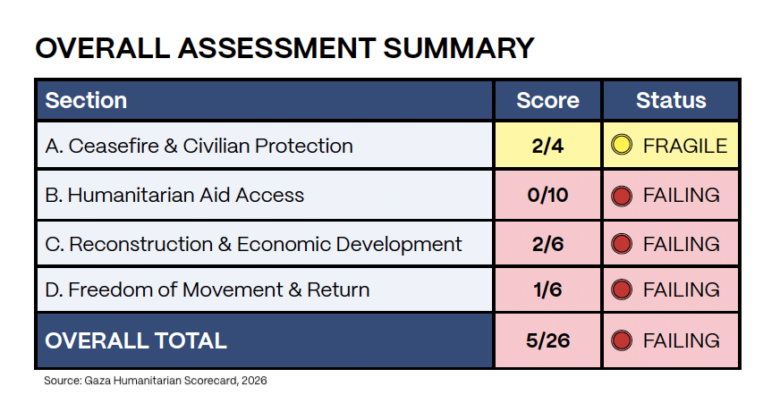
The joint scorecard released Thursday by the Danish Refugee Council, Norwegian Refugee Council, Oxfam, Refugees International and Save the Children is not a polemic. It does not assert failure from the outside, it documents failure from within the framework's own terms of reference. Against the agreement's stated objectives across the four core pillars of humanitarian access, civilian protection, basic services restoration and governance, the verdict is precise and devastating: implementation is "regrettably failing."
That formulation, clinical, sourced, methodologically explicit, is itself a form of accountability that political rhetoric cannot easily absorb or deflect.
The Numbers Behind the Collapse
Between 7 October 2023 and 25 March 2026, days 905 to 912 of a war with no visible end, Gaza's Ministry of Health reported 72,265 Palestinians killed and 171,959 injured. These figures, contested by Israeli authorities but corroborated in their broad orders of magnitude by independent epidemiological analysis, represent only the dead and wounded counted. The destroyed, the missing under rubble, the children dying of disease and malnutrition in conditions created deliberately, do not all appear in these registers.
UNRWA's situation report for 1–7 April 2026 documented continued airstrikes, shelling and gunfire across Gaza even in the ceasefire period. Thirty-nine of the agency's own staff have been killed since the beginning of the war, the total now standing at 391, the highest toll suffered by any UN agency in a single conflict in the organisation's history.
These are not incidental casualties. The documented, systematic targeting of protected persons and humanitarian infrastructure over more than two years has prompted the UN Secretary-General, multiple Special Rapporteurs, and the government of South Africa to invoke the language that international law reserves for the most extreme category of atrocity. The International Court of Justice, in its January 2024 provisional measures ruling, found it "plausible" that the rights of Palestinians under the Genocide Convention were at risk — a formal legal threshold with binding implications for all signatories to the Convention, including every EU member state and Canada.
What the Ceasefire Was Supposed to Do
The Trump administration's framework rested on four interdependent pillars:
Humanitarian Access: Sustained, unimpeded delivery of food, medicine, water and shelter materials at volumes sufficient to meet population needs — assessed by UN bodies at approximately 600 trucks per day.
Civilian Protection: A verifiable reduction in hostilities targeting civilian areas, and the establishment of protected zones in which displaced persons could shelter safely.
Restoration of Basic Services: Resumption of electricity, water and sewage infrastructure, primary healthcare, and functioning civil administration across Gaza's devastated territory.
Governance and Political Process: A pathway toward a post-hostilities governance arrangement for Gaza, including the gradual return of displaced persons to their areas of origin.
The scorecard assessed each pillar against measurable benchmarks. The findings are consistent across all four: either only partial, unsustained implementation or total failure to materialise.
The agreement did achieve some partial outcomes. Israeli hostages were released in the initial phases, and the intensity of bombardment fell, though it did not stop. These gains, real as they are, exist in isolation. The broader architecture within which they were meant to be embedded has not been built.
The Aid Blockade: A Starvation Strategy in Plain Sight
The most acute humanitarian failure is the deliberate obstruction of aid access. On 28 February 2026, the same day that Israel's conflict with Iran entered a new phase, absorbing international attention and diplomatic bandwidth, Israel shut Gaza's border crossings. The timing was noted by multiple aid organisations as a significant moment of geopolitical distraction exploited to tighten a siege.
After a partial, temporary reopening at Kerem Shalom, aid volumes have remained catastrophically inadequate. The roughly 600 trucks per day required to meet the basic survival needs of Gaza's population, figures established by the UN World Food Programme and OCHA before the war, have not been sustained at anything approaching that level.
Since March 2025, Israeli authorities have blocked UNRWA, the United Nations Relief and Works Agency for Palestine Refugees, the single largest humanitarian actor in Gaza, from directly bringing personnel and supplies into the territory. This is not obstruction at the margins. It is the functional exclusion of the UN's primary operational capacity from the most acute humanitarian emergency on earth.
The legal architecture governing this conduct is unambiguous. Article 54 of Additional Protocol I to the Geneva Conventions prohibits the use of starvation as a method of warfare. Customary international humanitarian law, binding on all parties regardless of treaty ratification, prohibits the deliberate obstruction of humanitarian access to civilian populations. The UN Security Council's Working Group on Children and Armed Conflict has documented that Israel's obstruction of aid access is specifically "denying women and girls protection and support they are entitled to under international law."
In October 2025, the International Court of Justice went further. In an order with binding force under the UN Charter, the ICJ ruled that Israel was legally obligated to guarantee sufficient food to Gaza's population and to allow UNRWA to operate. The continued exclusion of UNRWA since March 2025 constitutes, on its face, non-compliance with that order. Non-compliance with ICJ orders by a UN member state is a matter that can be referred to the Security Council under Article 94(2) of the UN Charter, a mechanism that has been invoked almost nowhere in modern history, but whose legal basis is available.
Displacement Without Resolution
Across Gaza, hundreds of thousands of people remain unable to return to the areas they fled during the most intense phases of bombardment. The homes, neighbourhoods and infrastructure to which they would return do not exist in any meaningful sense. The World Bank and UNITAR satellite analysis have estimated that between 50% and 70% of structures in Gaza have been damaged or destroyed, a figure that, if it applied to any city in Europe or North America, would constitute one of the most catastrophic urban destruction events of the modern era.
Displacement in this context is not a logistical problem awaiting resolution. It is an engineered crisis. The destruction of residential areas, the forced relocation orders, the demolition of farmland, water infrastructure and medical facilities, these have created a landscape in which the "right of return" to one's home, guaranteed under international humanitarian law and affirmed by UN General Assembly resolutions since 1948, exists as a legal right without a physical referent.
The ceasefire framework's provisions on displacement "have failed to materialize altogether." The political process that was supposed to create conditions for return has not advanced. The governance architecture remains absent. And the physical territory of Gaza continues to change, in ways that affect who can return, and to what.
Accountability Mechanisms Under Stress
The international legal response to the Gaza genocide has been more extensive than any comparable situation in recent memory. The ICJ proceedings initiated by South Africa under the Genocide Convention continue. The International Criminal Court's Pre-Trial Chamber, in May 2024, issued arrest warrants for Israeli Prime Minister Benjamin Netanyahu and former Defence Minister Yoav Gallant on charges of war crimes and crimes against humanity, the same bench that issued warrants against Vladimir Putin the previous year.
The ICC warrants represent a significant legal milestone. They impose travel restrictions on individuals subject to them across all 124 ICC member states, including every EU member state and Canada. They also create legal obligations for those states: the Rome Statute requires state parties to cooperate with the Court, including in executing arrest warrants.
European states have navigated this obligation with considerable discomfort. No ICC member state has publicly signalled that it would arrest Netanyahu or Gallant if they arrived on its territory. Germany's initial attempt to claim "head of government immunity", a doctrine the ICC has explicitly rejected, was a signal of how member states are attempting to manage legal obligations they find politically inconvenient.
For Canada, the situation is legally unambiguous under the Crimes Against Humanity and War Crimes Act, which implements the Rome Statute domestically. Canada's obligations are not discretionary. The government of Prime Minister Mark Carney, which came to office in March 2025 on a platform of renewed multilateralism and rule-of-law commitment, has been notably quiet on the question of ICC warrant compliance.
The Five-Organisation Scorecard: A Methodological Breakthrough
The joint assessment's significance extends beyond its findings. Its methodology may be its most durable contribution to humanitarian accountability.
Previous critiques of the ceasefire's failures, however accurate, were vulnerable to dismissal as politically motivated, epistemically contested, or insufficiently rigorous. The five-organisation scorecard circumvents these evasions. It establishes objective criteria drawn directly from the agreement's own text, defines measurable outcomes, and applies them jointly, across organisations with different institutional cultures, donor relationships and geographic footprints.
The resulting framework is, in the language of advocacy, "hard to politicise." It does not assert that the ceasefire is bad policy. It demonstrates, against the agreement's own benchmarks, that it is not being implemented.
Rights advocates in both the EU and Canada have described this as a model for future humanitarian accountability of political agreements, a structured, replicable approach to holding diplomatic frameworks accountable to their own promises rather than their authors' intentions.
The scorecard's publication also arrives at a moment when the competing crisis — the intensification of the Israel-Iran confrontation, is consuming what limited international diplomatic bandwidth had been available for Gaza. Advocacy organisations have warned explicitly that this distraction is not accidental: it creates conditions for continued impunity and entrenches the humanitarian emergency at precisely the moment when accountability architecture requires attention and political will to function.
The EU's Legal Exposure and Political Deficit
The European Union's response to the Gaza genocide has been defined by a structural contradiction: robust legal frameworks whose enforcement mechanisms have been selectively applied.
The EU Magnitsky Act, formally the EU Global Human Rights Sanctions Regime, provides a direct legal tool for targeted sanctions against individuals and entities responsible for serious human rights violations. The regulation's criteria plainly encompass documented conduct in Gaza. As of this writing, the EU has not imposed Magnitsky-linked sanctions in connection with the conflict.
The Corporate Sustainability Due Diligence Directive (CSDDD), scheduled for phased implementation beginning in 2027, will require large companies operating in the EU to conduct human rights due diligence across their supply chains. Companies with material links to settlement economies, the extraction of resources from occupied territory, or the supply of dual-use technology to actors engaged in documented IHL violations will face compliance obligations whose contours are now being actively litigated in European capitals.
The EU-Israel Association Agreement, which provides Israel with preferential trade access to the European single market, contains a human rights clause, Article 2, whose suspension has been formally requested by a coalition of member states and European Parliament resolutions. The legal mechanism exists. The political will to activate it has not yet materialised at the Council level, though the balance of European opinion has shifted considerably since October 2023.
The European Parliament has passed multiple resolutions calling for an arms embargo on Israel, an end to the blockade, and compliance with ICJ orders. These resolutions are politically significant but legally non-binding on member states. The gap between parliamentary expression and Council action encapsulates the EU's structural challenge: its institutions can speak, but its executive requires unanimity to act.
The joint scorecard now provides member states and civil society organisations with an objective baseline — drawn from the ceasefire agreement's own framework — to demand that the EU condition further engagement on enforceable humanitarian benchmarks. That conditionality argument is structurally stronger because the benchmarks originate in an agreement the EU helped to facilitate.
Canada's Obligations: Law, Policy and the Carney Test
Canada's legal obligations in relation to the Gaza genocide are extensive and, in several respects, underexercised. The Fighting Against Forced Labour and Child Labour in Supply Chains Act, which entered into force in January 2024, requires Canadian entities to report on and address forced labour and child labour in their supply chains. The Act's application to companies with operations linked to Israeli settlements in occupied Palestinian territory, where labour rights violations are extensively documented by OHCHR, the ILO, and domestic Israeli human rights organisations, has not been tested through enforcement. The framework exists; the political decision to apply it has not been made.
Canada's sanctions framework, principally the Special Economic Measures Act (SEMA) and the Justice for Victims of Corrupt Foreign Officials Act (JVCFOA), provides authority for targeted sanctions against individuals responsible for gross and systematic human rights violations. Canada has used SEMA in the context of Russia, Belarus and Myanmar. Its application to the Gaza context remains legally available and practically unused.
Canada has formally called for unrestricted humanitarian access to Gaza and has provided funding to UNRWA even as other donor states, including the United States — suspended contributions following Israeli allegations against the agency that subsequent independent review found to be unsubstantiated or significantly overstated. This is not nothing. But it falls considerably short of what Canada's legal frameworks, international obligations, and stated commitment to feminist foreign policy would imply.
The arrival of the Carney government brings both an opportunity and a test. Canada's relationship with the United States, newly stressed by tariff confrontation and governance anxiety, creates unusual political space for differentiation on the Gaza file. Canada's large Palestinian-Canadian diaspora community, concentrated in Ontario, Quebec and British Columbia, has maintained sustained advocacy pressure. And Canada's self-positioning as a rule-of-law champion within multilateral institutions is directly implicated by its response to ICC warrant obligations.
The joint scorecard, in this context, is a tool. It provides Canadian civil society, parliamentarians and advocates with an objective, multi-agency assessment of ceasefire failure that bypasses contested narratives and grounds advocacy demands in the agreement's own terms.
The Distraction Dynamic: Iran, Gaza, and the Architecture of Impunity
The timing of Israel's border crossing shutdown, on the same day the Iran conflict escalated, has attracted significant analysis from human rights organisations and conflict monitors. The pattern is not new. Throughout the war, periods of intensified hostilities in Gaza have coincided with moments of regional or international distraction: U.S. election cycles, European political crises, the Russian-Ukrainian conflict's fluctuating intensity. The diplomatic bandwidth available for accountability mechanisms, ICJ proceedings, ICC warrant enforcement, Security Council resolutions, is finite, and strategically exploitable.
The Iran confrontation has effectively reset the international community's attention architecture. Heads of government who might otherwise have faced sustained pressure over Gaza are managing a broader regional crisis. Diplomatic channels are saturated. The humanitarian emergency in Gaza, now in its third year, has the characteristics of what researchers at the Overseas Development Institute have called a "forgotten emergency", acute, documented, legally engaged, and systematically deprioritised.
Advocacy organisations working on the Gaza genocide have been explicit in naming this dynamic. The scorecard's publication, timed to coincide with the six-month ceasefire anniversary, is in part a deliberate act of counter-scheduling — an attempt to reassert the Gaza crisis onto agendas that have been reorganised around Iran.
Action Pathways: What EU and Canadian Actors Can Do
The joint scorecard is not only a document of accountability. It is a tool for advocates, journalists, policymakers and engaged citizens in the EU and Canada. Several pathways are available:
For policymakers and parliamentarians: The scorecard provides an objective baseline for conditionality demands on ceasefire renegotiation. The argument — that any revised agreement must include enforceable humanitarian benchmarks drawn from the existing framework — is structurally credible because it originates in the agreement's own terms. In the EU, this translates to pressure on the European External Action Service and the Council; in Canada, to parliamentary motions, Senate inquiries, and Global Affairs Canada engagement.
For civil society and advocacy organisations: The methodology pioneered by the five-organisation coalition, objective criteria, measurable outcomes, joint multi-agency reporting, offers a replicable model for future humanitarian accountability exercises. Organisations working on other protracted conflicts should study and adapt it.
For legal advocates: The ICJ's October 2025 order on food access and UNRWA operations, combined with the scorecard's documentation of continued non-compliance, creates an evidentiary base for third-state intervention procedures under the Genocide Convention. States that have acceded to the Convention, all EU member states and Canada, have standing to invoke its enforcement mechanisms before the ICJ.
For journalists and media organisations: The scorecard's methodology note and underlying data are publicly accessible. The documented gap between the ceasefire framework's promises and its implementation is a story with hard numbers, named organisations, and a clear accountability chain. It resists dismissal as opinion.
For diaspora communities: Palestinian-Canadian and Palestinian-European diaspora organisations have been among the most sustained advocates for accountability in this conflict. The scorecard provides fresh, credible, non-partisan evidence to bring to elected representatives, community organisations, and media platforms.
The Cost of Measured Failure
There is a particular cruelty in accountability language applied to catastrophe at scale. When five organisations spend months developing criteria, collecting data, and producing a document that concludes a ceasefire is "regrettably failing," the precision of the language stands in terrible contrast to what it is measuring: the systematic destruction of a people, their infrastructure, their food supply, and their future.
The Gaza genocide has now entered its third year. The international legal architecture engaged to address it, the ICJ, the ICC, the Security Council, the treaty bodies, represents the most extensive formal accountability mobilisation in response to any conflict since the Balkans. That architecture is also under its most severe stress test. Its effectiveness depends not on its existence but on the willingness of states to enforce it.
The joint scorecard is a contribution to that enforcement ecosystem. It provides the one thing that accountability mechanisms most need and most often lack: an objective, documented baseline against which failure can be named precisely, publicly, and repeatedly, until the failure stops.
Read the scordcard here: Download